HOME MODIFICATIONS PROVIDER IN ARKANSAS
By Fatumata Kaba · 2025-07-05 · 6 min read
MAKING HOMES SAFER AND MORE ACCESSIBLE TO SUPPORT INDEPENDENT LIVING FOR INDIVIDUALS WITH DISABILITIES
Home Modifications in Arkansas are essential services designed to assist individuals with developmental disabilities in remaining in their own homes by performing structural adaptations that improve accessibility, safety, and functionality. These services are authorized under the Community and Employment Supports (CES) Waiver and must be directly linked to specific goals identified in the participant’s Individualized Service Plan (ISP) to ensure the health, welfare, and safety of the individual.
Operating as a Home Modification provider requires a meticulous balance of construction expertise, clinical understanding of accessibility needs, and rigorous adherence to Medicaid waiver compliance standards. Providers act as a bridge between the participant's living environment and their functional needs, ensuring that all modifications facilitate independence rather than merely providing aesthetic or convenience-based updates.
What Are the Roles of Governing Agencies in Arkansas?
The provision of home modifications is heavily regulated to ensure quality, safety, and fiscal responsibility. The Arkansas Department of Human Services (DHS), specifically the Division of Developmental Disabilities Services (DDS), serves as the primary governing body. DDS is responsible for authorizing and monitoring home modification projects and certifying agencies as eligible CES Waiver providers. They ensure that all work performed adheres to the necessity criteria established for the waiver.
Additionally, the Arkansas Department of Human Services / Division of Medical Services (DMS) manages the administrative aspects of the Medicaid program. DMS is responsible for the processing of provider enrollment and the issuance of Medicaid reimbursement for approved modifications. At the federal level, the Centers for Medicare & Medicaid Services (CMS) provides the overarching regulatory framework, overseeing Medicaid waiver compliance for home and community-based accessibility supports nationwide.
Key agencies involved in the regulatory ecosystem include:
- Arkansas Department of Human Services (DHS) – Division of Developmental Disabilities Services (DDS): Responsible for authorization and monitoring.
- Arkansas Medicaid / Division of Medical Services (DMS): Manages provider enrollment and reimbursement.
- Centers for Medicare & Medicaid Services (CMS): Oversees federal Medicaid waiver compliance.
- Arkansas Contractors Licensing Board: Governs the professional licensing and bonding requirements for construction work.
How Can Providers Deliver Compliant Home Modification Services?
Home modifications must be pre-approved, necessary, and strictly tied to the Individualized Service Plan (ISP). Providers are expected to move beyond standard construction and focus on the specific physical requirements of the participant. The scope of service typically includes everything from the initial assessment of the residence to the final inspection of the installed modifications, requiring professional coordination with contractors, inspectors, and DDS case managers.
Approved providers often deliver services that include wheelchair ramps, widened doorways, roll-in showers, and specialized bathroom alterations. Other critical services involve the installation of stair lifts, platform lifts, non-slip flooring, and adjustments to lighting or environmental controls like HVAC systems. Detailed documentation, including cost breakdowns and before/after photos of the work, is a mandatory requirement for every project to ensure accountability and reimbursement eligibility.
What Are the Licensing and Enrollment Prerequisites?
Transitioning into the role of a Home Modification provider requires formalizing the business entity and obtaining specific credentials. Before applying for the CES Waiver, an agency must register with the Arkansas Secretary of State, obtain a federal Employer Identification Number (EIN), and secure a Type 2 National Provider Identifier (NPI). These foundational steps allow the business to interact with the Medicaid system as a formal entity.
Beyond general business registration, providers must ensure their workforce is qualified. This involves holding valid contractor licenses and maintaining appropriate bonding and general liability insurance. Because home modifications involve significant structural changes to residential property, compliance with state construction laws is as critical as adherence to Medicaid policy. Providers must be prepared to demonstrate that all personnel, whether employees or subcontractors, meet the professional standards required to perform work safely within a participant’s home.
- Register the business with the Arkansas Secretary of State.
- Obtain an IRS EIN and NPI (Type 2).
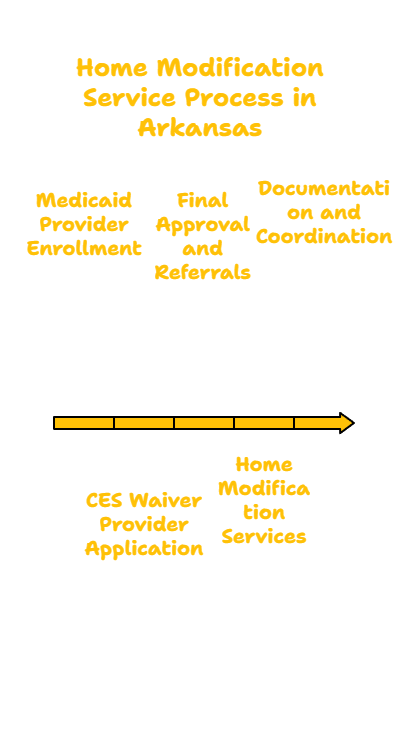
- Apply through the DDS CES Waiver Provider Application process.
- Enroll as a provider via the Arkansas Medicaid Portal.
- Maintain current contractor licenses, bonds, and comprehensive insurance policies.
What Is the Provider Enrollment and Onboarding Process?
The enrollment process is a multi-step journey that requires precision and patience. The first phase involves registering with Arkansas Medicaid via the Provider Portal, where the agency submits licenses, tax documents, and banking information for Electronic Funds Transfer (EFT). The second phase requires the submission of the CES Waiver Provider Application to DDS, which includes detailed service descriptions, budget procedures, and documentation of staff credentials.
Once the agency is formally enrolled and approved, they move into the service readiness phase. Referrals for home modifications generally arrive through DDS case managers. These referrals are tied to specific modifications authorized in the participant's ISP. Providers should maintain a robust policy and procedure manual that covers pre-approval workflows, client intake, consent procedures, and warranty documentation to ensure that every project is audit-ready from the beginning.
Which Documentation and Staffing Standards Are Required?
Operational success depends on maintaining a transparent trail of documentation. Required documents include copies of the business license, the IRS EIN letter, NPI confirmation, and evidence of current contractor licensing. Internally, the agency must manage project-specific documentation, such as pre-approval scopes of work, safety compliance checklists, and financial tracking logs that correlate invoices with authorized expenditures.
Staffing requirements are equally specific. The organization needs a Project Coordinator or Home Modification Supervisor with documented experience in residential construction or accessibility adaptations. Any staff performing manual work must hold current Arkansas contractor licenses where applicable and possess an understanding of ADA compliance. All staff members, regardless of their role, require training in home safety, HIPAA confidentiality, emergency procedures, and the specific documentation workflows required by the CES Waiver.
- Project Coordinator: Must have experience in construction or project management.
- Contractors/Technicians: Must hold current licenses and insurance.
- Training: Must include HIPAA, home safety, and waiver-specific documentation protocols.
Frequently Asked Questions
Are home modifications considered permanent structural changes?
Yes, home modifications involve structural adaptations to a participant’s residence. These are only approved when they are necessary to ensure the health, safety, and independence of the individual, and they must be authorized within the participant’s Individualized Service Plan (ISP).
How long does the provider enrollment process typically take?
The timeline varies depending on the completeness of the application. Generally, the Medicaid and CES Waiver enrollment phase takes approximately 45 to 90 days, while business formation and licensing can take an additional 30 to 60 days. Providers should plan for a total launch timeline of several months.
Can modifications be done for aesthetic or comfort reasons?
No. Modifications are exclusively for health, welfare, and safety purposes. Medicaid does not reimburse for upgrades that are purely for aesthetics, convenience, or home improvement that does not directly address an accessibility barrier linked to the participant's disability.
Key Takeaway
Launching a home modification agency in Arkansas requires a rigorous commitment to both construction quality and Medicaid compliance. By aligning business operations with the guidelines provided by the Division of Developmental Disabilities Services (DDS) and maintaining strict oversight of all documentation, providers can effectively support individuals with disabilities in their goal of independent living while ensuring long-term program sustainability.
Last verified: 2024. This information is for general educational purposes only and does not constitute legal or professional advice. Always refer to the latest Arkansas Department of Human Services (DHS) and Medicaid policy manuals for the most current regulatory requirements.