HOME MODIFICATION SERVICES PROVIDER IN WYOMING
By Fatumata Kaba · 2026-04-14 · 6 min read
Home Modification Services in Wyoming provide essential physical adaptations to the primary residences of individuals with developmental disabilities, chronic health conditions, or age-related mobility limitations. By facilitating structural changes—such as installing ramps, widening doorways, and upgrading bathroom accessibility—these services enable participants to maintain safety, reduce the risk of injury, and support successful community integration. These services are authorized under specific Wyoming Medicaid Home and Community-Based Services (HCBS) waivers, requiring strict adherence to Individualized Plan of Care (IPC) guidelines and prior authorization protocols.
What Are the Governing Agencies and Oversight Requirements?
Navigating the regulatory environment in Wyoming requires coordination with several key state entities. The Wyoming Department of Health serves as the primary oversight body, specifically through the Developmental Disabilities Division (DDD) and the Division of Healthcare Financing. These departments determine policy, authorize services, and conduct fiscal monitoring to ensure that home modification funds are utilized efficiently and according to the specific needs defined in a participant’s waiver program.
Beyond state-level administration, the success of a modification project relies heavily on the collaboration between Case Management Agencies and Public Health Nursing (PHN). These entities perform the initial needs assessment, gather the necessary clinical documentation, and submit formal requests for modifications to be included in the participant's IPC. Providers must maintain open lines of communication with these case managers to ensure that all work performed aligns with the approved scope and the specific functional requirements of the client.
- Department of Health (DDD & Healthcare Financing): Sets policy and reviews service authorizations.
- Case Management Agencies/PHN: Coordinate assessments and submit IPC documentation.
- Medicaid Provider Services: Manages the logistics of provider enrollment and the reimbursement lifecycle.
How Do Providers Define and Scope Covered Home Modifications?
Home modifications are classified as structural or environmental changes intended to increase independence within the participant's home. To be considered a covered service, a modification must be directly linked to a documented functional limitation. The goal of these services is to prevent institutionalization by providing a living environment that is both safe and accessible. Providers must ensure that the work performed is not merely cosmetic or related to general home maintenance, which remains the responsibility of the homeowner or landlord.
Commonly approved modifications include the installation of grab bars, roll-in showers, stair lifts, vertical platform lifts, and lowered countertops. Other technical enhancements, such as smart door openers or non-slip flooring, may be covered if they are deemed essential for the participant's daily living activities. Before any work begins, the provider must obtain approval through the Medicaid prior authorization process, confirming that the modification meets cost-effectiveness standards and complies with all local building codes and ADA accessibility guidelines.
What Are the Essential Licensing and Administrative Prerequisites?
Before offering services under Wyoming Medicaid, a business must establish a formal administrative foundation. This begins with registering the business entity with the Wyoming Secretary of State and securing a Federal Employer Identification Number (EIN). If the provider intends to bill Medicaid directly, obtaining a Type 2 National Provider Identifier (NPI) is a necessary step. Beyond these regulatory identifiers, the business must secure robust insurance coverage, including general liability, workers’ compensation, and property damage policies, to protect both the agency and the participant.
Operational compliance also requires the creation of a comprehensive Home Modification Policy & Procedure Manual. This document serves as the backbone of the provider’s internal operations, detailing everything from the bidding process and contractor selection to client safety protocols and warranty management. Establishing relationships with licensed contractors who are well-versed in accessibility standards is critical, as these professionals will be responsible for executing the physical installations according to the approved IPC specifications.
- Register business with the Wyoming Secretary of State.
- Obtain a Federal EIN and Type 2 NPI.
- Develop a detailed Home Modification Policy & Procedure Manual.
- Secure liability, workers’ compensation, and property damage insurance.
- Partner with licensed contractors familiar with ADA requirements.
What Steps Are Involved in the Wyoming Provider Enrollment Process?
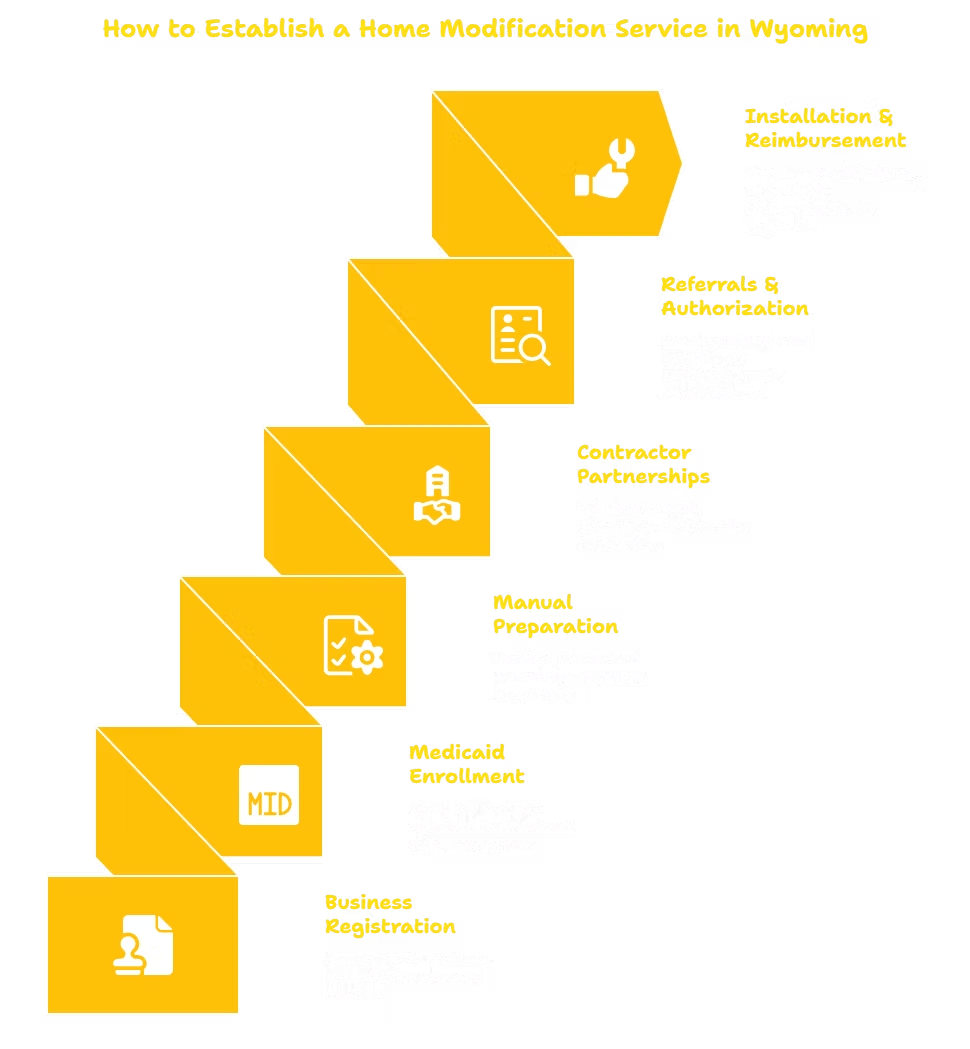
The transition from a service provider to an authorized Medicaid vendor involves a structured, sequential process. Initial steps focus on the administrative setup, including registration and the acquisition of necessary credentials. Once the foundational business requirements are met, the entity must apply for Medicaid enrollment specifically under the relevant HCBS waivers. This involves submitting detailed documentation, including staff credentials and the aforementioned policy manual, to the state for review.
Once enrolled, the provider enters the operational phase of coordinating with case managers for referrals. This cycle typically includes conducting on-site evaluations, drafting precise cost estimates, and submitting those estimates for prior authorization. Following approval of the IPC and the authorization of funds, the provider oversees the installation process. Upon the successful completion of the work and the final inspection, the provider submits the required documentation and invoices to receive reimbursement through the state’s payment systems.
How Do You Maintain Compliance and Quality Documentation?
Rigorous documentation is the cornerstone of maintaining Medicaid provider status. Every project must be supported by a paper trail that demonstrates medical necessity, compliance with safety standards, and fiscal transparency. This includes maintaining itemized cost sheets, detailed invoices, and photographic evidence of the home’s condition both before and after the modification. These records are subject to state audits and must be kept in accordance with HIPAA and state record-retention requirements.
Furthermore, internal quality control is vital. Providers should maintain a clear tracking system for contractor credentials, background checks, and proof of insurance. The Policy & Procedure Manual should explicitly define the protocols for incident reporting, the informed consent process, and the handling of any necessary permits required by local municipalities. Maintaining these records not only ensures compliance but also protects the provider’s reputation and long-term eligibility to serve waiver participants.
Frequently Asked Questions
What criteria determine if a modification is "medically necessary"?
A modification is considered necessary if it addresses a documented functional limitation identified in the participant’s assessment. The change must directly improve the individual's ability to live independently and safely. The request must be included in the participant's Individualized Plan of Care (IPC) and meet Medicaid’s cost-effectiveness standards.
Can a provider perform work on rental properties?
Yes, modifications can be performed in rental properties, provided that the necessary permissions from the property owner are obtained. All legal requirements, including landlord consent and adherence to local building codes, must be documented as part of the project’s authorization file before work commences.
What is the role of a project coordinator in the modification process?
A project coordinator acts as the bridge between the state case managers, the participant, and the construction contractors. They are responsible for ensuring that all work stays within the budget approved in the IPC, coordinating the timing of installations, ensuring ADA compliance, and managing all required documentation for Medicaid reimbursement.
Key Takeaway
Successfully operating as a Home Modification Services provider in Wyoming requires a disciplined approach to both construction quality and regulatory compliance. By aligning business operations with the specific requirements of the Comprehensive, Supports, and Community Choices waivers—and maintaining meticulous documentation throughout the project lifecycle—providers can effectively support the independence of waiver participants while maintaining a sustainable and compliant business model.
Last verified: October 2023. Disclaimer: This article is for informational purposes only and does not constitute legal or professional medical advice. Requirements for Medicaid waiver programs are subject to change. Please consult the official Wyoming Department of Health guidelines and relevant state statutes for the most current information regarding your specific situation.