HOME MODIFICATION SERVICES PROVIDER IN WISCONSIN
By Fatumata Kaba · 2026-04-14 · 5 min read
CREATING SAFE, ACCESSIBLE, AND FUNCTIONAL LIVING SPACES FOR INDIVIDUALS WITH DISABILITIES AND MOBILITY CHALLENGES
Home Modification Services in Wisconsin are specialized residential adaptations designed to support individuals with disabilities, chronic conditions, or age-related mobility limitations by enhancing home safety and accessibility. These services are vital for enabling participants to maintain independence in their own homes, thereby reducing the risk of institutionalization and supporting long-term community integration through Medicaid waiver programs such as IRIS, Family Care, Partnership, and the Children’s Long-Term Support (CLTS) Waiver.
To successfully operate as a provider in this sector, businesses must align their services with functional needs identified in the participant’s Individualized Service Plan (ISP) or Plan of Care. All modifications must be authorized by the relevant waiver program and adhere to state safety, construction, and professional licensing standards enforced by the Wisconsin Department of Health Services (DHS) and the Department of Safety and Professional Services (DSPS).
What Are the Roles of Governing Agencies in Wisconsin?
The regulatory landscape for home modification providers in Wisconsin involves a coordinated effort between state departments and regional oversight bodies. The Wisconsin Department of Health Services (DHS) serves as the primary authority, establishing the overarching waiver rules and quality standards that govern how home modifications are delivered and funded under Medicaid. Compliance with these standards is mandatory for all participating agencies.
ForwardHealth acts as the operational hub for the provider community. Their role encompasses managing Medicaid provider enrollment, overseeing the billing cycle, and processing reimbursements for services authorized under the various waiver programs. Providers must maintain active, good standing with ForwardHealth to ensure consistent service delivery and payment processing.
On the regional level, IRIS Consultant Agencies and Managed Care Organizations (MCOs) are responsible for the participant-facing side of the service. They assess the functional needs of the individual, approve specific modifications through the formal service planning process, and provide ongoing oversight to ensure that the work performed meets quality and safety benchmarks. Additionally, the Wisconsin Department of Safety and Professional Services (DSPS) ensures that any structural, plumbing, or electrical work is performed by appropriately licensed professionals, upholding statewide building codes.
Which Services Are Covered Under Medicaid Waivers?
Home modifications are physical alterations to a residence that facilitate safe and functional access to essential living areas. These modifications are strictly intended to address the limitations imposed by a participant’s disability or condition. Consequently, all projects must demonstrate a clear nexus between the modification and the participant’s functional independence, prioritizing cost-effectiveness over aesthetic or luxury upgrades.
Examples of covered modifications frequently authorized under waiver programs include:
- Wheelchair ramps and widened doorways for improved ingress and egress
- Roll-in showers, grab bars, and other bathroom safety features
- Stair lifts, vertical platform lifts, and secure handrail installations
- Lever-style hardware, door handles, and remote door openers
- Lowered countertops, accessible cabinetry, and reachable workspace configurations
- Non-slip flooring and lighting enhancements to prevent falls
- Specialized HVAC adjustments where medically necessary
- Minor plumbing or electrical modifications to accommodate medical equipment or accessibility tools
What Are the Licensing and Enrollment Prerequisites?
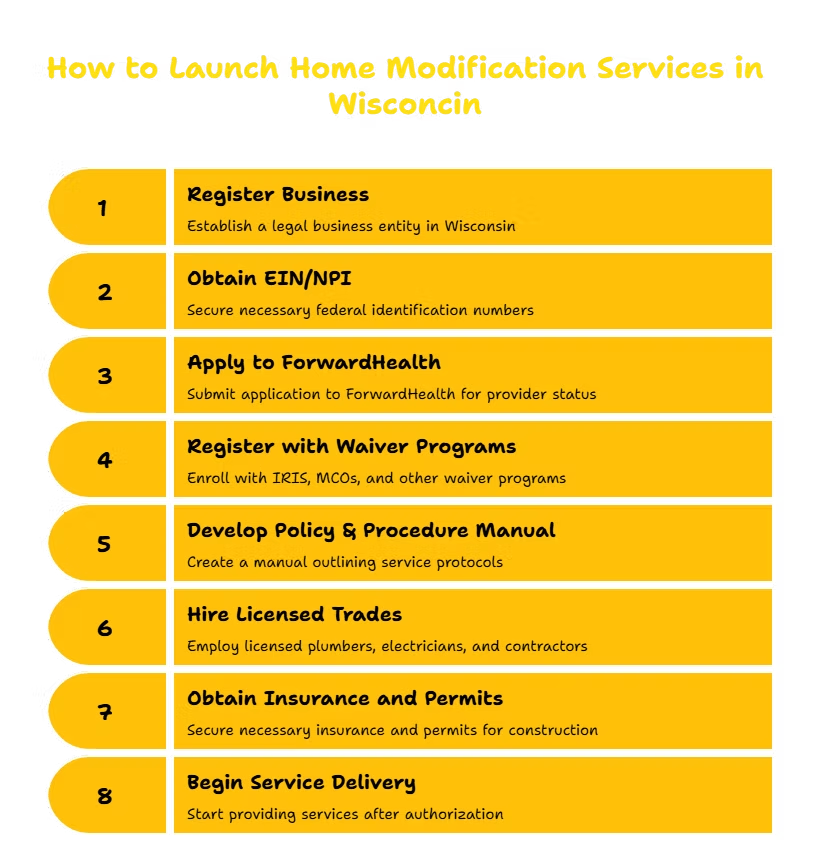
Establishing a professional home modification business requires a rigorous adherence to administrative and operational prerequisites. Before providing services, a business must be registered with the Wisconsin Department of Financial Institutions (DFI) and possess a Federal Employer Identification Number (EIN). If applicable, the business should also secure a Type 2 NPI to facilitate billing within the Medicaid framework. Once these foundational steps are complete, the agency must apply for provider status through ForwardHealth and the relevant waiver programs.
Operational readiness is demonstrated through the creation of a comprehensive Home Modification Services Policy & Procedure Manual. This document serves as the backbone of the provider’s business, detailing protocols for home assessments, scope-of-work documentation, and subcontractor oversight. Providers are expected to maintain adequate liability insurance and ensure that all personnel—including in-house staff and hired tradespeople—possess the necessary credentials to perform safe, ADA-compliant residential construction.
How Do You Successfully Enroll and Launch Operations?
The enrollment process is a structured sequence that transitions a business from legal registration to active service delivery. Providers should first secure all business documentation, including trade licenses for plumbing, electrical, and general construction work. Following this, the provider must navigate the enrollment applications for ForwardHealth and engage with IRIS Fiscal Employer Agents (FEAs) or MCO networks, as these entities represent the primary gateways to waiver-funded opportunities.
Once initial paperwork is submitted, providers must complete any required orientation or program-specific training. This phase is critical, as it aligns the provider’s internal workflows with the specific documentation requirements of the waiver care teams. Services can only commence once the care team has fully authorized the project, ensuring that the work is directly linked to the participant's ISP. Consistent communication with care coordinators during this phase is essential for managing expectations and project timelines.
The estimated timeline for this launch is as follows:
- Business Registration & Policy Manual Development: 2–3 weeks
- Licensing and Contractor Credentialing: 30–45 days
- Enrollment with Waiver Programs: 1–3 months
- Service Delivery: Begins upon formal service authorization and bid approval
Frequently Asked Questions
Are general home repairs or luxury upgrades covered by Wisconsin Medicaid?
No. Medicaid waiver funds for home modifications are strictly limited to accessibility-related adaptations that address a documented functional need. General home maintenance, repairs, and aesthetic or luxury upgrades are not reimbursable under these programs.
What role does an Occupational Therapist play in the process?
An Occupational Therapist (OT) is often utilized to perform an objective evaluation of the participant's home environment. They provide functional recommendations that link specific home modifications to the participant's daily living needs, ensuring the modifications effectively support their independence and safety.
What documentation is required to bill for a project?
Providers must maintain meticulous records, including the service authorization from the care team, approved cost estimates, documented home assessments, and proof of trade license compliance. Additionally, pre- and post-modification inspection documentation and photos are often required to verify the work was completed in accordance with the agreed-upon scope.
WAIVER CONSULTING GROUP’S START-UP ASSISTANCE SERVICE — WISCONSIN HOME MODIFICATION PROVIDER
WCG assists remodeling firms, contractors, and OT-led businesses in launching compliant, Medicaid-approved home modification services for Wisconsin’s waiver populations. Our support encompasses waiver enrollment, the development of comprehensive Policy & Procedure Manuals, creation of standardized cost estimate and bid templates, and establishing compliance workflows for ADA and safety regulations.
Key Takeaway: Success as a home modification provider in Wisconsin requires a dual focus on rigorous administrative compliance with ForwardHealth and the DHS, and the technical ability to deliver high-quality, accessibility-focused construction that meets the unique, documented needs of waiver participants.
Last verified: October 2023. This content is for informational purposes only and does not constitute legal or professional advice. Requirements for Medicaid waiver programs are subject to change. Please consult the official Wisconsin Department of Health Services (DHS) and ForwardHealth websites for the most current rules, provider manuals, and policy updates.