HOME MODIFICATION SERVICES PROVIDER IN VERMONT
By Fatumata Kaba · 2026-04-09 · 5 min read
Home Modification Services in Vermont provide essential structural adaptations that enable individuals with disabilities and chronic health conditions to maintain their independence, prevent unnecessary institutionalization, and ensure a safe living environment. By facilitating essential physical changes to a residence, these services are authorized through Vermont Medicaid’s Home and Community-Based Services (HCBS) waivers and are overseen by the Department of Disabilities, Aging, and Independent Living (DAIL) in conjunction with Designated Agencies (DAs) or Specialized Service Agencies (SSAs).
How Do Vermont Medicaid HCBS Waivers Authorize Home Modifications?
Home modifications are not considered general home improvements; they must be identified as a functional necessity within a participant’s Individual Support Plan (ISP). To be eligible for reimbursement, the proposed structural changes must be directly related to the individual’s disability and validated by an environmental assessment. This ensures that every dollar spent serves the goal of increasing participant autonomy and safety within their existing home environment.
The authorization process relies heavily on coordination between the participant, their care team, and the state agencies. Providers must ensure that the scope of work aligns strictly with the approved ISP. Because these modifications are funded through specific Medicaid waiver programs—such as the Developmental Disabilities Services Waiver (DDSW), the Choices for Care (CFC) Waiver, and the Brain Injury Program—providers must maintain rigorous documentation to prove the functional necessity of every project before billing the Department of Vermont Health Access (DVHA).
Who are the Governing Agencies Responsible for Oversight?
Operating as a Home Modification provider in Vermont requires navigating a multi-layered regulatory environment. The Department of Disabilities, Aging, and Independent Living (DAIL) serves as the primary authority, responsible for the oversight of HCBS waivers and ensuring that all modifications align with the individualized needs outlined in the participant's support plan. Simultaneously, the Department of Vermont Health Access (DVHA) handles the financial aspect of the program, managing Medicaid enrollment and the processing of claims for completed services.
Beyond state health agencies, structural integrity and safety are governed by the Vermont Division of Fire Safety and the Department of Public Safety. Providers must ensure that all modifications strictly adhere to local building codes and safety regulations. Coordination with Designated Agencies (DAs) or Specialized Service Agencies (SSAs) is also vital, as these entities are typically responsible for the initial ISP planning, service authorization, and the final inspection of completed modifications to verify they meet the participant's requirements.
- DAIL: Authorizes funding under HCBS Waivers and ensures compliance with the ISP.
- DVHA: Manages Medicaid provider enrollment and the payment of claims.
- Division of Fire Safety: Enforces local building codes and safety compliance.
- DAs/SSAs: Facilitate service authorization and perform post-modification reviews.
What Constitutes an Allowable Home Modification?
Allowable modifications are defined by their capacity to improve accessibility and mobility for individuals with specific functional limitations. These projects are strictly limited to necessary adaptations; they cannot include aesthetic upgrades, general repairs, or enhancements that increase the property value without providing a direct functional benefit to the participant. Each project must be cost-effective and vetted against the participant's documented clinical needs.
Commonly approved modifications include structural changes like the installation of wheelchair ramps, the widening of doorways, and the creation of roll-in showers. Other essential adaptations include grab bars, accessible toilets, stair lifts, and ceiling lifts. In some cases, providers may also implement smart home features or kitchen modifications, such as lowered countertops, provided they are supported by a clear, disability-related justification within the service plan.
What are the Licensing and Provider Enrollment Requirements?
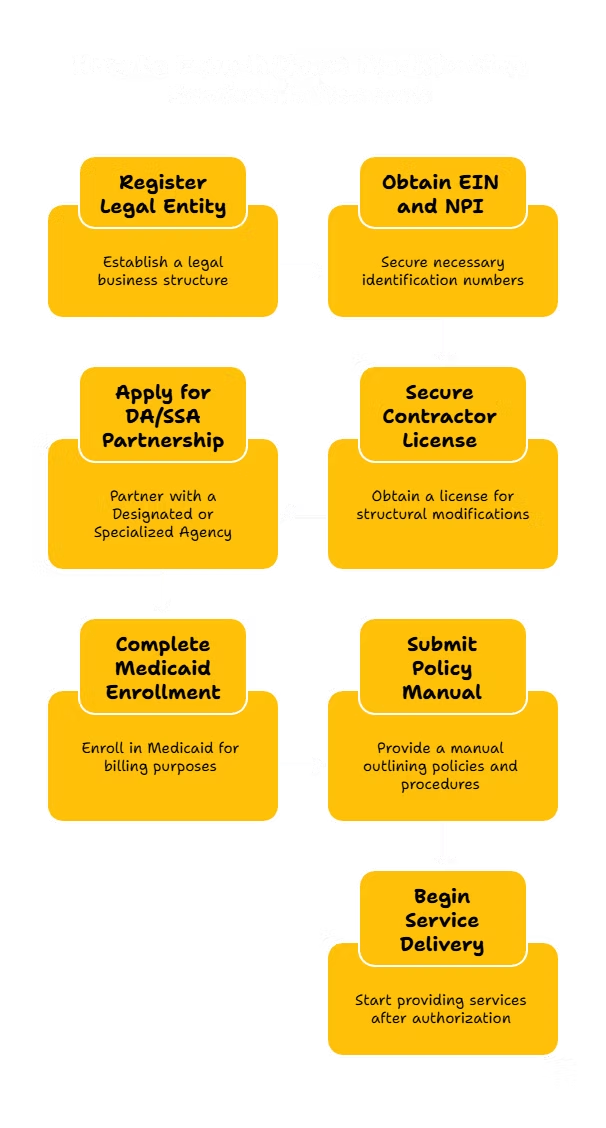
Becoming an approved provider requires a systematic approach to business registration and credentialing. Before initiating services, a business must be properly registered with the Vermont Secretary of State. Providers must obtain an Employer Identification Number (EIN) and a Type 2 National Provider Identifier (NPI). Furthermore, because these services involve structural work, obtaining a valid Vermont contractor’s license through the Office of Professional Regulation is a mandatory prerequisite for legal operation.
The enrollment path involves securing a partnership with a DA or SSA, or applying directly to DAIL for recognition as a qualified provider. Once registered, the agency must develop a comprehensive Policy & Procedure Manual. This document serves as the foundation for operational compliance, covering everything from billing and HIPAA policies to safety protocols and incident reporting. Finally, providers must maintain adequate liability and workers' compensation insurance to satisfy state requirements and protect both the organization and the program participants.
How Do Providers Manage Staffing and Compliance?
Staffing requirements center on both technical competency and regulatory adherence. A primary role within any home modification firm is that of the Licensed Contractor or Construction Specialist, who must possess a valid Vermont contractor’s license and have a thorough understanding of Americans with Disabilities Act (ADA) standards. These professionals are responsible for the safe execution of structural changes while maintaining compliance with DAIL’s specific home modification criteria.
Additionally, providers may employ an Accessibility Specialist or Project Coordinator to manage the flow of information between the provider agency, the participant, and the case management team. Regardless of the role, all staff must undergo rigorous training, including client rights, HIPAA compliance, and environmental assessment procedures. Maintaining updated records of staff background checks, insurance coverage, and professional credentials is essential to remaining in good standing within the Vermont Medicaid network.
Frequently Asked Questions
How long does the provider enrollment process typically take?
The timeline varies by phase: business setup and licensing usually require 2–4 weeks; DA/SSA partnership or DAIL approval takes 1–2 months; and Medicaid enrollment via DVHA takes approximately 4–6 weeks. Service delivery may only commence after these steps are completed and the participant's environmental assessment is approved.
Can modifications be performed for aesthetic purposes?
No. Medicaid funding is strictly reserved for modifications that are necessary, cost-effective, and directly related to a participant’s functional limitations. Any work that is deemed a general home improvement or primarily aesthetic in nature will not be covered or reimbursed by HCBS waivers.
What documentation is required for each modification project?
Providers must maintain a robust record-keeping system including a formal scope of work, cost estimates, pre- and post-modification documentation (including photography), signed client consent forms, and proof of inspection by relevant agencies to ensure compliance with the participant's ISP.
Key Takeaway
Launching a home modification service for Vermont Medicaid participants requires a dedicated commitment to regulatory compliance, precise documentation, and a thorough understanding of the specific functional needs of the population served. Success in this field is predicated on the ability to bridge the gap between structural construction expertise and the stringent administrative demands of the HCBS waiver system, ensuring that every project effectively promotes the safety and independence of individuals throughout the state.
Last verified: 2024. The information provided herein is for general educational purposes only and does not constitute legal or professional advice. Requirements for Medicaid provider enrollment and state licensing are subject to change. Always consult directly with the Vermont Department of Disabilities, Aging and Independent Living (DAIL) or the appropriate governing body to verify current regulations and requirements before initiating any business activities.