HOME MODIFICATION SERVICES PROVIDER IN SOUTH DAKOTA
By Fatumata Kaba · 2025-10-15 · 5 min read
CREATING SAFE, ACCESSIBLE LIVING ENVIRONMENTS FOR INDIVIDUALS WITH DISABILITIES AND COMPLEX MEDICAL NEEDS
Home Modification Services in South Dakota empower individuals with disabilities or complex medical needs to maintain independence by physically adapting their living environments to ensure safety and accessibility. These services, authorized by the South Dakota Department of Human Services (DHS) and delivered through Medicaid Home and Community-Based Services (HCBS) waivers, provide a critical link between institutional care and community integration.
By providing structural changes that facilitate daily living tasks, these services reduce the reliance on 24-hour caregiver assistance and prevent injury. Providers must navigate a complex regulatory environment, ensuring that every modification is medically necessary, compliant with state safety standards, and directly tied to the participant's Individual Service Plan (ISP).
How Do Governing Agencies Regulate Home Modification Services?
The delivery of home modification services in South Dakota is overseen by a structured hierarchy of state and federal agencies. The South Dakota Department of Human Services (DHS) – Division of Developmental Disabilities (DDD) serves as the primary regulatory body for HCBS waivers, holding the responsibility for provider authorization and ensuring that all modifications align with the participant's care plan goals.
Complementing this, the South Dakota Department of Social Services (DSS) – Medical Services Division manages the fiscal components of the program, including Medicaid funding and adherence to state-level waiver regulations. At the highest level, the Centers for Medicare & Medicaid Services (CMS) establishes the federal framework for these services, ensuring that South Dakota’s programs remain consistent with federal standards for home and community-based access.
What Types of Modifications Are Eligible Under Medicaid Waivers?
Home modifications are classified as permanent or semi-permanent changes to a residence designed to remove barriers to daily functioning. To qualify for reimbursement, these modifications must be substantiated by medical necessity and documented within the participant’s ISP as essential to their health, safety, or care plan outcomes.
Commonly approved modifications include:
- Wheelchair ramps, widened doorways, and specialized handrails.
- Accessible bathroom installations, such as roll-in showers, grab bars, and roll-under sinks.
- Mechanical accessibility aids like ceiling lifts and stair lifts.
- Ergonomic adjustments, including lowered cabinetry, accessible switches, and smart thermostats.
- Safety-focused interior changes, such as non-slip flooring and barrier removal.
- Exterior safety enhancements like improved lighting or motion-sensor technology.
- Administrative requirements including pre-modification assessments, post-installation inspections, and verification of homeowner consent.
How Do Providers Successfully Navigate Enrollment Requirements?
Becoming an approved Home Modification provider requires a rigorous adherence to administrative and operational prerequisites. Business owners must first establish their legal entity with the South Dakota Secretary of State and secure essential business identifiers, specifically an Employer Identification Number (EIN) and a Type 2 National Provider Identifier (NPI). This foundational step ensures the business is recognized for billing purposes within the Medicaid system.
Once the business is legally established, providers must apply for enrollment through the DHS-DDD. This process involves proving organizational capacity to manage construction projects, which includes maintaining robust general liability and workers' compensation insurance. Providers are also expected to develop a comprehensive Home Modification Services Policy & Procedure Manual, which serves as the internal blueprint for compliance, billing, and safety protocols.
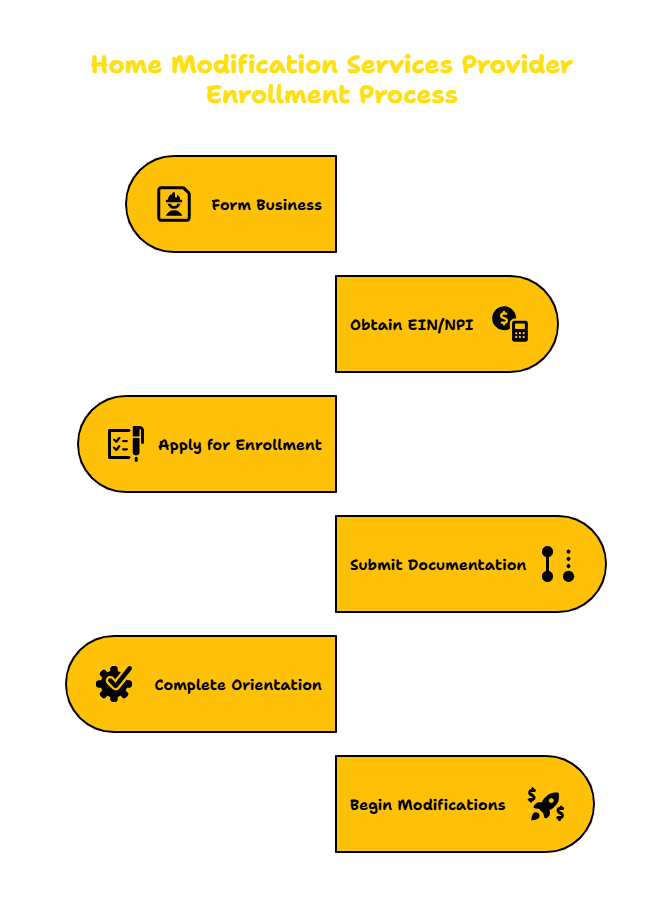
The enrollment workflow follows a sequential path:
- Business formation and procurement of EIN/NPI.
- Formal application submission to DHS-DDD for enrollment under the CHOICES, FS360, or Medically Fragile waivers.
- Submission of critical documentation, including sample consent forms, standardized modification plans, and billing templates.
- Participation in mandatory provider orientation and completion of compliance verification audits.
- Authorization to begin service delivery once participant-specific ISP funding is secured.
What Are the Essential Staffing and Documentation Protocols?
Operational success depends heavily on the role of the Home Modification Project Coordinator, who acts as the primary liaison between the participant, the state, and the construction team. This role typically requires experience in residential modification, disability-related construction, or occupational therapy. When physical construction is required, the provider must utilize licensed contractors—such as electricians or plumbers—who hold active South Dakota licensure and have passed necessary background checks.
Documentation is the backbone of the audit process. Every project must be supported by a file that includes the initial medical justification, signed homeowner agreements, cost estimates, and records of the final inspection. Providers must ensure that all staff members are trained on HIPAA privacy standards, disability sensitivity, and the specific billing requirements mandated by the South Dakota DHS.
Frequently Asked Questions
Which Medicaid waivers cover home modification services in South Dakota?
Home modification services are covered under the CHOICES Waiver, the Family Support 360 Waiver, and the Medically Fragile Waiver. Additionally, for individuals under age 21, some medically necessary modifications may be accessible through the Early and Periodic Screening, Diagnostic, and Treatment (EPSDT) benefit with a physician’s order.
What is the typical timeline for launching a home modification provider agency?
The launch process generally spans 4 to 7 months. Business formation and initial licensing typically take 1 to 2 months, followed by 2 to 3 months for the provider enrollment application and documentation submission. Final staffing, contractor setup, and orientation add another 1 to 2 months before the provider is ready to begin modifications upon project-specific funding approval.
What documentation must be included in the Policy & Procedure Manual?
A compliant manual must include an intake process, procedures for documenting medical justification, homeowner permission forms, contractor agreements, pre- and post-modification inspection reports, cost estimate templates, participant satisfaction surveys, safety verification logs, and strict HIPAA compliance protocols.
Key Takeaway for Prospective Providers
Success as a Medicaid Home Modification provider in South Dakota requires a dual focus on construction expertise and administrative precision. By ensuring that all business practices—from initial intake and medical justification to final post-installation inspections—align strictly with the requirements set by the Department of Human Services, providers can ensure sustainable participation in the CHOICES, FS360, and Medically Fragile waiver programs while effectively improving the quality of life for participants.
Last verified: November 2024. This content is for informational purposes only and does not constitute legal or professional advice. Requirements for Medicaid provider enrollment are subject to change by the South Dakota Department of Human Services (DHS) and the Centers for Medicare & Medicaid Services (CMS). Providers should consult official agency portals for the most current regulations and policy manuals.