HOME MODIFICATION SERVICES PROVIDER IN RHODE ISLAND
By Fatumata Kaba · 2025-10-09 · 5 min read
Home Modification Services in Rhode Island are essential community-based interventions designed to increase independence and safety for individuals with disabilities, aging populations, and those with mobility limitations. By providing physical adaptations to a participant’s primary residence—such as ramps, roll-in showers, and widened doorways—these services ensure that individuals can remain in their homes rather than transitioning to institutional care settings. These services are authorized through the Rhode Island Executive Office of Health and Human Services (EOHHS) and the Department of Behavioral Healthcare, Developmental Disabilities & Hospitals (BHDDH) as part of the state’s Medicaid Home and Community-Based Services (HCBS) waiver framework.
Understanding the Regulatory Landscape for Home Modifications
Navigating the governance of Medicaid-funded home modifications requires a firm grasp of both state and federal oversight. The Rhode Island Executive Office of Health and Human Services (EOHHS) serves as the primary authority, managing Medicaid funding and establishing the standards for authorized environmental adaptations under the 1115 Global Waiver. Because these modifications are non-routine and strictly tied to an individual’s disability-related functional limitations, compliance with EOHHS guidelines is mandatory for any provider seeking reimbursement.
In addition to EOHHS, the Department of Behavioral Healthcare, Developmental Disabilities & Hospitals (BHDDH) plays a critical role in coordinating these services specifically for participants with developmental disabilities. Furthermore, the Rhode Island Department of Health (RIDOH) maintains oversight regarding contractor licensing and safety standards for structural renovations. At the federal level, the Centers for Medicare & Medicaid Services (CMS) sets the overarching policy for HCBS spending, ensuring that all modifications align with federal requirements for medical necessity and participant safety.
Key Services and Environmental Adaptations
Approved providers of Home Modification Services must be prepared to deliver a wide array of physical improvements tailored to the participant’s unique needs as defined by their Individualized Service Plan (ISP). These modifications are intended to maximize the participant’s functional capacity within their living environment. Typical services provided under these waivers include:
- Mobility Enhancements: Installation of exterior ramps, platform lifts, stair glides, and the widening of doorways to accommodate wheelchairs or other assistive devices.
- Bathroom and Kitchen Modifications: Roll-in showers, grab bars, accessible toilet height adjustments, lowered countertops, and adaptive cabinetry or sink configurations.
- Safety and Environmental Controls: Implementation of smart-home technology such as voice-activated lighting, automatic door openers, non-slip flooring, and levered door handles.
- Structural Repairs: Essential maintenance and repairs to existing authorized modifications to ensure long-term functionality and safety.
Provider Enrollment and Business Compliance
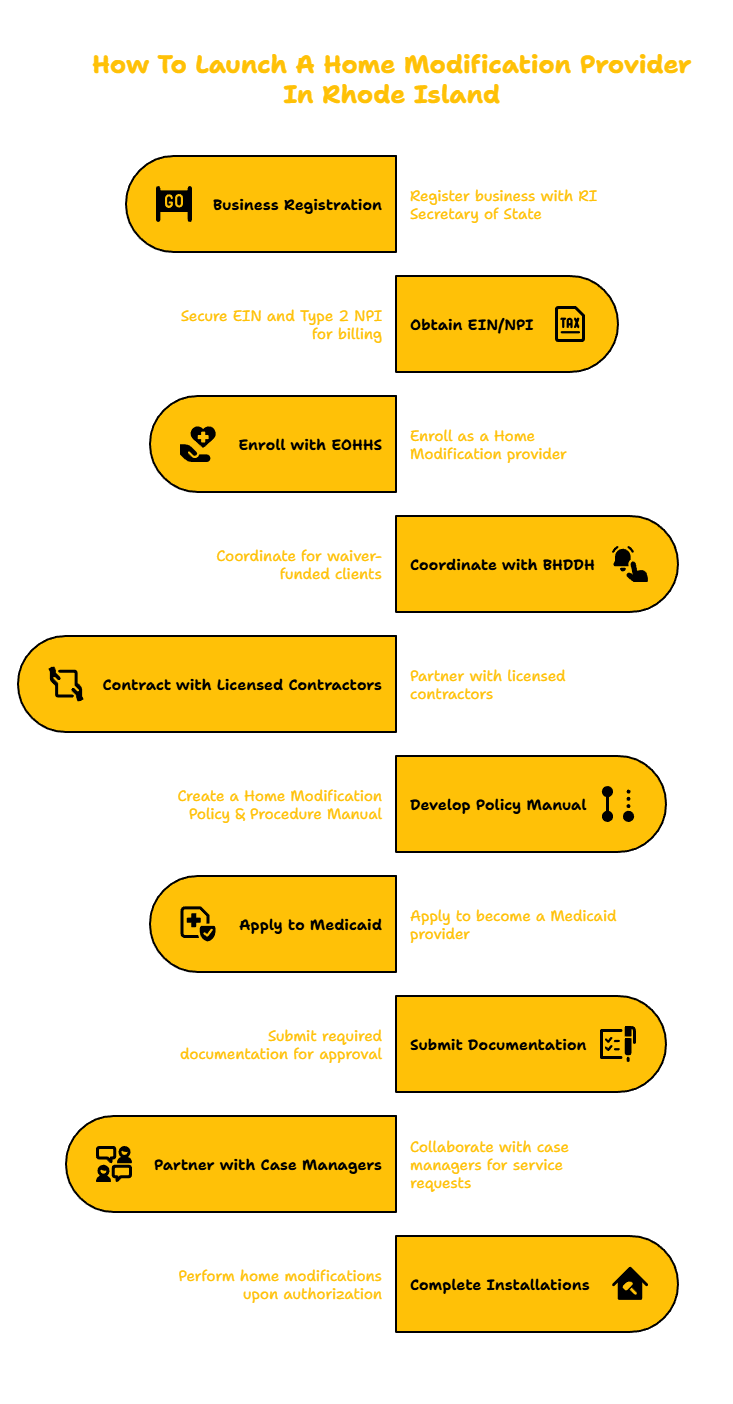
Establishing a business as a Medicaid-approved provider is a multi-step process that demands rigorous attention to administrative detail. Before rendering services, an entity must be properly registered with the Rhode Island Secretary of State and obtain a federal Employer Identification Number (EIN). If the entity intends to bill Medicaid directly, it must also secure a Type 2 National Provider Identifier (NPI). The process continues with formal enrollment as a Medicaid provider through the EOHHS portal, where the organization must demonstrate its capacity to deliver environmental adaptations in accordance with state waiver guidelines.
Beyond basic registration, providers must develop a comprehensive Home Modification Services Policy & Procedure Manual. This document serves as the foundation for the agency’s operations and must explicitly outline installation standards, safety protocols, and compliance measures. Providers are expected to maintain clear lines of communication with waiver case managers and BHDDH coordinators to ensure that every project is pre-approved and aligned with the participant's ISP. Coordination with licensed tradespeople, including plumbers and electricians, is essential to ensure all work meets local building codes and ADA accessibility guidelines.
Staffing Requirements and Operational Standards
Successful execution of home modification projects relies on a team that balances technical construction expertise with an understanding of clinical accessibility needs. A dedicated Home Modification Specialist or Coordinator is usually required to manage project planning, conduct on-site assessments, and handle the complex documentation required by Medicaid. This individual acts as the primary liaison between the participant, the case manager, and the installation team.
All on-site work must be performed by or supervised by contractors who hold valid Rhode Island licenses. Because these services involve vulnerable populations, all staff members and subcontractors must adhere to strict safety and privacy protocols. This includes the completion of mandatory background checks, HIPAA confidentiality training, and education on abuse prevention. Many providers also opt to consult with a licensed Occupational Therapist (OT) during the assessment phase to ensure that the proposed modifications accurately address the participant’s clinical requirements and long-term goals.
Navigating Medicaid Waiver Programs
Home Modification Services are funded through several distinct Medicaid channels, each with specific eligibility criteria. Understanding these programs allows providers to better serve their target populations. The primary programs include the 1115 Global Waiver, which provides physical home adaptations for adults, and the BHDDH Developmental Disability (DD) Waivers, specifically tailored for individuals with intellectual or developmental disabilities. Additionally, the Katie Beckett/TEFRA program covers essential modifications for pediatric participants, and various self-directed waiver options allow participants to choose from a list of approved providers.
- Authorization Process: All projects require an approved ISP or authorization from a case manager before the work commences.
- Documentation Standards: Providers must maintain detailed proof of completion, including "before and after" documentation, to justify reimbursement claims.
- Scope of Work: Every project must be accompanied by a detailed scope of work that outlines the materials, labor, and expected outcomes, ensuring the modification is non-routine and medically necessary.
Frequently Asked Questions
What is the difference between home maintenance and home modification?
Medicaid-funded Home Modification Services are specifically designed to address functional limitations and accessibility needs, such as installing a ramp or a roll-in shower. General home maintenance, such as roof repair or painting, is typically not considered a reimbursable HCBS service unless it is directly tied to the safety and functionality of a specific disability-related modification.
Can a provider bill for work performed before receiving an authorization?
No. Medicaid rules strictly prohibit the reimbursement of services rendered prior to formal authorization. All projects must be vetted by the participant’s case manager and receive the necessary approvals through the relevant agency—EOHHS or BHDDH—before any materials are purchased or installation begins.
What documentation is required to ensure a successful reimbursement?
To ensure timely payment, providers must submit comprehensive documentation, including proof of business registration, valid contractor licenses, the authorized scope of work, participant consent forms, and post-installation validation that the work meets all safety and accessibility standards.
Key Takeaway
Launching a home modification agency in Rhode Island requires a dual focus on rigorous business compliance and specialized technical knowledge. By maintaining strong relationships with Medicaid case managers, adhering to strict documentation and safety standards, and ensuring all contractors are properly licensed, providers can build a sustainable practice that significantly improves the quality of life and community independence for Rhode Island’s most vulnerable residents.
Last verified: October 2023. This information is provided for educational purposes only and does not constitute legal or financial advice. Regulations governing Rhode Island Medicaid HCBS waiver programs are subject to change; providers should consult directly with the Executive Office of Health and Human Services (EOHHS) and the Department of Behavioral Healthcare, Developmental Disabilities & Hospitals (BHDDH) for the most current policy requirements and provider enrollment guidance.