HOME MODIFICATION SERVICES PROVIDER IN PENNSYLVANIA
By Fatumata Kaba · 2025-10-08 · 6 min read
Home Modification Services in Pennsylvania are critical Medicaid-funded supports designed to facilitate aging in place and promote independence by adapting the physical living environments of individuals with disabilities or chronic health conditions. Through the state’s Home and Community-Based Services (HCBS) waivers—administered by the Office of Long-Term Living (OLTL), the Office of Developmental Programs (ODP), and Community HealthChoices (CHC) Managed Care Organizations—qualified providers deliver essential structural modifications that reduce institutionalization risks and enhance functional safety.
What Are the Governing Agencies and Regulatory Requirements?
The regulatory landscape for home modifications in Pennsylvania is multifaceted, requiring coordination across federal and state lines. At the federal level, the Centers for Medicare & Medicaid Services (CMS) mandates that all environmental adaptation services adhere to strict 1915(c) waiver standards, ensuring that modifications are medically necessary and cost-effective. Compliance with these standards is the foundation upon which all provider operations must be built.
At the state level, the Pennsylvania Department of Human Services (DHS) acts as the primary authority. Providers must navigate the specific requirements set forth by OLTL and ODP, as well as the operational protocols established by CHC Managed Care Organizations (MCOs). Furthermore, all business entities must be registered with the Pennsylvania Department of State, and those performing construction work must comply with the Pennsylvania Department of Labor & Industry’s Home Improvement Contractor (HIC) registration program.
- Department of Human Services (DHS): Oversees the authorization of services through waivers and coordinates with Service Coordinators and Administrative Entities.
- CHC MCOs: Responsible for funding approvals and managing the roster of vendors authorized to install modifications.
- Department of Labor & Industry: Enforces mandatory HIC registration for all entities providing home improvement services.
How Do Providers Deliver Home Modification Services?
Home modification services encompass a broad spectrum of structural and environmental adaptations. The primary goal is to remove physical barriers that impede the participant’s ability to perform activities of daily living. Providers are tasked not only with the physical installation of equipment but also with the comprehensive project management required to ensure that each modification meets the unique, clinically documented needs of the participant.
The scope of work generally includes a professional site evaluation followed by the development of a detailed scope of work document. Providers are responsible for the procurement of high-quality materials and the oversight of all installation phases, ensuring that work is conducted in accordance with ADA accessibility standards and local building codes. Post-installation inspections are a mandatory component to verify that the modifications meet the safety requirements defined in the service authorization.
- Accessibility Modifications: Installation of wheelchair ramps, widened doorways, roll-in showers, and stair lifts.
- Environmental Control Units (ECUs): Implementation of smart home technology and adaptive controls to foster independence.
- Project Management: Full-cycle oversight including site assessments, contractor coordination, and meticulous documentation of project costs and completion photos.
What Is the Process for Provider Enrollment in Pennsylvania?
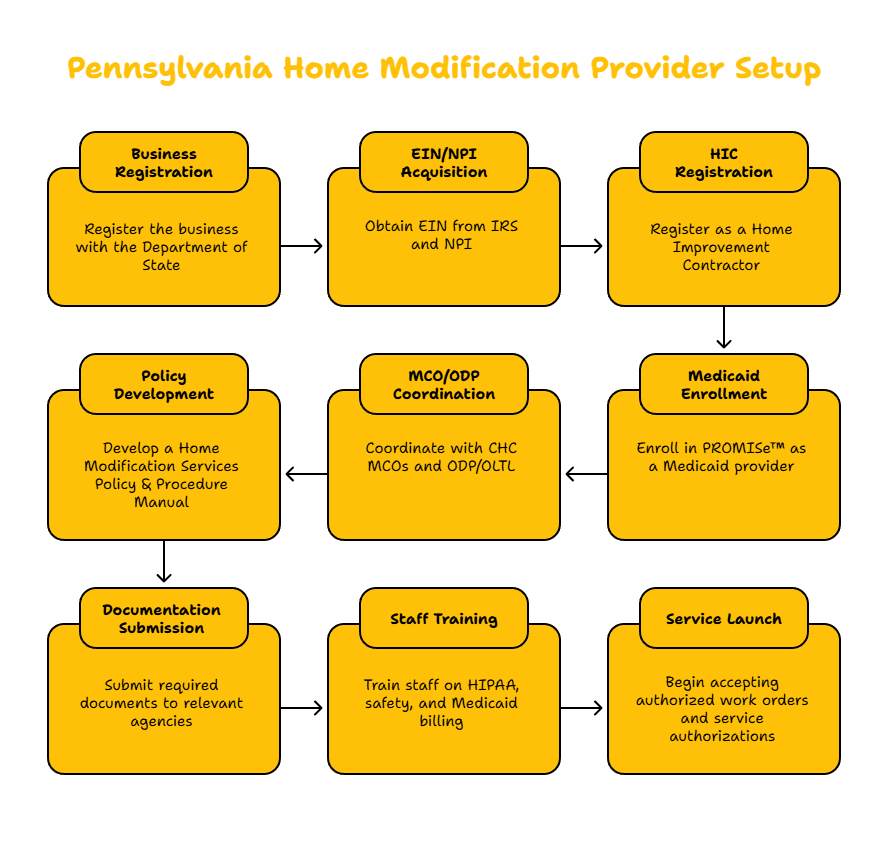
Becoming an approved Medicaid provider is a sequential process that begins with formalizing the business entity. After securing an Employer Identification Number (EIN) and a Type 2 National Provider Identifier (NPI), the provider must register with the Pennsylvania PROMISe™ portal. This portal is the primary gateway for billing and Medicaid administrative functions in the Commonwealth.
Following registration, the provider must demonstrate technical and operational readiness to the relevant MCOs or Administrative Entities. This involves submitting detailed policy and procedure manuals, proof of insurance—including general liability and workers' compensation—and evidence of proper licensure. Consistency in documentation and a clear understanding of the specific waiver requirements are paramount to successful enrollment and the receipt of service authorizations.
- Legal Foundation: Secure business registration, EIN, NPI, and HIC status.
- Medicaid Integration: Complete the enrollment process within the PROMISe™ system.
- Credentialing: Submit qualifications, insurance documentation, and operational protocols to the appropriate CHC MCOs or ODP Administrative Entities.
What Documentation Is Required for Compliance and Audit Readiness?
Documentation serves as the audit trail for Medicaid-funded services. For a home modification provider, this documentation must be robust, transparent, and readily available for review by state auditors or MCO representatives. Maintaining a comprehensive Home Modification Services Policy & Procedure Manual is a mandatory requirement that governs every action from initial participant intake to the final billing cycle.
The documentation must clearly delineate the clinical rationale for the modification, cost estimates approved by the funding source, and proof of completion. Incident reporting and HIPAA compliance protocols must also be clearly documented to protect participant privacy and ensure worksite safety. Precise record-keeping ensures that the services provided remain eligible for reimbursement and that the agency remains in good standing with the state.
- Project Documentation: Pre-authorization forms, detailed scopes of work, and itemized cost estimates.
- Administrative Records: HIPAA compliance training logs, incident report files, and service tracking logs.
- Verification Materials: Post-installation inspection reports, before-and-after photographs, and signed completion verifications.
How Are Staff and Contractors Managed Effectively?
Successful execution of home modification projects relies on a well-structured team of project managers, contractors, and administrative coordinators. Each role carries specific responsibilities regarding safety, compliance, and communication. Project managers must possess a deep understanding of ADA-compliant design, while installers must maintain their HIC registration and adhere to the highest standards of workmanship.
All staff members and subcontractors must undergo rigorous training, particularly regarding HIPAA compliance and the specific rules of the Medicaid program. Annual credentialing and license renewals are essential to ensure that the agency continues to meet the standards required by the Department of Human Services. By establishing clear workflows for staff, providers can reduce the risk of billing errors and project delays.
Frequently Asked Questions
What is the primary role of a Service Coordinator in home modification?
The Service Coordinator acts as the liaison between the participant and the provider. They are responsible for identifying the need for modifications, submitting the request to the MCO or Administrative Entity for approval, and monitoring the delivery of services to ensure they align with the participant’s care plan.
Are all home modifications covered under Pennsylvania Medicaid?
Only modifications that are deemed medically necessary to ensure the health, safety, and welfare of the participant or to enable them to remain in the community are typically covered. Providers must ensure that each project receives specific prior authorization before work commences to guarantee reimbursement.
How does the HIC registration relate to Medicaid provider enrollment?
The Home Improvement Contractor (HIC) registration is a mandatory state requirement for any individual or business performing home improvements in Pennsylvania. Without valid HIC registration, a provider cannot fulfill the legal requirements necessary to hold a contract as a Medicaid-approved Home Modification provider.
The key takeaway for any organization entering the Pennsylvania home modification market is the necessity of strict regulatory adherence. Success is predicated on maintaining a balance between high-quality construction standards and the administrative precision required by Medicaid and MCO partners. By focusing on detailed documentation, maintaining valid HIC and Medicaid enrollments, and fostering strong relationships with Service Coordinators, providers can ensure long-term viability and provide meaningful support to the community.
Last verified: May 2024. This information is provided for general guidance and is based on the current standards of the Pennsylvania Department of Human Services and related governing bodies. Regulations and policies are subject to change; providers should regularly consult the official Pennsylvania Department of Human Services website and the PROMISe™ provider portal for the most current information and requirements.