HOME MODIFICATION SERVICES PROVIDER IN NORTH DAKOTA
By Fatumata Kaba · 2025-09-18 · 5 min read
Home Modification Services in North Dakota are essential initiatives designed to enable individuals with disabilities, chronic conditions, or age-related limitations to remain safely in their own homes. By facilitating physical adaptations—such as ramp installations, bathroom modifications, and smart home technology integration—these services directly support the goal of community-based living by removing environmental barriers. These services are authorized and reimbursed through North Dakota Medicaid Home and Community-Based Services (HCBS) waiver programs, requiring providers to adhere to strict regulatory, safety, and quality-of-care standards.
Understanding the Governance of North Dakota Home Modification Services
The administration of Home Modification Services in North Dakota involves a collaborative effort between state and federal entities to ensure funding is used appropriately and services meet individual needs. The North Dakota Department of Human Services (NDDHS) serves as the primary agency responsible for managing the Medicaid waiver funding, overseeing the enrollment process for providers, and monitoring reimbursement practices. Their role is to ensure that all modifications align with the state’s broader mission of providing person-centered, home-based support.
Complementing this, the North Dakota Medical Services Division (MSD) manages the specific requirements of Medicaid waiver programs and oversees provider participation. For services targeting the elderly or adults with disabilities, the North Dakota Division of Aging Services provides additional oversight to ensure care standards remain high. Finally, the federal Centers for Medicare & Medicaid Services (CMS) maintains overarching authority, ensuring that North Dakota’s programs comply with national regulations regarding accessibility, safety, and the quality of person-centered care.
What Are the Core Components of Home Modification Services?
Home Modification Services provide a comprehensive range of physical changes to a participant's residence. The primary objective is to enhance accessibility, safety, and independence for individuals navigating physical or mobility-related challenges. Approved providers perform a variety of installations, ranging from structural alterations to the implementation of modern environmental controls.
Providers generally deliver the following types of support:
- Accessibility Modifications: Installation of ramps, widening of doorways, and addition of sturdy handrails.
- Bathroom Adaptations: Incorporation of grab bars, roll-in showers, and raised toilet seats to improve daily hygiene accessibility.
- Kitchen Modifications: Adjustments such as lowering countertops, installing pull-out shelves, and fitting adaptive faucets.
- Safety Enhancements: Installation of non-slip flooring, emergency alert systems, and smoke detectors.
- Bedroom Modifications: Setup of adjustable beds, ceiling lifts, and safety rails for mobility support.
- Environmental Controls: Implementation of voice-activated lighting, programmable thermostats, and automatic door openers.
- Structural and Smart Home Integration: Widening of hallways, reinforcing floors for wheelchair weight-bearing capacity, and integrating automated monitoring systems.
How Can Organizations Meet Licensing and Enrollment Requirements?
Becoming an approved Home Modification Services provider in North Dakota requires a rigorous, multi-step process centered on business legitimacy and operational readiness. Before initiating the Medicaid enrollment, an organization must be legally registered with the North Dakota Secretary of State. Once the entity is established, leadership must obtain an IRS Employer Identification Number (EIN) and a National Provider Identifier (NPI) Type 2, which is necessary for billing services as an organization.
Beyond basic business registration, agencies must demonstrate organizational capacity. This includes maintaining comprehensive general and professional liability insurance policies and developing formal internal policies. These policies must detail how the agency handles the planning of home modifications, ensures ongoing safety compliance, and manages client satisfaction. Furthermore, all staff must undergo mandatory background checks, health screenings, and comprehensive training in specialized modification techniques to ensure they are qualified to perform work in sensitive home environments.
What is the Process for Medicaid Provider Enrollment?
The enrollment process is facilitated through the North Dakota Medicaid Management Information System (MMIS). Interested providers must first initiate an application for Home Modification Services under the relevant HCBS waivers. During this phase, the applicant must submit exhaustive documentation, including Articles of Incorporation, proof of valid insurance, and evidence of the required staff qualifications. A failure to provide complete documentation can lead to delays in the approval process.
Once the application is submitted, the NDDHS and the MSD conduct a program readiness review. This review evaluates the provider’s operational protocols, safety standards, and overall technical expertise. Once these entities are satisfied that the provider meets all Medicaid participation requirements, the agency receives authorization. Following final approval, the provider may begin billing Medicaid using designated procedure codes specific to the authorized services provided to waiver participants.
What Documentation and Staffing Standards Are Required?
Successful agencies maintain a centralized Policy & Procedure Manual that serves as the foundation for their operations. This document must contain detailed protocols for needs assessments, modification planning, quality assurance, and HIPAA compliance. It must also outline specific procedures for maintaining records, handling grievances, and responding to emergencies. Because this work involves modifying living spaces, documentation regarding the safety and hygiene protocols during the construction phase is essential for auditing purposes.
Staffing requirements are equally stringent to ensure high-quality, safe outcomes for participants:
- Program Director: Should possess a degree in construction management, rehabilitation technology, or healthcare administration, along with demonstrable management experience.
- Modification Specialists: Required to hold certification in construction or rehabilitation engineering, focusing on adaptive improvements.
- Installation Technicians: Must have verified experience in carpentry or relevant equipment installation, with preference given to those with safety compliance certifications.
- Ongoing Training: All staff must complete annual competency evaluations, training in participant rights, HIPAA compliance, and adaptive construction safety standards.
Frequently Asked Questions
Which Medicaid waiver programs cover Home Modification Services?
In North Dakota, these services are authorized under the Aged and Disabled Waiver, the Technology Dependent Waiver, the Developmental Disabilities Waiver, and the standard Home and Community-Based Services (HCBS) Waiver.
How long does the provider enrollment process typically take?
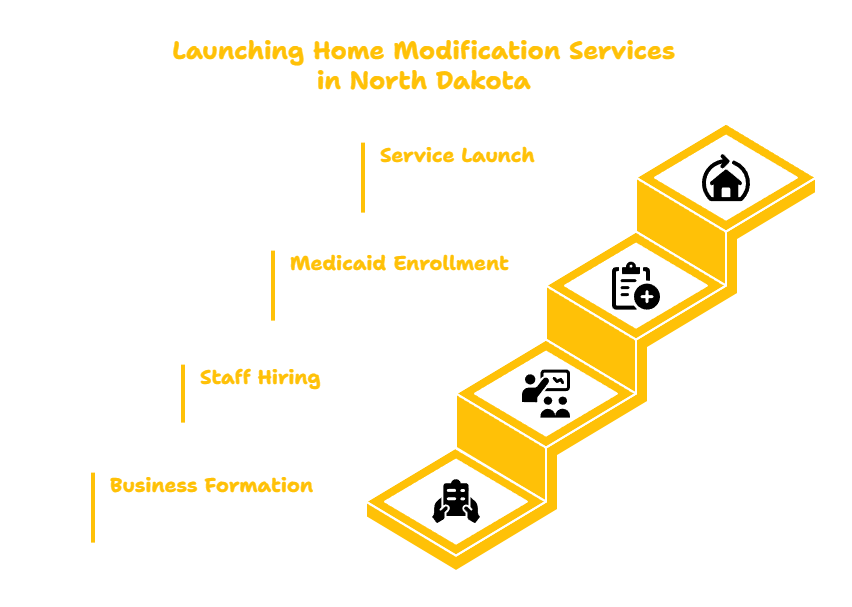
The total timeline for launch is approximately 6 to 9 months. This includes 1-2 months for business formation, 2-3 months for staffing and development, 60-90 days for Medicaid enrollment and readiness review, and 30-45 days for billing setup.
What must be included in the provider’s policy manual?
The manual must document needs assessment protocols, safety and quality assurance procedures, staff credentialing records, HIPAA compliance measures, participant rights and grievance processes, and specific standards for Medicaid billing and service tracking.
Waiver Consulting Group’s Start-Up Assistance
Waiver Consulting Group provides expert guidance for agencies seeking to launch and operate as Medicaid-compliant Home Modification Service providers in North Dakota. This assistance encompasses the entire organizational lifecycle, from initial business registration and Medicaid MMIS enrollment to the development of robust policy manuals. We assist with the creation of staff credentialing templates, training programs, and quality assurance systems designed to withstand state audits. By integrating financial management strategies with operational readiness, we help providers establish a stable foundation for delivering essential accessibility services to their communities.
Key Takeaway: Successful navigation of the North Dakota Home Modification Services market requires a strict adherence to NDDHS and MSD regulatory frameworks, the maintenance of detailed, audit-ready operational manuals, and the assembly of a highly qualified team capable of meeting the specific safety and accessibility needs of Medicaid waiver participants.
Last verified: 05/20/2024. This content is provided for informational purposes only and does not constitute legal or professional advice. Always refer to the official North Dakota Department of Human Services (NDDHS) guidance and the current Medicaid State Plan for the most recent regulatory requirements and program updates.