HOME MODIFICATION SERVICES PROVIDER IN NORTH CAROLINA
By Fatumata Kaba · 2025-09-15 · 5 min read
Home Modification Services in North Carolina play a critical role in supporting individuals with disabilities, allowing them to maintain independence and safety within their own residences. These services involve physical, structural, or technological adaptations designed to improve accessibility and functionality for participants enrolled in various North Carolina Medicaid Home and Community-Based Services (HCBS) waiver programs.
For provider agencies, delivering these services requires rigorous adherence to standards set by the North Carolina Department of Health and Human Services (NCDHHS) and the Division of Health Benefits (NC Medicaid). By providing essential modifications—ranging from ramp installations to smart home integration—providers help facilitate long-term community living and reduce the need for institutionalized care.
What Are the Governing Agencies and Regulatory Oversight for Home Modifications?
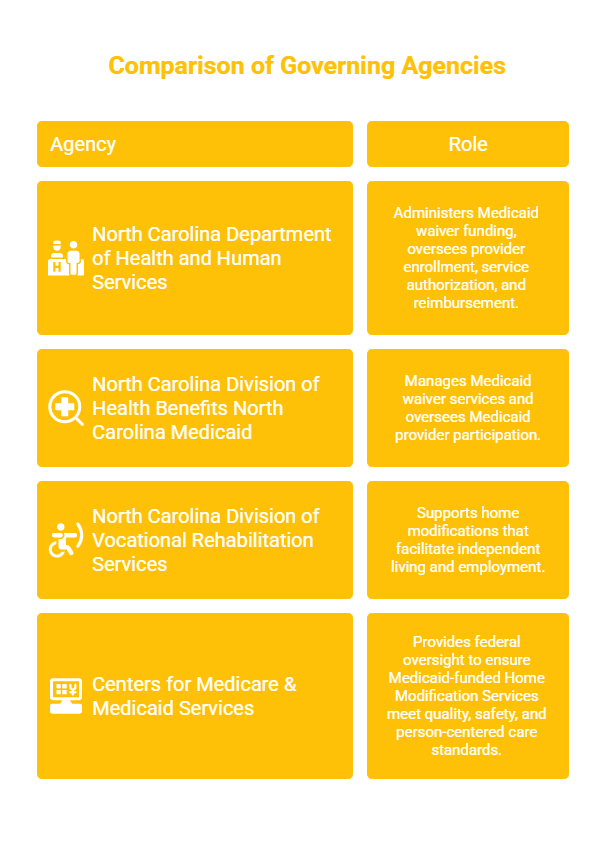
The delivery of Home Modification Services in North Carolina is subject to multi-layered oversight to ensure participant safety and fiscal accountability. The primary state agency is the North Carolina Department of Health and Human Services (NCDHHS), which administers Medicaid waiver funding, oversees provider enrollment, and regulates reimbursement processes. Working in tandem, the North Carolina Division of Health Benefits (NC Medicaid) manages the operational aspects of waiver services and monitors provider participation to ensure compliance with state and federal regulations.
Additionally, the North Carolina Division of Vocational Rehabilitation Services (NCDVRS) plays a vital role by supporting modifications that specifically facilitate employment and independent living outcomes. At the federal level, the Centers for Medicare & Medicaid Services (CMS) provides overarching guidance. CMS ensures that all Medicaid-funded services adhere to national standards for quality, safety, and person-centered care, verifying that physical modifications directly address the functional limitations of the participants served.
How Do Providers Successfully Implement Home Modification Services?
Providers must be prepared to deliver a comprehensive suite of modifications that meet the diverse needs of the waiver population. Approved adaptations generally include structural changes such as the installation of ramps, widened doorways for wheelchair access, and specialized bathroom adaptations like roll-in showers or grab bars. Kitchen modifications, including lowering countertops and installing adaptive faucets, are also common, as are safety enhancements like non-slip flooring and emergency alert systems.
Beyond physical infrastructure, the scope of services increasingly includes modern technological integrations. Providers may install environmental controls—such as remote-controlled thermostats, lighting, and door openers—or implement smart home technology that utilizes voice-activated systems to maximize a participant's autonomy. Detailed documentation is a mandatory component of these services, as providers must maintain thorough records of initial needs assessments, installation procedures, and ongoing maintenance to satisfy Medicaid billing and audit requirements.
What Are the Licensing and Enrollment Requirements for Agencies?
The journey to becoming a certified Home Modification provider begins with formal business and administrative setup. Agencies must register with the North Carolina Secretary of State and obtain both a federal Employer Identification Number (EIN) and a Type 2 National Provider Identifier (NPI). Once these legal and identity-related foundations are in place, the agency must enroll as a Medicaid Waiver Home Modification provider through the NCTracks Provider Portal, which serves as the centralized hub for all North Carolina Medicaid transactions.
Operational readiness is a prerequisite for approval. Agencies are required to maintain comprehensive general and professional liability insurance policies. Furthermore, providers must develop and document formal internal policies regarding modification planning, safety compliance, and client satisfaction. Before any work commences, providers must verify that all staff members have cleared background checks, completed mandatory health screenings, and received specialized training in adaptive modification techniques.
- Register the business entity with the North Carolina Secretary of State.
- Obtain EIN from the IRS and NPI (Type 2).
- Enroll as a Medicaid Waiver Home Modification provider via the NCTracks Provider Portal.
- Maintain robust general liability and professional liability insurance coverage.
- Develop comprehensive policies for modification planning, safety compliance, and client service.
What Is the Required Staffing and Professional Development Structure?
The success of a Home Modification agency relies heavily on the qualifications and ongoing training of its workforce. A Program Director must be appointed to provide administrative oversight, typically holding a degree in construction management, rehabilitation technology, or healthcare administration, coupled with significant experience in home adaptation projects. This leadership ensures that the agency’s work aligns with state safety codes and the specific clinical needs of waiver participants.
On-the-ground execution requires Home Modification Specialists and technical staff who bring construction, carpentry, or rehabilitation engineering expertise to the project. Beyond technical skill, every staff member must undergo regular training in HIPAA compliance, the rights of the participants, and emergency response protocols. Annual competency evaluations are required to ensure that staff remain proficient in adaptive construction techniques and that documentation remains accurate and audit-ready.
Which Medicaid Waivers Cover These Services?
Home Modification Services are integrated into several key North Carolina Medicaid HCBS waivers, each designed to support different populations with unique requirements. Providers must be familiar with the specific rules governing these programs to ensure proper service authorization and reimbursement. The applicable programs include:
- Innovations Waiver
- Community Alternatives Program for Disabled Adults (CAP/DA)
- Community Alternatives Program for Children (CAP/C)
- Traumatic Brain Injury (TBI) Waiver
- Home and Community-Based Services (HCBS) Waiver
Frequently Asked Questions
How long does the provider enrollment process take?
The timeline varies based on the agency's readiness. Typically, business formation and compliance preparation take 1–2 months, followed by 2–3 months for staffing and program development. The formal NCDHHS and NC Medicaid enrollment and readiness review process generally takes 60–90 days, with an additional 30–45 days required to finalize billing setups.
What must be included in the Home Modification Policy Manual?
The manual must detail the entire project lifecycle, including needs assessment protocols, safety and quality assurance procedures for installations, staff credentialing records, and strict HIPAA compliance measures. It must also cover grievance handling, emergency response plans, and standard operating procedures for Medicaid billing and documentation.
Is specialized training required for installation staff?
Yes. All installation technicians must have experience in construction or adaptive equipment installation. They are also required to complete training in client safety, adaptive construction techniques, and ongoing professional development to stay current with accessibility standards and compliance requirements.
Waiver Consulting Group provides comprehensive start-up assistance for agencies looking to enter the North Carolina Home Modification market. Services include assistance with business registration, Medicaid enrollment, policy manual development, staff credentialing, and the establishment of quality assurance systems designed to meet state and federal audit standards.
Key takeaway: Achieving status as a compliant Home Modification provider in North Carolina requires a disciplined approach to administrative documentation, strict adherence to state-specific enrollment protocols in NCTracks, and a commitment to maintaining a qualified, safety-conscious workforce that meets the standards of the NCDHHS and the various HCBS waiver programs.
Last verified: 2024. This content is for informational purposes and does not constitute legal or professional advice. Always consult with the North Carolina Department of Health and Human Services (NCDHHS) or the NCTracks provider portal for the most current regulatory updates and requirements.