HOME MODIFICATION SERVICES PROVIDER IN NEW YORK
By Fatumata Kaba · 2025-09-04 · 5 min read
Home Modification Services in New York are specialized interventions designed to enhance accessibility, safety, and functional independence for individuals with disabilities, chronic conditions, or significant mobility challenges. By facilitating structural changes and adaptive installations within the primary residence, these services allow participants to remain in their communities rather than transitioning to institutional care, with funding authorized under various New York Medicaid Home and Community-Based Services (HCBS) waiver programs.
For provider agencies, establishing a Home Modification program requires navigating a complex regulatory landscape governed by the New York State Department of Health (NYSDOH), the Office for People With Developmental Disabilities (OPWDD), and the Office of Mental Health (OMH). Success in this sector depends on strict adherence to Medicaid enrollment requirements, rigorous safety compliance, and the development of robust operational policies that prioritize participant wellbeing and ADA-standard environmental design.
What Are the Regulatory Frameworks and Governing Agencies for Home Modification Services?
The delivery of Home Modification Services in New York is overseen by a multi-tiered regulatory structure to ensure that Medicaid-funded projects meet federal and state safety benchmarks. The Centers for Medicare & Medicaid Services (CMS) provides the overarching federal oversight, ensuring that waiver-funded modifications are consistent with the quality and accessibility standards required to maintain the integrity of the Medicaid program.
At the state level, the New York State Department of Health (NYSDOH) serves as the primary administrator for Medicaid waiver funding, overseeing the enrollment of providers, the formal authorization of services, and the reimbursement processes. Depending on the specific population served, other agencies play critical roles in oversight and compliance:
- Office for People With Developmental Disabilities (OPWDD): Provides dedicated oversight for modifications tailored to individuals with developmental disabilities.
- New York State Office of Mental Health (OMH): Ensures that modifications for individuals with mental and behavioral health needs are supportive of therapeutic goals and personal safety.
How Do Providers Define and Deliver Approved Home Modification Services?
Home Modification Services involve deliberate structural changes and technological adaptations designed to mitigate physical barriers. These projects are not merely aesthetic; they are clinical necessities that enable independent living. Approved providers are responsible for the full lifecycle of these modifications, from the initial accessibility assessment to the final installation and safety verification.
Provider activities typically encompass a wide range of technical interventions, including:
- Accessibility Enhancements: Installation of ramps, stairlifts, and the widening of doorways to accommodate mobility aids.
- Bathroom and Kitchen Adaptations: Installation of grab bars, roll-in showers, accessible sinks, lowered countertops, and adaptive fixtures.
- Safety and Mobility Supports: Implementation of non-slip flooring, handrails, safety lighting, ceiling lifts, and tracking systems.
- Environmental Controls: Integration of smart home systems to allow for the remote control of lighting, climate, and door entry points.
- Specialized Environment Design: Modifications specifically tailored for individuals with sensory processing disorders and the addition of emergency accessible exits.
What Are the Prerequisites for Provider Enrollment and Compliance?
To operate as a Medicaid Waiver Home Modification provider, an entity must establish a formal business foundation that meets New York State's stringent legal and insurance requirements. The process begins with the registration of the business entity with the New York Department of State and the procurement of an Employer Identification Number (EIN) from the IRS and a Type 2 National Provider Identifier (NPI).
Following organizational registration, prospective providers must prepare for the formal enrollment process through the eMedNY portal. This phase requires the development of a comprehensive Policy and Procedure Manual. This manual must explicitly outline how the agency will handle accessibility assessments, project planning, and ongoing safety compliance. Additionally, agencies must secure necessary general and professional liability insurance and implement robust internal protocols for conducting staff background checks and mandatory health screenings.
What Is the Required Documentation for Program Approval?
The New York Medicaid provider enrollment process is documentation-intensive. Agencies must provide evidence of their organizational readiness to perform safe, high-quality modifications. Submissions must include foundational documents such as Articles of Incorporation, IRS confirmation of the EIN, NPI verification, and proof of all required insurance coverages.
Beyond the legal entity documentation, providers must present a detailed operational framework. This documentation must address several critical areas of agency management:
- Policy Frameworks: Detailed procedures for accessibility assessments, construction safety, and quality assurance.
- Credentialing and Records: Proof of staff training, background checks, and annual competency evaluations.
- Billing and Compliance: Standardized methods for tracking modifications and ensuring that all Medicaid billing complies with federal and state audit standards.
- Participant Protections: Clearly defined policies regarding HIPAA compliance, the protection of participant rights, and formal grievance handling procedures.
- Emergency Preparedness: Protocols for safety verification and emergency response during and after the construction process.
Which Professional Staffing Roles Are Essential for Program Operations?
A successful Home Modification program relies on a multidisciplinary team. The Home Modification Program Director must possess either a Bachelor’s or Master’s degree in construction management, rehabilitation engineering, or a related healthcare administrative field, coupled with deep experience in project management and accessibility planning.
The frontline staff must also be highly qualified to ensure the safety and comfort of program participants. Essential roles include:
- Accessibility Consultants: Professionals certified in architecture, rehabilitation technology, or accessibility planning who possess the expertise to assess residential needs accurately.
- Construction Technicians: Skilled workers experienced in building modifications, who understand ADA standards and prioritize construction safety, with a strong preference for those holding OSHA certifications.
All staff are required to undergo consistent training in accessibility planning, construction compliance, and the nuances of client interaction. Regular professional development and annual competency evaluations are mandatory to maintain agency standing.
Frequently Asked Questions
Which Medicaid waiver programs cover Home Modification Services in New York?
Home Modification Services are available under several key waivers, including the OPWDD Comprehensive Waiver, the Home and Community-Based Services (HCBS) Waiver, the Nursing Home Transition and Diversion (NHTD) Waiver, the Traumatic Brain Injury (TBI) Waiver, and the Children’s Waiver.
How long does the provider enrollment process typically take?
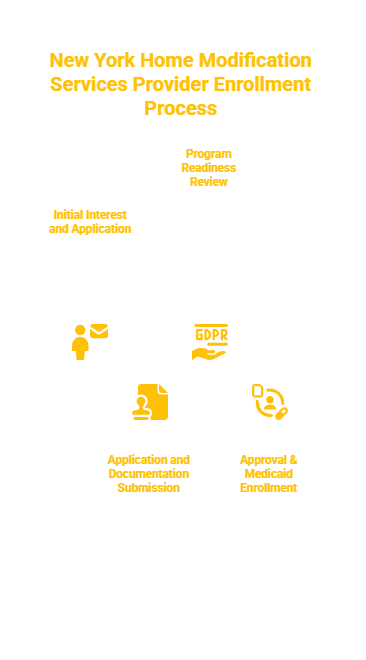
The timeline varies based on organizational readiness, but generally, business formation and compliance preparation take 1–2 months, staff hiring and program development take 2–3 months, the Medicaid enrollment and readiness review process spans 60–90 days, and final billing setup takes 30–45 days.
What is the primary responsibility of an Accessibility Consultant in this program?
An Accessibility Consultant is responsible for conducting thorough, in-home assessments to determine which physical modifications are necessary for the participant's independence and safety, ensuring that all proposed changes comply with relevant building codes and Medicaid requirements.
Key Takeaway
Launching a Home Modification Services agency in New York requires a precise, phased approach that integrates construction expertise with strict Medicaid compliance and regulatory oversight. By focusing on robust policy development, staff credentialing, and meticulous documentation, providers can effectively support the independence of individuals in their communities while building a sustainable and audit-ready Medicaid enterprise.
Last verified: October 2023. This information is provided for general guidance and does not constitute legal or professional advice. Agencies should consult directly with the NYSDOH and the eMedNY portal for the most current regulatory updates and specific enrollment instructions.