HOME MODIFICATION SERVICES PROVIDER IN NEW HAMPSHIRE
By Fatumata Kaba · 2025-07-27 · 5 min read
Home Modification Services in New Hampshire enable individuals with disabilities, chronic conditions, and mobility challenges to maintain their independence by providing essential adaptive improvements to their living environments. These services are authorized and reimbursed through New Hampshire Medicaid Home and Community-Based Services (HCBS) waiver programs, requiring providers to adhere to strict regulatory standards overseen by the Department of Health and Human Services (DHHS) and the Bureau of Elderly and Adult Services (BEAS).
What are the Regulatory Foundations for New Hampshire Home Modification Services?
The delivery of home modification services in New Hampshire is governed by a multi-tiered regulatory framework. At the state level, the New Hampshire Department of Health and Human Services (DHHS) serves as the primary authority, managing provider enrollment, service authorization, and the reimbursement process for Medicaid-funded projects. The Bureau of Elderly and Adult Services (BEAS) works closely with providers to ensure that all modifications align with quality standards, participant safety protocols, and the specific mandates of the state’s various HCBS waiver programs.
At the federal level, the Centers for Medicare & Medicaid Services (CMS) provides overarching guidance. CMS oversight is designed to ensure that state-funded modifications remain person-centered, promote community integration, and strictly adhere to participant protection standards. Providers must demonstrate ongoing compliance with both state regulations and federal expectations to maintain their status as active Medicaid billing entities.
How Are Home Modification Services Structured for Participants?
Home modifications are classified as services intended to improve accessibility, safety, and functionality for individuals with physical or cognitive disabilities. Each project is grounded in a participant's Individualized Service Plan (ISP), ensuring that the scope of work is tailored to specific clinical and environmental needs identified during a professional assessment. By addressing structural barriers, these services prevent institutionalization and support aging in place.
- Accessibility Improvements: Installation of wheelchair ramps, widening of doorways, and fitting of handrails.
- Bathroom Modifications: Installation of roll-in showers, grab bars, accessible sinks, and raised toilet seats.
- Kitchen Adjustments: Lowering countertops, installing accessible cabinetry, and adapting appliances.
- Safety and Mobility Enhancements: Installation of stairlifts, vertical platform lifts, safety alarms, improved lighting, and slip-resistant flooring.
- Home Automation: Integration of smart home technologies for automated lighting, climate control, and security management.
What Are the Prerequisites for Provider Enrollment and Licensing?
Becoming an approved Home Modification Services provider in New Hampshire requires a rigorous approach to business formation and compliance. Before initiating the Medicaid enrollment process, an agency must formally register with the New Hampshire Secretary of State and secure a federal Employer Identification Number (EIN). Additionally, the entity must obtain a Type 2 National Provider Identifier (NPI) for institutional billing purposes.
Beyond standard business registration, providers must ensure their contracting operations are fully licensed and insured. This includes holding any relevant contractor licenses required by the New Hampshire Office of Professional Licensure and Certification. Comprehensive liability insurance—covering both general and professional liabilities—is a prerequisite for enrollment, as is the development of robust internal policies regarding project planning, safety, and subcontractor management.
How Does the Medicaid Provider Enrollment Process Function?
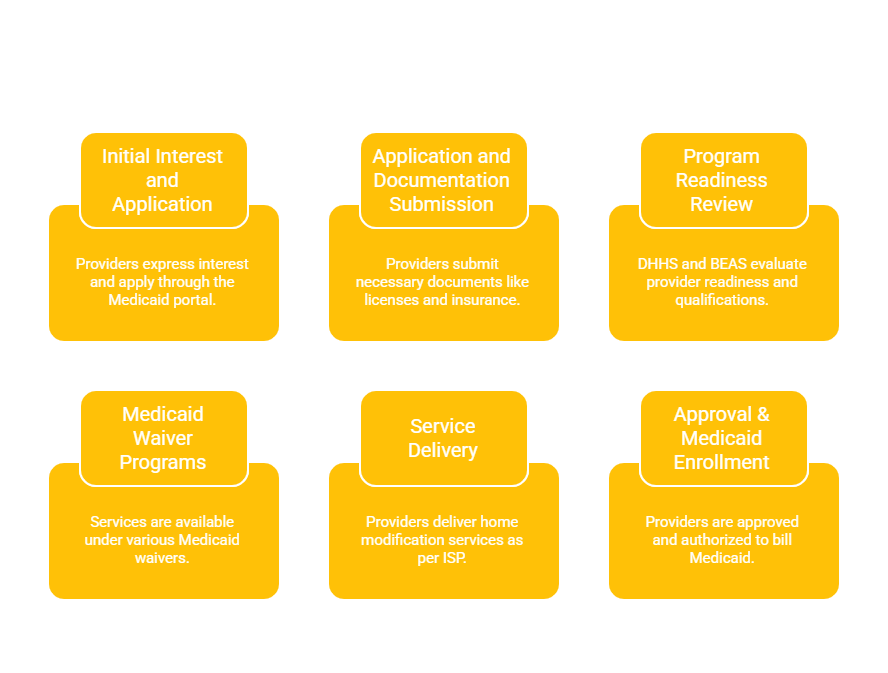
The enrollment journey is a multi-phase process managed through the New Hampshire Medicaid Provider Enrollment Portal. Applicants begin by submitting a formal request for enrollment under the HCBS waiver categories. During this phase, providers must upload essential documentation, including articles of incorporation, proof of insurance, and valid contractor credentials. A critical component of this stage is the submission of a detailed Policy and Procedure Manual, which must outline the provider's standards for safety, risk assessment, and billing documentation.
Once the application is submitted, the DHHS and BEAS conduct a program readiness review. This evaluation assesses the provider's ability to maintain safety protocols, manage projects in accordance with building codes, and verify contractor qualifications. Following a successful review and final approval, the provider is officially authorized to deliver services and bill Medicaid using the designated service codes associated with the state's waiver programs.
What Are the Essential Staffing and Credentialing Requirements?
Success in this field relies on a workforce that understands both clinical necessity and construction standards. Agencies must designate a Home Modification Program Director who holds a bachelor’s degree in a relevant field, such as construction management or healthcare administration, and possesses demonstrable experience in accessibility projects. Accessibility specialists should ideally hold certifications like the Certified Aging-in-Place Specialist (CAPS) to ensure project outcomes meet high clinical standards.
All staff and contracted labor must undergo thorough background checks and credential verification. Furthermore, agencies are responsible for providing ongoing training for their teams. This includes, but is not limited to, HIPAA compliance, client rights, safety and risk management, and the maintenance of rigorous project documentation to satisfy Medicaid audit requirements.
Frequently Asked Questions
Which Medicaid waiver programs cover these home modification services?
Home modification services are available through several New Hampshire waivers, including the Choices for Independence (CFI) Waiver, the Developmental Disabilities (DD) Waiver, the Acquired Brain Disorder (ABD) Waiver, the In-Home Support (IHS) Waiver for Children, and general HCBS Waiver programs.
What is the typical timeline to launch a new provider agency?
The launch process generally spans 5 to 8 months. Business formation and initial compliance preparation typically take 1–2 months, followed by 2–3 months for hiring and program development. Medicaid enrollment and readiness reviews usually span 60–90 days, with an final phase of 30–45 days required to finalize billing systems and launch operations.
Are smart home technologies covered under these waivers?
Yes, smart home integration is often included within the scope of services, particularly when technology supports the safety, independence, and accessibility of individuals with mobility impairments, such as automated lighting, security, and climate control management.
Key Takeaway
Launching a Medicaid-compliant Home Modification Services agency in New Hampshire requires meticulous attention to both state-level regulatory compliance and federal HCBS quality standards. By focusing on the integration of professional licensure, rigorous staff credentialing, and standardized project management, providers can successfully support the accessibility needs of participants while maintaining robust administrative standing with the DHHS and BEAS.
Last verified: September 2024. This information is provided for educational purposes and does not constitute legal or financial advice. Please consult with the New Hampshire Department of Health and Human Services (DHHS) or a qualified consultant to ensure full compliance with current state and federal regulations.