HOME MODIFICATION SERVICES PROVIDER IN MARYLAND
By Fatumata Kaba · 2025-09-02 · 6 min read
Home Modification services in Maryland are essential interventions designed to improve the health, safety, and independence of individuals with disabilities by modifying their living environments. These services, authorized under Maryland Medicaid Home and Community-Based Services (HCBS) programs, allow participants to remain in their homes rather than transitioning to institutional settings, by funding physical adaptations that increase accessibility and support mobility.
For contractors and service providers, entering this market requires strict adherence to state-mandated regulatory standards, comprehensive clinical documentation, and precise billing practices through the Long-Term Services and Supports (LTSS) Maryland system. By aligning business operations with the requirements of the Maryland Department of Health (MDH) and the Developmental Disabilities Administration (DDA), providers can effectively deliver critical support while maintaining compliance with state and federal standards.
How Do Home Modification Services Support Maryland Medicaid Participants?
At their core, Home Modification services function as a bridge between a participant’s physical needs and their ability to function independently within a residential setting. When an individual’s disability limits their range of motion, balance, or ability to navigate standard architecture, these modifications—such as the installation of ramps, widened doorways, or roll-in showers—become a matter of clinical necessity rather than simple home improvement. These projects are always tied directly to the participant's specific functional limitations and must be clearly articulated within their Person-Centered Plan (PCP).
The scope of these services is broad, encompassing both internal and external physical changes. Common modifications include the installation of stair lifts, platform lifts, grab bars, lowered countertops, and specialized visual alert systems for sensory-impaired residents. Every modification must be authorized by the appropriate oversight agency, ensuring that the work is not only safe and high-quality but also directly contributes to the participant's goals of health and community integration.
- Increasing the accessibility and overall usability of the home environment.
- Facilitating the safe use of mobility devices and assisting with physical transfers.
- Enhancing participant safety to mitigate fall risks and other household hazards.
- Enabling individuals to remain safely in their own homes, avoiding unnecessary institutionalization.
What Are the Essential Licensing and Regulatory Requirements for Providers?
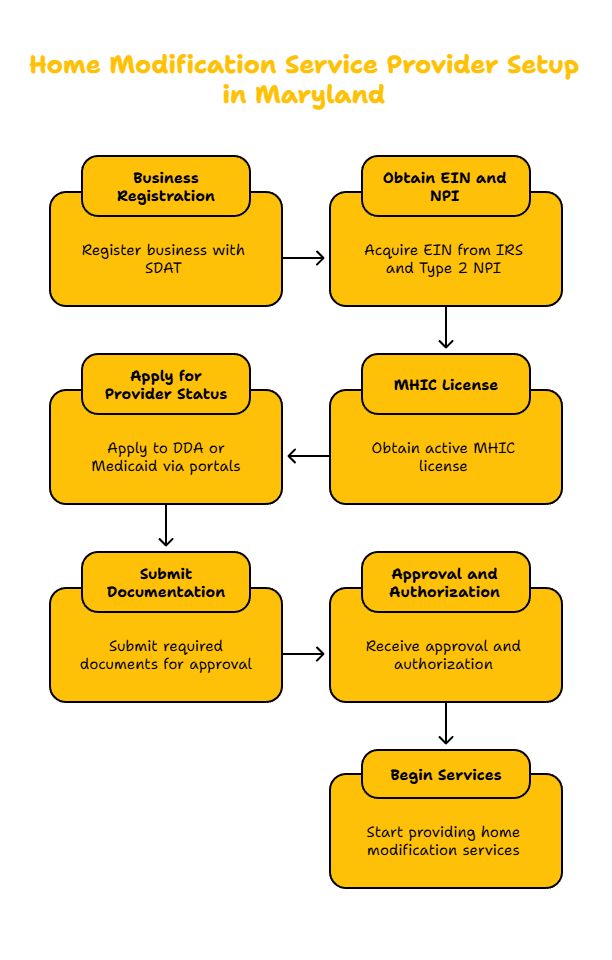
Becoming an approved Home Modification provider in Maryland is a structured process that prioritizes consumer safety and business legitimacy. Before a provider can bill for services, they must establish a formal business entity, typically registered with the Maryland Department of Assessments and Taxation (SDAT). Additionally, the entity must obtain a valid Employer Identification Number (EIN) from the IRS and a Type 2 National Provider Identifier (NPI) to function within the healthcare billing ecosystem.
Beyond standard business formation, the provider must hold an active Maryland Home Improvement Commission (MHIC) license. This is non-negotiable, as it ensures the provider meets the professional standards required for residential construction. Providers must also maintain comprehensive general liability insurance and, where applicable, workers’ compensation coverage. Throughout the delivery of services, providers are expected to remain in strict compliance with the Americans with Disabilities Act (ADA), local building codes, and specific DDA accessibility requirements.
How Should a New Provider Navigate the Enrollment Process?
The enrollment journey is divided into sequential phases, beginning with the foundational establishment of the business and the acquisition of the necessary trade licenses. Once the MHIC license and insurance are secured, the provider must engage with the official state portals. Depending on the intended scope of work, this involves navigating the ePREP portal for general Medicaid or the DDA Provider Application Portal for disability-specific services.
During the application, providers must clearly designate their service category as "Environmental Accessibility Adaptation" for DDA-funded projects or "Home Modifications" for Community First Choice (CFC) projects. The submission process is rigorous, requiring a comprehensive package that includes proof of credentials, detailed scope-of-services descriptions, and examples of past proposals. Providers should be prepared for a thorough review process by state agencies to ensure that their business model and technical capabilities align with the needs of the Medicaid and DDA populations.
- Step 1: Formalize business entity via SDAT, acquire EIN/NPI, and secure MHIC licensure.
- Step 2: Submit provider enrollment applications through the ePREP or DDA Provider Application portals.
- Step 3: Provide all requested documentation, including safety protocols, staff credentials, and business insurance.
- Step 4: Await official approval and utilize the LTSS Maryland system to manage claims once authorized by a participant's PCP.
Which Documentation and Policy Manual Standards Are Mandatory?
Maintaining a high level of clinical and operational documentation is the hallmark of a successful waiver provider. Regulatory bodies require that every project be backed by a clear audit trail. This begins with the formal agreement between the provider and the participant, followed by detailed work proposals and bid comparisons that demonstrate fiscal responsibility. Because these services are funded through public programs, transparency in pricing and the necessity of materials is monitored closely.
A provider's policy and procedure manual serves as the primary tool for maintaining this standard. It must include detailed sections on emergency protocols, HIPAA privacy compliance, and infection control—the latter being critical when working in private homes. Documentation must also include pre- and post-modification photos, participant consent forms, and thorough inspection checklists to verify that all work meets both quality expectations and the specific needs outlined in the participant's plan.
What Are the Key Differences in Medicaid Waiver Programs?
Home Modification services are distributed across several distinct Maryland programs, each serving a specific demographic. The Community First Choice (CFC) program is available to individuals who meet a nursing facility level of care, focusing on cost-effective adaptations that promote independent living. Concurrently, DDA waiver programs—including Community Pathways, Community Supports, and Family Supports—address the specific needs of individuals with intellectual and developmental disabilities.
For participants utilizing Self-Directed Services, the process offers additional flexibility, as the individual may use their approved budget to select and contract with authorized vendors directly. Regardless of the specific waiver program, the core objective remains consistent: providing the equipment, materials, labor, and necessary permits to make a home fully accessible. From initial assessments to the final follow-up, the provider’s role is to ensure the modification is not just a construction project, but a clinical success.
Frequently Asked Questions
Are there specific training requirements for staff conducting home modifications?
Yes, all staff should be trained in ADA compliance, home accessibility codes, and person-centered planning principles. It is also mandatory for staff to be well-versed in HIPAA confidentiality, risk management, and infection control protocols to ensure professional conduct within a participant's home.
How long should a provider expect the enrollment process to take?
While timelines can vary based on the completeness of the initial submission, business formation and licensing typically take 2–3 weeks. The policy manual and application preparation follow for another 2–3 weeks, with the state-level enrollment review by DDA or Medicaid usually spanning 6–10 weeks before final approval is granted.
What is the role of LTSS Maryland in the billing process?
LTSS Maryland is the central system for service tracking and billing for waiver services. Once a provider is enrolled and a project is authorized under a participant's Person-Centered Plan, the provider submits claims and documentation through this system to receive reimbursement for completed, verified work.
Key Takeaways for Prospective Providers
Success as a Home Modification provider in Maryland depends on the integration of high-quality construction standards with the administrative discipline required by Medicaid and DDA waivers. By maintaining an active MHIC license, adhering to the rigorous documentation standards required for the LTSS Maryland billing system, and ensuring that all modifications are directly tied to the participant's person-centered needs, providers can build a sustainable and impactful practice. Always remember that compliance is an ongoing requirement, not a one-time event; providers must stay current with updates from the Maryland Department of Health and other governing bodies to ensure long-term authorization and success.
Last verified: May 2024. This information is intended for educational purposes and should not be considered legal or medical advice. Please consult with the Maryland Department of Health and the Developmental Disabilities Administration for the most current regulations and program requirements.