HOME MODIFICATION SERVICES PROVIDER IN KENTUCKY
By Fatumata Kaba · 2025-07-25 · 5 min read
CREATING SAFE AND ACCESSIBLE HOMES TO SUPPORT INDEPENDENT LIVING AND QUALITY OF LIFE
Home Modification Services in Kentucky provide essential support to individuals with disabilities or chronic health conditions by physically adapting their living environments to ensure safety and accessibility. By reducing the risk of falls and removing physical barriers, these services empower participants to maintain independence within their communities, effectively reducing the reliance on long-term institutional care through Medicaid-funded Home and Community-Based Services (HCBS) waivers.
What Are the Governing Agencies for Home Modifications in Kentucky?
The delivery of home modification services in Kentucky is regulated by a hierarchy of state and federal authorities. The Kentucky Cabinet for Health and Family Services (CHFS), specifically the Department for Medicaid Services (DMS), acts as the primary agency responsible for administering Medicaid reimbursement, establishing enrollment standards, and overseeing the integrity of the Medicaid program.
The Kentucky Department for Aging and Independent Living (DAIL) works in tandem with DMS to define waiver criteria and quality standards. On a federal level, the Centers for Medicare & Medicaid Services (CMS) ensures that all environmental adaptations align with federal guidelines and the principles of person-centered planning. Furthermore, Managed Care Organizations (MCOs) play a daily operational role by authorizing specific modifications, credentialing local vendors, and managing the billing and quality review processes for participants enrolled in their plans.
What Scope of Work is Included Under Home Modification Services?
Home modification services involve structural and functional changes designed to enhance accessibility and promote safety within a participant's residence. These services are not intended for general home improvements or aesthetic renovations; rather, they must be clinically justified as a medical necessity. Providers must ensure that all proposed modifications are clearly documented in the participant’s Person-Centered Service Plan (PCSP).
Approved projects often focus on removing environmental hazards and facilitating daily living activities. Common examples of eligible modifications include:
- Installation of wheelchair ramps, specialized grab bars, and stair lifts.
- Bathroom adaptations such as roll-in showers, raised toilets, and widened doorways.
- Kitchen accessibility improvements including lowered countertops and the installation of accessible appliances.
- Installation of non-skid flooring, handrails, and adaptive door hardware.
- Technological supports like voice-activated systems or door alarms, where permitted by the waiver.
- Structural modifications required to accommodate the use of durable medical equipment (DME).
What Are the Provider Licensing and Enrollment Requirements?
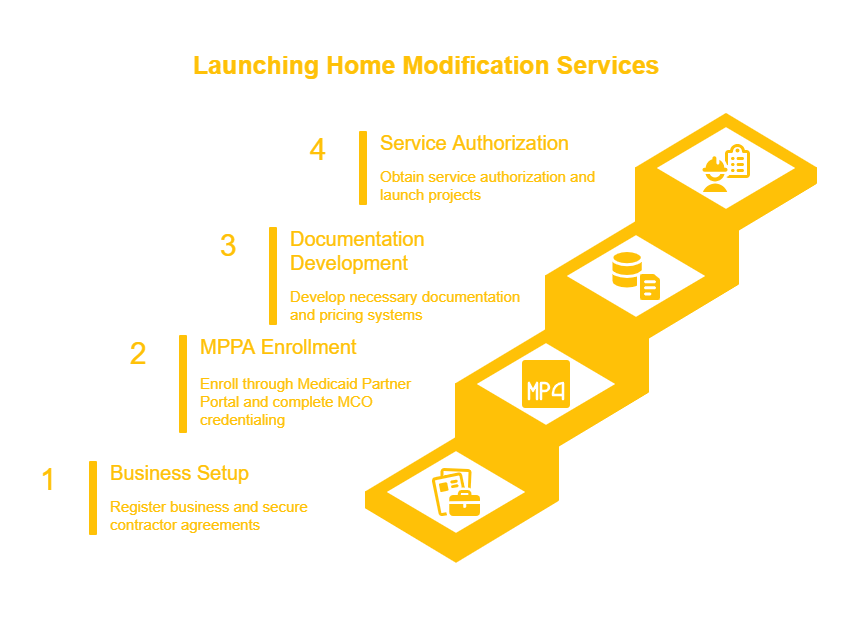
Establishing a home modification agency requires strict adherence to both business and clinical standards. Providers must first register their business entity with the Kentucky Secretary of State and secure an IRS Employer Identification Number (EIN) and a Type 2 National Provider Identifier (NPI). These foundational steps are necessary to navigate the Medicaid Partner Portal Application (MPPA), which serves as the gateway for enrollment as an official Medicaid vendor.
Operational requirements extend beyond basic business registration. Providers must maintain comprehensive general liability insurance, as well as construction-specific bonding and insurance as required by state law. All work must be executed by licensed contractors, electricians, and plumbers. Furthermore, an agency must maintain a formal Policy & Procedure Manual that ensures compliance with the Americans with Disabilities Act (ADA), local building codes, and HIPAA-protected record-keeping standards.
How Do Providers Navigate the Enrollment and Authorization Process?
The enrollment process is structured to ensure that only qualified vendors provide services under the HCBS waivers. Providers must complete their initial registration through the MPPA, selecting the appropriate classification for Environmental Accessibility Adaptations or Home Modifications. Following this, providers engage directly with MCOs to complete credentialing, which includes the submission of detailed pricing structures and compliance documentation.
Once enrolled, the operational workflow for individual projects is highly standardized to protect both the participant and the Medicaid program. The process generally follows these steps:
- Obtaining a home assessment or a physician’s recommendation to establish medical necessity.
- Submitting a formal modification request, including itemized estimates, to the MCO for pre-authorization.
- Executing the project in strict accordance with the approved scope and building codes.
- Submitting final documentation, including photographic evidence of completion and project invoices, to secure reimbursement.
What Documentation and Staffing Standards Are Required?
Maintaining high-quality service delivery requires a team capable of balancing construction logistics with Medicaid compliance. Providers should appoint a Project Coordinator or Home Modification Manager who oversees the entire lifecycle of an adaptation project, from initial assessment to final inspection. This individual is responsible for vetting subcontractors, maintaining background checks, and ensuring that all tradespeople hold the appropriate Kentucky state licenses and certifications.
Documentation is the backbone of the reimbursement process. Agency files must be audit-ready and include the following:
- Evidence of business licensure, IRS EIN, and Type 2 NPI.
- Proof of general liability and construction insurance.
- Comprehensive Policies & Procedures Manual covering home assessment templates, consent forms, project scope logs, and repair warranty protocols.
- Staff and subcontractor credentials, including HIPAA compliance training certificates and documentation of safety orientation.
Frequently Asked Questions
Which Medicaid waivers cover home modification services?
Home modification services are available through several Kentucky HCBS waivers, including the Supports for Community Living (SCL) Waiver, the Michelle P. Waiver (MPW), the Home and Community-Based (HCB) Waiver, the Acquired Brain Injury (ABI and ABI-LTC) Waivers, and the Model II Waiver (MIIW).
Can modifications be done on any type of property?
Modifications can be performed in participant-owned or rented private residences, as well as authorized group homes or supported living arrangements. All modifications must be directly linked to the functional needs defined in the participant’s Person-Centered Service Plan (PCSP).
How long does the provider setup process take?
Business setup and contractor agreements typically take 1–2 months, while the MPPA enrollment and MCO credentialing process usually spans 60–90 days. Developing the necessary internal documentation and pricing systems generally requires an additional 1–2 months of planning.
Key Takeaway
Successful participation in Kentucky's home modification program requires a meticulous approach to regulatory compliance, precise project documentation, and a deep understanding of MCO credentialing requirements. By aligning agency policies with state building codes and Medicaid service delivery standards, providers can effectively support the independence of waiver participants while maintaining a sustainable and compliant business model.
Last verified: October 2023. Disclaimer: This information is for educational purposes only and does not constitute legal or professional advice. Always verify current requirements with the Kentucky Department for Medicaid Services (DMS) and relevant Managed Care Organizations (MCOs) before initiating any business activities or service delivery.