HOME MODIFICATION SERVICES PROVIDER IN INDIANA
By Watchen Roberts · 2025-08-13 · 6 min read
ENHANCING SAFETY, ACCESSIBILITY, AND INDEPENDENCE THROUGH STRUCTURAL ADAPTATIONS
Home Modification Services in Indiana provide critical structural adaptations that enable individuals with disabilities, chronic conditions, or age-related limitations to remain safely in their homes rather than transitioning to institutional settings. Authorized under various Indiana Medicaid Home and Community-Based Services (HCBS) waiver programs, these services facilitate greater independence by modifying the physical environment to accommodate mobility devices and daily living needs.
For service providers and construction companies, entering this sector requires a deep understanding of the regulatory landscape governed by the Indiana Family and Social Services Administration (FSSA). Success depends on aligning business operations with strict clinical, financial, and safety standards to ensure that all modifications—ranging from ramp installations to complex bathroom renovations—meet the individualized needs of waiver participants while remaining fully compliant with state and federal oversight.
Who Governs Home Modification Services in Indiana?
The delivery of Home Modification Services is overseen by a structured hierarchy of agencies tasked with ensuring that participants receive high-quality, medically necessary interventions. At the state level, the Indiana Family and Social Services Administration (FSSA) serves as the primary governing body. Within the FSSA, the Division of Disability and Rehabilitative Services (DDRS) and the Division of Aging are responsible for defining service standards, authorizing specific projects, and conducting ongoing quality monitoring.
Financial oversight is managed by the Indiana Office of Medicaid Policy and Planning (OMPP), which oversees Medicaid funding, manages the provider enrollment process, and dictates reimbursement protocols. At the federal level, the Centers for Medicare & Medicaid Services (CMS) provides the overarching regulatory framework. CMS ensures that Indiana’s waiver programs adhere to federal HCBS standards, which emphasize participant-centered care, fiscal accountability, and the requirement that all home modifications are strictly tied to documented medical or functional necessity.
What Are the Scope and Requirements for Approved Modifications?
Home Modification Services encompass a wide range of physical adaptations designed to remove barriers to accessibility. These services must be prescribed based on an individualized assessment conducted by a qualified professional, such as an Occupational Therapist or a specialized accessibility consultant. The resulting recommendations are then integrated into the participant’s Individualized Service Plan (ISP) before any work can commence. Common approved modifications include the installation of wheelchair ramps, stair lifts, vertical platform lifts, and the widening of doorways to accommodate specialized equipment.
Beyond structural access, the scope extends to safety and functional enhancements within primary living spaces. Providers frequently implement bathroom modifications—such as roll-in showers, grab bars, and raised toilets—and kitchen adaptations like lowered countertops and accessible cabinetry to foster autonomy in Activities of Daily Living (ADLs). Because these modifications are funded through Medicaid, every project must be documented to show it directly addresses the health, welfare, and safety needs of the participant, rather than serving as general home improvement.
How Do Providers Navigate the Licensing and Enrollment Process?
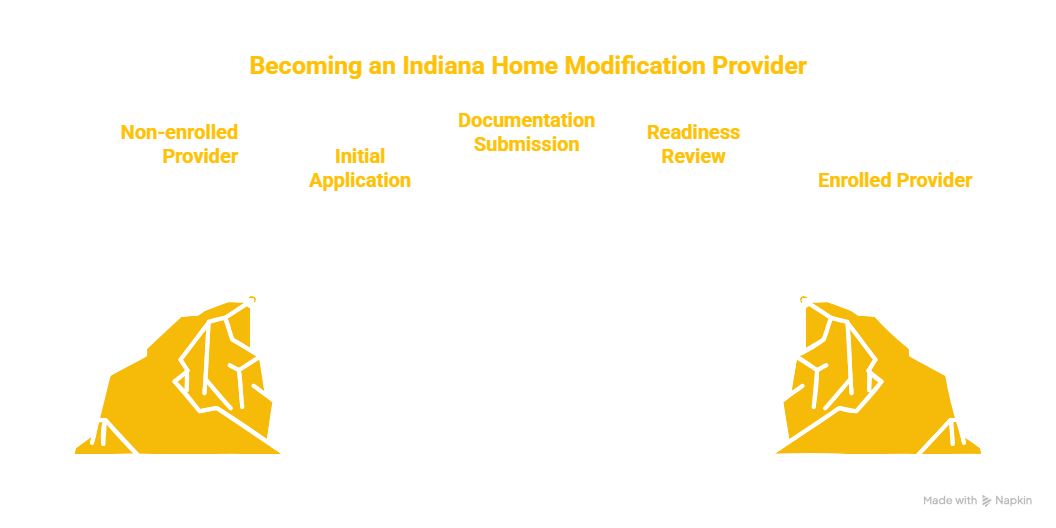
To operate as a Medicaid-enrolled provider, an entity must establish a solid administrative foundation. This begins with registering the business with the Indiana Secretary of State and obtaining both an Employer Identification Number (EIN) and a Type 2 National Provider Identifier (NPI). Because this field involves residential construction, the provider must maintain active contractor licensure, bonding, and adequate insurance, including general and product liability coverage, in strict accordance with local and state building codes.
The enrollment process itself is conducted through the Indiana Medicaid Provider Enrollment Portal. Prospective providers must submit comprehensive documentation, including evidence of their contractor status, proof of insurance, and a robust Policy and Procedure Manual. This manual is a critical component of the readiness review, as it must detail the provider's processes for conducting home assessments, securing project approvals, ensuring participant safety during construction, and managing HIPAA-compliant records. If the provider utilizes subcontractors, those entities must also meet all credentialing and safety requirements mandated by the state.
What Are the Essential Staffing and Operational Standards?
Operational excellence in this field requires the designation of a Home Modification Program Manager. This individual is responsible for overseeing project delivery, ensuring ADA compliance, and managing the background clearance process for all employees and subcontractors. While the Program Manager handles the technical and administrative aspects, the involvement of an Occupational Therapist or Assistive Technology Consultant is often required to ensure that the proposed modifications are clinically appropriate and evidence-based for the participant’s specific condition.
All staff involved in the delivery of services must undergo mandatory training. This curriculum must cover participant rights, safety protocols, HIPAA confidentiality, and OSHA-compliant construction standards. For evaluators and consultants, the requirement for ongoing continuing education ensures that their recommendations remain current with evolving accessibility standards. Maintaining documentation of these trainings is an essential part of remaining audit-ready, as Medicaid oversight agencies frequently verify staff credentials and safety training completion during routine site visits and quality reviews.
Which Medicaid Waivers Cover These Services?
Home Modification Services are integrated into several key Indiana Medicaid waiver programs. These include the Community Integration and Habilitation (CIH) Waiver, the Family Supports Waiver (FSW), the Aged and Disabled (A&D) Waiver, and the Traumatic Brain Injury (TBI) Waiver. Each of these programs provides a pathway for eligible participants to receive home adaptations that prevent institutionalization and support aging in place.
While the specific dollar limits and administrative procedures may vary slightly by waiver, the core focus remains the same: the provision of accessibility-related structural modifications, the integration of adaptive equipment, and the performance of necessary repairs to ensure that the modifications remain functional over time. Providers must ensure that their billing systems can distinguish between these different programs, as each may have unique authorization codes and documentation submission requirements for their respective participants.
Frequently Asked Questions
Is a building permit required for all Medicaid-funded home modifications?
Yes, all home modifications must comply with local and state building codes. Providers are responsible for securing the necessary permits as part of the project installation process to ensure that the modifications are legally compliant and safe for the participant.
Can providers perform general home repairs under the waiver?
No, Medicaid funding is strictly limited to modifications that address medical or functional necessity. General home maintenance, aesthetic upgrades, or home repairs unrelated to the participant’s disability or ADL needs are not covered under these programs.
What is the typical timeline for becoming an active provider?
The journey from initial business formation to becoming a billable Medicaid provider typically spans 6 to 9 months. This includes building business infrastructure, hiring and credentialing staff, undergoing the Medicaid provider readiness review, and setting up the financial systems necessary to process claims.
WAIVER CONSULTING GROUP’S START-UP ASSISTANCE SERVICE — INDIANA HOME MODIFICATION SERVICES PROVIDER
WCG supports contractors, DME companies, and community accessibility specialists in launching Medicaid-compliant Home Modification Services across Indiana. The scope of work includes business registration, contractor licensing guidance, the development of comprehensive Policy & Procedure Manuals, and the setup of audit-ready documentation systems. WCG also assists with Medicaid billing system integration, professional branding, and the development of quality assurance workflows to ensure long-term compliance with state and federal standards.
Key takeaway: Establishing a successful Home Modification Services provider agency in Indiana requires a multi-layered approach that prioritizes regulatory compliance, participant safety, and rigorous documentation to satisfy Medicaid audit requirements while effectively supporting the accessibility needs of waiver participants.
Last verified: September 2024. This information is for educational purposes only and does not constitute legal or professional advice. Always verify current Indiana state regulations and Medicaid manual updates directly through the FSSA and official provider portals before initiating business operations or submitting claims.