HOME MODIFICATION SERVICES PROVIDER IN ILLINOIS
By Fatumata Kaba · 2025-07-19 · 5 min read
Becoming an approved Home Modification Services provider in Illinois is a strategic way to support individuals with disabilities and seniors while participating in the state’s Home and Community-Based Services (HCBS) waiver programs. This role involves performing structural adaptations that enhance accessibility and safety, directly enabling participants to remain in their homes rather than transitioning into institutional care.
To successfully operate, providers must navigate a rigorous regulatory environment overseen by the Illinois Department of Healthcare and Family Services (HFS) and the Illinois Department of Human Services (DHS). Success in this sector requires not only construction expertise but also strict adherence to Medicaid administrative, billing, and quality assurance standards.
What Are the Governing Regulatory Agencies?
The landscape for home modification in Illinois is managed by three primary entities, each serving a distinct function in the oversight of service delivery. Understanding these roles is essential for any provider seeking to maintain long-term compliance and remain in good standing.
The Illinois Department of Healthcare and Family Services (HFS) acts as the state’s lead Medicaid agency. HFS is responsible for the overall administration of waiver funding, the oversight of provider enrollment, and the processing of reimbursements for services rendered under Medicaid. Simultaneously, the Illinois Department of Human Services (DHS)—specifically through the Division of Rehabilitation Services (DRS) and the Division of Developmental Disabilities (DDD)—coordinates the clinical and practical side of the work, managing service authorizations, monitoring the quality of modifications, and ensuring all projects meet specific participant-centered needs.
Finally, the Centers for Medicare & Medicaid Services (CMS) provides federal oversight. CMS ensures that Illinois’ home modification offerings align with the federal HCBS Settings Rule and that all structural changes are integrated into a participant-centered planning framework. Providers must ensure that every project is documented and executed in accordance with these federal expectations.
What Is the Scope of Home Modification Services?
Home Modification Services are defined by their ability to increase the functional independence of a Medicaid waiver participant. These services are not general home improvements; they must be medically necessary adaptations specifically requested to mitigate safety risks or physical barriers within the home environment.
Approved projects often focus on high-traffic areas, such as bathrooms and entryways. Common modifications include the installation of ramps, platform lifts, grab bars, and widened doorways to accommodate mobility aids. Additionally, providers may execute kitchen modifications, such as lowering countertops or installing accessible appliances, and integrate environmental control units, such as voice-activated systems, to assist those with limited mobility or dexterity.
- Installation of ramps, lifts, grab bars, or widened doorways
- Bathroom modifications, such as roll-in showers, accessible sinks, and raised toilets
- Kitchen modifications for improved usability, including lowered countertops
- Installation of stairlifts and vertical platform lifts
- Structural modifications to improve wheelchair mobility or reduce fall risks
- Environmental control units for enhanced accessibility
How Do Providers Navigate Enrollment and Licensing?
The pathway to becoming a Medicaid provider begins with ensuring the business entity is properly established and recognized by the state of Illinois. Prospective providers must register their business with the Illinois Secretary of State and secure both an IRS Employer Identification Number (EIN) and a Type 2 National Provider Identifier (NPI).
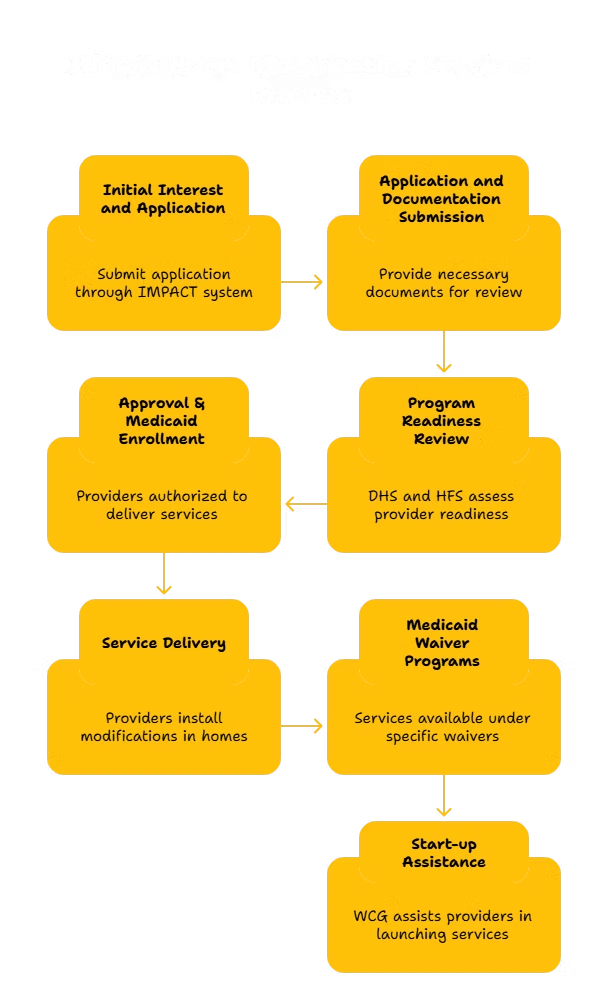
Once the entity is formed, the provider must utilize the Illinois Medicaid Provider Enrollment Portal (IMPACT) to submit a formal application. This process includes proving that the agency holds all necessary contractor licenses required by local jurisdictions. Because this is a medical-waiver-funded service, applicants must also demonstrate high standards of professional practice by providing proof of general liability, professional liability, and workers’ compensation insurance.
The enrollment phase is followed by a program readiness review. During this stage, DHS and HFS assess the provider’s capacity to manage complex construction projects within a clinical context. This includes evaluating the provider’s internal policies for home assessment, construction quality control, and participant protection protocols. Only after this rigorous vetting is a provider authorized to bill for services under the appropriate waiver codes.
What Are the Essential Staffing and Training Standards?
Staffing requirements for home modification providers emphasize a blend of technical construction knowledge and a compassionate, clinical understanding of disability needs. The Project Manager or Home Modification Specialist serves as the primary liaison between the provider agency and the participant, requiring a professional background in architecture, occupational therapy, or accessibility-focused construction.
All personnel, including subcontractors, must adhere to strict safety and compliance standards. Because these services are provided in the homes of vulnerable populations, companies are expected to perform thorough background screenings. Furthermore, every staff member must complete mandatory training modules prior to engaging with participants, covering critical areas such as infection control, emergency response, HIPAA compliance, and the specific mandates of the HCBS Settings Rule.
- Project Manager / Home Modification Specialist with construction or accessibility design experience
- Licensed and insured construction workers or qualified subcontractors
- Participant safety, confidentiality, and HIPAA training
- Infection control and environmental safety protocols
- Emergency response, incident reporting, and ADA accessibility guidelines
What Are the Frequently Asked Questions?
Which Medicaid waivers currently support home modification services?
In Illinois, these services are authorized under the Adults with Developmental Disabilities Waiver, the Children and Young Adults with Developmental Disabilities Waiver, the Persons with Brain Injury (BI) Waiver, the Persons with Disabilities (PD) Waiver, and the Elderly Waiver (Community Care Program).
What documentation is required for the audit-readiness of a project?
Providers must maintain comprehensive documentation, including the participant’s Individualized Service Plan (ISP) or Person-Centered Plan (PCP) authorizing the work, home assessment reports, design plans, evidence of building code compliance, subcontractor management records, and detailed billing logs for every project.
How long should a new agency expect the startup process to take?
From initial business formation and insurance acquisition to final enrollment in the IMPACT system and project launch, the entire process generally takes between 5 and 7 months, depending on the speed of regulatory reviews and the completeness of the provider’s policy documentation.
Waiver Consulting Group’s Start-up Assistance Service
WCG assists contractors, accessibility specialists, and community service agencies in launching Medicaid-compliant Home Modification Services under Illinois’ HCBS waiver programs. Our scope of work includes business registration support, the development of comprehensive Policy & Procedure Manuals, staff credentialing templates, and Medicaid billing setup. We also provide guidance on accessible design standards and assist in building referral networks with case managers and service coordinators to help your agency thrive in the Illinois Medicaid landscape.
Key takeaway: Success as a home modification provider in Illinois rests upon the trifecta of rigorous administrative compliance, professional construction standards, and strict adherence to the participant-centered planning protocols required by the state’s Medicaid waiver programs. Maintaining these standards from day one is the most effective way to ensure long-term program eligibility and service stability.
Last verified: May 2024. This information is intended for professional informational purposes and does not constitute legal or financial advice. Regulations for Medicaid waiver programs are subject to change. Consult with the Illinois Department of Healthcare and Family Services (HFS) or the Illinois Department of Human Services (DHS) for the most current policy requirements.