HOME MODIFICATION SERVICES PROVIDER IN HAWAII
By Fatumata Kaba · 2025-07-16 · 5 min read
ENHANCING SAFETY, ACCESSIBILITY, AND INDEPENDENCE THROUGH CUSTOMIZED HOME ADAPTATIONS
Home Modification Services in Hawaii represent a vital component of the state’s long-term care infrastructure, providing essential structural adaptations that enable individuals with disabilities and aging-related needs to remain in their own homes rather than institutional settings. By delivering specialized construction and installation services, providers facilitate community-based living through improvements that directly enhance participant safety, functional independence, and overall quality of life.
What Are the Governing Agencies for Hawaii Home Modification Providers?
The regulatory framework for Home Modification Services in Hawaii is a collaborative effort between state and federal entities designed to ensure participant safety and fiscal accountability within the Medicaid system. The Department of Human Services (DHS) Med-QUEST Division serves as the primary authority, managing provider enrollment, establishing reimbursement structures, and overseeing the integration of these services into the broader Medicaid ecosystem.
Beyond the Med-QUEST Division, the Department of Health (DOH) Developmental Disabilities Division (DDD) plays a central role for participants with intellectual and developmental disabilities (IDD). These divisions work in tandem with the Centers for Medicare & Medicaid Services (CMS), which provides the federal oversight necessary to ensure that all home modifications adhere to national Home and Community-Based Services (HCBS) quality and accessibility standards.
How Do Providers Define and Execute Qualified Home Modifications?
Home Modification Services are not general home repair or improvement projects; they are clinical and functional necessities dictated by a participant’s documented needs. Approved providers must focus on structural changes that directly address barriers to daily living. These modifications are strictly defined by the requirements outlined in the participant’s Individualized Service Plan (ISP), ensuring that every dollar spent directly contributes to the safety or mobility of the individual.
Providers generally deliver a range of specialized installations and adaptations, including:
- Installation of wheelchair ramps, specialized stair lifts, and widened doorways to improve physical access.
- Bathroom modifications, such as the installation of roll-in showers, high-contrast grab bars, and height-adjusted sinks.
- Kitchen modifications, including lowered countertops and the integration of accessible appliance controls.
- Structural adjustments to flooring or layout to mitigate fall risks, including non-slip surfaces and handrails.
- Installation of environmental control units and emergency alert systems to provide remote or automated assistance.
What Are the Essential Licensing and Provider Approval Requirements?
Launching a Medicaid-compliant home modification agency in Hawaii requires a rigorous adherence to both state business regulations and healthcare-specific enrollment criteria. Before applying to the Med-QUEST Division, an organization must be fully registered with the Hawaii Department of Commerce and Consumer Affairs (DCCA). Additionally, the business must secure an Employer Identification Number (EIN) from the IRS and a Type 2 National Provider Identifier (NPI) for claims processing.
Operational prerequisites also include securing appropriate contractor licensure, which is mandatory for any firm performing structural modifications. Depending on the specific scope of the project, this often includes a C-5 Cabinet, Millwork and Finish Carpentry license, a C-15 Electronic Systems license, or a general contractor license. Furthermore, providers must maintain comprehensive insurance coverage, including commercial general liability, professional liability, and workers’ compensation to protect both the agency and the participant.
How Does the Med-QUEST Provider Enrollment Process Function?
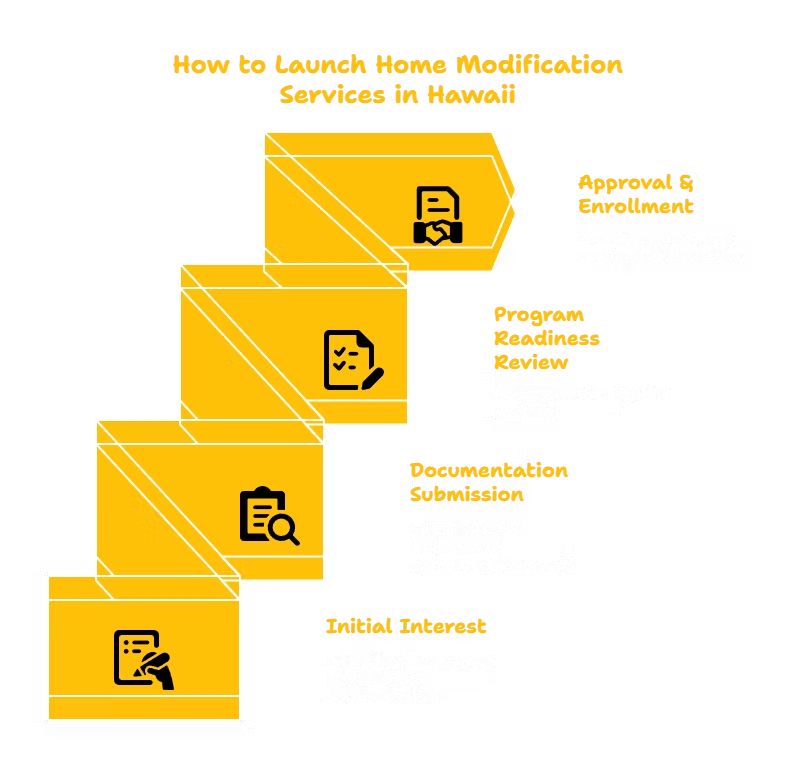
The enrollment process is structured to verify that a provider has the institutional capacity to deliver safe, effective, and compliant services. Applicants must first submit a comprehensive Provider Enrollment Application to the Med-QUEST Division, explicitly identifying Home Modification Services as their area of specialty. This stage requires the submission of all corporate documentation, including proof of licensure and insurance certificates.
Following the initial submission, the program enters a readiness review phase where the DHS and DOH evaluate the provider’s internal operations. This includes an inspection of proposed project plans, participant intake protocols, safety standards, and documentation management practices. Once the state confirms that the applicant meets all HCBS requirements, the provider is approved and must configure their billing systems to accommodate specific codes for assessment, design, construction, and final inspection.
What Are the Staffing and Documentation Requirements for Compliance?
Maintaining compliance requires a robust internal policy framework. Providers are expected to maintain an HCBS-compliant Policy & Procedure Manual that covers participant intake, safety protocols, HIPAA confidentiality, and grievance handling. Staffing requirements are equally stringent; project managers or supervisors should possess verifiable experience as a licensed contractor, while construction technicians must be skilled in ADA-compliant installations.
Every employee must undergo background screening and complete mandatory training modules to maintain eligibility. These modules focus on:
- Safety, risk management, and the nuances of working within a participant's home environment.
- HIPAA confidentiality and an understanding of participant rights under Medicaid rules.
- Emergency response protocols and incident reporting requirements.
- Annual continuing education regarding updated building codes and accessibility standards.
Frequently Asked Questions
Are general home repairs covered under the Medicaid waiver?
No. Medicaid HCBS funds are restricted to modifications that directly facilitate the participant's independence and safety as specified in their Individualized Service Plan. Routine maintenance or general home improvements unrelated to a disability are not covered.
What is the typical timeline to launch a new home modification agency?
The full cycle from initial business formation to Medicaid enrollment typically takes between 135 and 220 days. This includes 2–4 weeks for licensing, 60–90 days for the readiness review, 30–45 days for hiring, and 45–60 days for billing system configuration.
Which programs authorize these services in Hawaii?
Home Modification Services are primarily authorized under the Developmental Disabilities/Intellectual Disabilities (DD/ID) Waiver and the Community Care Services (CCS) Program, provided the modifications are deemed necessary for safe community-based living.
Key Takeaway
Establishing a Home Modification Services agency in Hawaii requires a strategic approach that balances construction expertise with the rigorous documentation and compliance standards of the Med-QUEST and DOH systems. By prioritizing participant-centered policies, maintaining active contractor licenses, and ensuring staff are well-versed in both safety standards and HIPAA, providers can effectively contribute to the essential HCBS infrastructure that allows vulnerable individuals to thrive in their own homes.
Last verified: 2024-05-22. Disclaimer: This guide is for informational purposes only and does not constitute legal or professional advice. Always verify requirements directly with the Hawaii Department of Human Services (DHS) Med-QUEST Division or relevant state authorities, as regulations and procedures are subject to change.