HOME MODIFICATION SERVICES PROVIDER IN DELAWARE
By Fatumata Kaba · 2025-07-07 · 5 min read
CREATING SAFE, ACCESSIBLE LIVING ENVIRONMENTS TO SUPPORT INDEPENDENT LIVING FOR INDIVIDUALS WITH DISABILITIES
Home Modification Services in Delaware are critical interventions that allow individuals with intellectual, developmental, or physical disabilities to remain safely within their homes by facilitating necessary structural or environmental adaptations. These services, authorized under the Delaware Lifespan Waiver and overseen by the Division of Developmental Disabilities Services (DDDS), require providers to ensure all renovations are person-centered, medically necessary, and strictly aligned with the participant’s Individual Service Plan (ISP).
Understanding the Regulatory Framework and Oversight Agencies
The delivery of home modification services in Delaware operates under a multi-tiered regulatory structure designed to protect participants and ensure the effective use of Medicaid funding. Providers must navigate the requirements set forth by state and federal authorities to maintain compliance. The Division of Developmental Disabilities Services (DDDS) serves as the primary entity responsible for authorizing and monitoring these projects, ensuring that every modification is directly tied to the unique needs of the waiver participant.
In addition to DDDS, the Division of Medicaid and Medical Assistance (DMMA) plays a pivotal role in the administration and funding of these Medicaid waiver services. Finally, the Centers for Medicare & Medicaid Services (CMS) provides the overarching federal framework, mandating that all home-based services adhere to rigorous Home and Community-Based Services (HCBS) regulations. Providers must understand these inter-agency relationships to ensure that their documentation and operational practices satisfy state and federal audits.
- DDDS: Authorizes and monitors home modifications; ensures person-centered care and medical necessity.
- DMMA: Administers Medicaid funding for all waiver-approved home modification services.
- CMS: Establishes federal HCBS standards to ensure quality of care and appropriate use of federal funds.
Defining Scope of Practice and Eligible Home Modifications
Home Modification Services involve permanent or semi-permanent changes to a participant’s residence aimed at removing physical barriers and enhancing personal independence. Because these projects are funded through Medicaid, every modification must be substantiated by a medical necessity directly related to the individual’s disability. Before any work commences, the project must be pre-approved by DDDS and explicitly documented within the participant’s Individual Service Plan (ISP).
Approved providers are responsible for the end-to-end management of these projects, which often include assessments, the procurement of materials, construction, and final verification. Common services include the installation of accessibility equipment such as wheelchair ramps, stair lifts, and roll-in showers. Additionally, structural changes like widening doorways, lowering counters, and installing non-slip flooring are frequently authorized when they directly facilitate a participant's ability to live independently.
Navigating Licensing and Provider Enrollment Requirements
Becoming an approved Home Modification Services provider in Delaware requires a proactive approach to business credentialing. Providers must first ensure their business entity is registered with the Delaware Division of Corporations and possess a valid Federal Employer Identification Number (EIN). Furthermore, a Type 2 National Provider Identifier (NPI) is essential for administrative and billing purposes within the Medicaid system.
Operational requirements are equally stringent. Providers must hold a valid Delaware contractor’s license or demonstrate that they have a verifiable process for subcontracting work to licensed professionals. Liability insurance, including both general and product liability, is mandatory to protect both the agency and the participant. Finally, providers must implement a robust, HIPAA-compliant documentation system to manage sensitive client information while maintaining records that adhere to ADA-compliant building standards and waiver-specific material requirements.
- Register business with the Delaware Division of Corporations.
- Obtain IRS EIN and Type 2 NPI.
- Secure a valid Delaware contractor’s license.
- Maintain comprehensive general and product liability insurance.
- Develop a HIPAA-compliant records management system.
The Step-by-Step Provider Enrollment and Referral Process
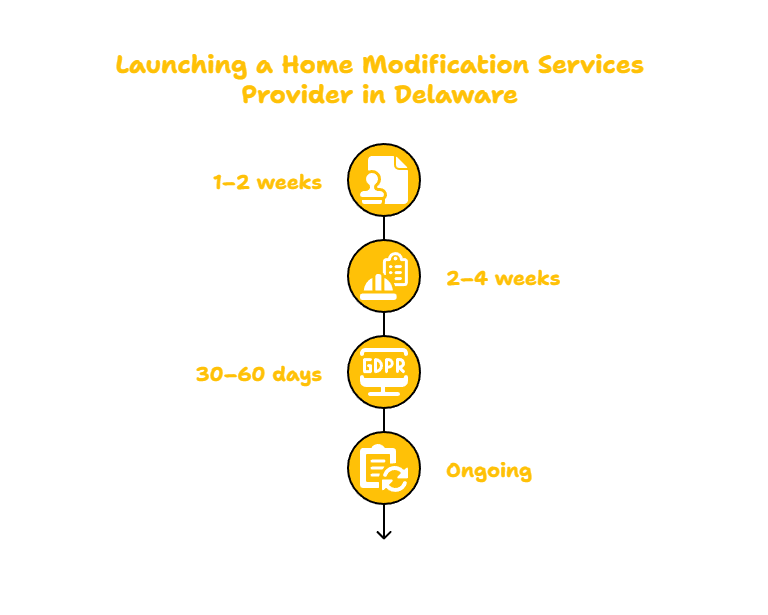
The journey to becoming an active provider begins with the formal application submitted to DDDS for Home Modification Services. This application must include all relevant business certifications, proof of insurance, and detailed project protocols. Once approved by DDDS, the provider must complete the enrollment process with Delaware Medicaid (DMAP) to be eligible for direct billing and reimbursement.
Successful project execution relies heavily on collaboration. Once enrolled, providers will work closely with support coordinators, occupational therapists, and DDDS representatives to evaluate the participant's home. These professionals determine the necessary modifications, which are then integrated into the ISP. Following formal approval, the provider performs the installation, ensures safety inspections are conducted, and submits final documentation to conclude the project for payment processing.
Establishing Essential Documentation and Operational Policies
A successful Home Modification agency must maintain a comprehensive policy and procedure manual. This manual serves as the backbone for audit readiness and operational consistency. It must clearly outline the lifecycle of a project, from the initial intake assessment and pre-approval procedures to the final walkthrough and warranty documentation. Providers must also maintain meticulous records, including before-and-after project photographs, ADA compliance checklists, and verified material logs.
Staffing and subcontractor oversight are also critical components of these policies. Every individual involved in a project must adhere to safety protocols, HIPAA regulations, and professional conduct standards. This includes maintaining up-to-date staff credentials, background check documentation, and clear agreements between the primary provider and any subcontractors utilized on a job site. Incident reporting and safety inspection procedures should be standardized to ensure that the living environment remains safe and fully functional for the participant upon project completion.
Frequently Asked Questions
What is the role of an Accessibility Evaluator?
An Accessibility Evaluator plays a consultative role by identifying specific environmental barriers within a participant's home. They often work alongside therapists to ensure that proposed modifications meet the functional needs of the individual while strictly adhering to the requirements of the Delaware Lifespan Waiver.
Are subcontractors allowed for home modification projects?
Yes, providers may use subcontractors to perform the actual construction. However, the primary provider is responsible for ensuring that all subcontractors are appropriately licensed, insured, and trained on the specific requirements of the Medicaid waiver program and HIPAA confidentiality standards.
What happens if a project requires changes after it has been approved?
If a project scope changes, it is essential to communicate with the participant's support coordinator immediately. Any deviation from the original, approved ISP must be reviewed and authorized by DDDS before additional work is performed to ensure that the modifications remain covered under the waiver.
Key Takeaway
Success as a Delaware Home Modification Services provider hinges on the intersection of technical construction proficiency and strict adherence to Medicaid administrative requirements. By prioritizing a thorough understanding of DDDS regulations, maintaining diligent documentation, and fostering strong professional relationships with case managers and therapists, providers can build a sustainable and impactful service agency that facilitates long-term independence for individuals with disabilities.
Last verified: November 2024. This content is for informational purposes only and does not constitute legal or professional advice. Requirements for Medicaid waiver programs are subject to change by state and federal agencies; providers should consult official DDDS and DMMA guidelines for the most current regulations.