HOME MODIFICATION SERVICES PROVIDER IN CONNECTICUT
By Fatumata Kaba · 2025-07-08 · 5 min read
Home Modification Services in Connecticut encompass specialized physical adaptations designed to enhance safety, accessibility, and functional independence for individuals residing in the community. By participating as an authorized provider under Connecticut Medicaid Home and Community-Based Services (HCBS) waivers—including the Connecticut Home Care Program for Elders (CHCPE), Acquired Brain Injury (ABI) Waivers, and the Personal Care Assistance (PCA) Waiver—businesses can provide essential environmental interventions that directly prevent institutionalization.
To successfully operate in this sector, providers must navigate a regulatory framework overseen by the Connecticut Department of Social Services (DSS) and the Centers for Medicare & Medicaid Services (CMS). This guide outlines the essential steps for establishing a compliant, high-quality home modification agency capable of delivering authorized, cost-effective accessibility solutions to Connecticut’s vulnerable populations.
What Are the Regulatory Requirements for Connecticut Home Modification Providers?
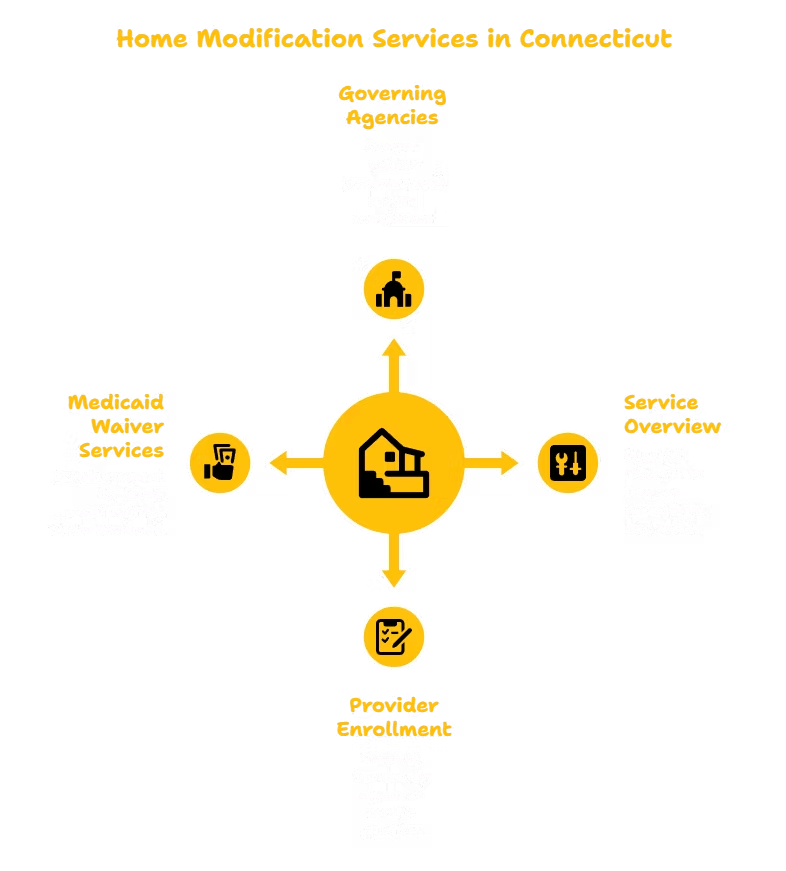
Operating a home modification agency requires strict adherence to state and federal standards to ensure participant safety and fiscal accountability. The Connecticut Department of Social Services (DSS) serves as the primary governing agency, overseeing waiver program standards and authorizing funding for modifications that are deemed medically necessary within an individual’s care plan. Providers must ensure that all projects align with federal HCBS guidelines, which prioritize community integration and accessibility.
Beyond DSS, businesses must comply with the regulations set forth by the Connecticut Department of Consumer Protection (DCP). Because home modifications involve structural changes, providers must maintain valid Home Improvement Contractor registrations. Compliance necessitates maintaining adequate insurance coverage, including general liability and workers' compensation, to protect both the business and the participant during the installation process.
- Maintenance of a valid Home Improvement Contractor registration through the DCP.
- Enrollment as an active provider in the Connecticut Medicaid Provider Enrollment Portal.
- Adherence to ADA-compliant design standards for all structural modifications.
- Utilization of licensed subcontractors where specific trade certifications are required by state law.
How Do You Scope and Deliver Medicaid-Funded Home Modifications?
Home modifications are defined by their ability to support an individual's specific medical or functional needs. Unlike general contracting, these services must be explicitly tied to a goal within the participant's care plan, such as improving bathroom accessibility to prevent falls or installing ramps to facilitate egress. Each project requires a rigorous process of pre-installation assessment, careful documentation, and final verification to ensure the modification meets the participant's needs.
Providers are responsible for delivering a wide range of services, including the installation of grab bars, stair lifts, and roll-in showers. In the kitchen, modifications may involve lowering counters or installing pull-out shelving to accommodate mobility devices. Furthermore, technological integrations—such as visual and auditory alert systems—are often essential for participants with sensory impairments. Consistent communication with care managers is vital to ensuring that every project remains within the authorized scope and budget.
What is the Process for Enrolling as a Medicaid Provider in Connecticut?
The enrollment process is a multi-stage undertaking that requires precise administrative attention. Initially, a business must establish its legal foundation by registering with the Connecticut Secretary of the State and obtaining both an EIN from the IRS and a Type 2 NPI. Once the business is legally formed and registered as a Home Improvement Contractor with the DCP, the entity may apply for Medicaid provider enrollment through the Connecticut Medicaid Provider Enrollment Portal.
During the enrollment process, agencies must clearly define the waiver programs they intend to serve, such as CHCPE or the ABI waivers. Applicants will be required to submit all relevant business documentation, including proof of contractor registration and detailed descriptions of the specific services offered. Following approval, the provider must remain in close coordination with state-assigned care managers, who act as the primary conduit for referrals and service authorizations.
What Documentation and Policies Are Necessary for Operational Compliance?
Administrative rigor is a cornerstone of a compliant home modification agency. Providers must maintain a comprehensive policy and procedure manual that covers the entire lifecycle of a project, from initial intake to final inspection. This manual should include detailed protocols for performing home assessments, generating accurate estimates, and documenting the completion of work to justify billing for Medicaid reimbursement.
Documentation requirements are extensive and serve as the audit trail for state oversight. Agencies should maintain standardized templates for all project phases, including client consent forms, warranty policies, and accessibility checklists. Incident reporting and contractor oversight protocols are also mandatory, as they ensure that the agency can effectively manage risks in the home environment and address any issues that arise during or after construction.
- Articles of Incorporation and business registration documents.
- Detailed internal policy manual covering intake, assessment, and safety procedures.
- Signed service authorizations and project bid documentation.
- Post-installation verification logs and quality assurance checklists.
How Should Agencies Manage Staffing and Training for Accessibility Projects?
Successful home modification agencies rely on a combination of project management expertise and technical construction proficiency. A dedicated Project Manager or Home Modification Coordinator is essential to bridge the gap between clinical needs—often identified by occupational therapists—and the physical installation of home adaptations. This role requires a strong understanding of accessibility planning and the ability to interpret care plan requirements into actionable construction tasks.
All staff and installers must be trained in the unique requirements of working with vulnerable populations. This includes maintaining strict confidentiality, demonstrating respect for the participant's home environment, and adhering to safety protocols during the installation process. Regular training sessions on Medicaid billing compliance and ADA standards help ensure that all staff members contribute to the overall quality and reliability of the service provided.
Frequently Asked Questions
Which Medicaid waiver programs cover home modifications in Connecticut?
Home modifications are covered under the Connecticut Home Care Program for Elders (CHCPE), the Acquired Brain Injury (ABI) Waivers I & II, the Personal Care Assistance (PCA) Waiver, and the Medically Complex Children’s Waiver.
How long does the provider enrollment process typically take?
Business formation generally takes 1–2 weeks, while DCP contractor registration takes 2–4 weeks. The DSS Medicaid enrollment process typically requires 30–60 days, though these timelines can vary based on application completeness and agency volume.
What role does the Department of Consumer Protection play?
The DCP is responsible for regulating home improvement contractors in the state. Providers must be registered with the DCP to legally perform the structural modifications required under Medicaid waiver programs.
Key Takeaway
Launching a Medicaid-compliant home modification service in Connecticut requires a methodical approach that balances state-mandated contractor licensing with the specific clinical and documentation requirements of the Department of Social Services. By prioritizing accurate assessment, rigorous documentation, and clear communication with care teams, agencies can establish a sustainable model that significantly improves the quality of life for participants while meeting all regulatory obligations.
Last verified: October 2023. The information provided in this article is for educational purposes only and does not constitute legal or professional advice. Requirements for Medicaid provider enrollment and home improvement contracting in Connecticut may be subject to change. Prospective providers should consult directly with the Connecticut Department of Social Services (DSS) and the Department of Consumer Protection (DCP) to ensure compliance with current state and federal regulations.