HOME MODIFICATION SERVICES PROVIDER IN CALIFORNIA
By Fatumata Kaba · 2025-07-07 · 5 min read
Creating Safer, More Accessible Homes to Support Independent Living for Individuals with Disabilities
Home Modification Services in California provide the essential physical adaptations required to ensure individuals with developmental disabilities or physical limitations can live safely and independently in their own homes. These services are authorized through the California Department of Developmental Services (DDS) via Regional Centers, the Self-Determination Program (SDP), and specific Home and Community-Based Services (HCBS) Waivers, requiring strict alignment with an individual’s Individual Program Plan (IPP) or Person-Centered Plan (PCP).
How Are Home Modification Services Governed and Regulated in California?
The delivery of home modification services in California operates under a multi-tiered regulatory framework designed to ensure client safety and fiscal responsibility. The California Department of Developmental Services (DDS) maintains primary oversight, coordinating through 21 nonprofit Regional Centers located across the state. These Regional Centers serve as the local gatekeepers, responsible for authorizing modifications within an individual's IPP, approving qualified vendors, and conducting ongoing monitoring for safety and compliance.
Beyond the Regional Center system, the California Department of Health Care Services (DHCS) manages various Medi-Cal programs, including Early and Periodic Screening, Diagnostic, and Treatment (EPSDT) and specific HCBS waivers that may fund home accessibility improvements. All service delivery must adhere to federal guidelines established by the Centers for Medicare & Medicaid Services (CMS), which mandate that modifications remain necessary, cost-effective, and directly related to the functional needs of the individual as outlined in their person-centered plan.
What Specific Modifications Qualify as Home Modification Services?
Home modification services encompass a broad spectrum of physical environmental adaptations intended to enhance accessibility and daily function. To be eligible for funding, every modification must be documented as a direct necessity for the individual’s disability-related needs, rather than a general home improvement or aesthetic upgrade. Service providers must ensure that the work performed maximizes the individual’s ability to remain in their own home and community.
Approved providers typically deliver a wide range of accessibility solutions, including:
- Construction of wheelchair ramps and widening of interior or exterior doorways.
- Accessible bathroom conversions, such as the installation of grab bars, roll-in showers, and lowered sinks.
- Installation of stair lifts, platform lifts, and other mobility-assistive devices.
- Kitchen adaptations, including adjusted countertop heights and the installation of accessible appliances.
- General safety improvements, such as the addition of handrails, high-visibility non-slip flooring, and specialized lighting.
- Comprehensive project management, including coordination with local permit offices, professional contractors, and the documentation of expenses, project photos, and final installation reports.
What Are the Prerequisites for Provider Licensing and Vendorization?
To operate as a formal provider of home modification services, an organization must navigate both state-level business licensing and Regional Center-specific vendorization requirements. At a baseline, the business must be registered with the California Secretary of State, hold a valid IRS Employer Identification Number (EIN), and maintain a National Provider Identifier (NPI) Type 2 for billing and organizational identification purposes.
Professional licensing is a non-negotiable requirement in the construction and accessibility sector. Providers must hold a valid California Contractor License, typically a Class B – General Building license, or the relevant specialty trade license applicable to the scope of work. Furthermore, companies must maintain active general liability insurance and appropriate bonding to protect both the agency and the client. All staff members and subcontractors who perform work inside a client's home are subject to rigorous background check requirements to ensure the health and safety of the population served.
How Do Agencies Complete the Regional Center Vendorization Process?
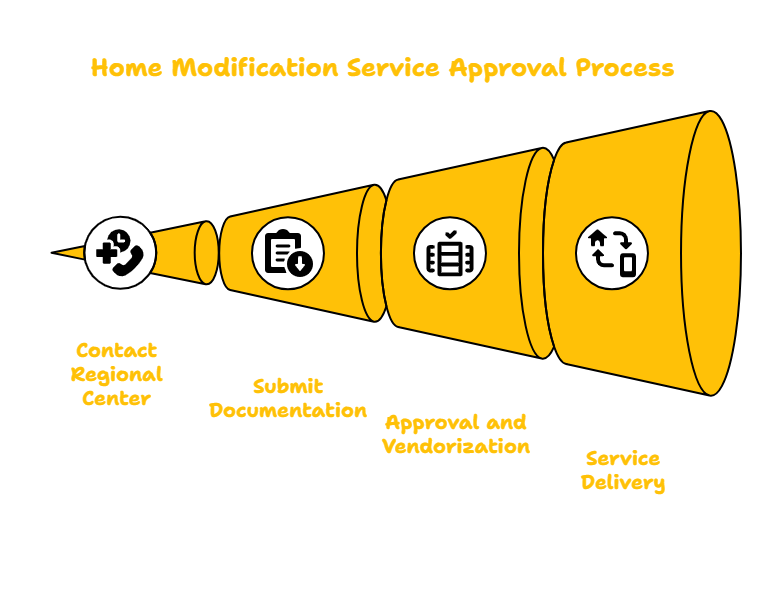
The process of becoming a vendor with a California Regional Center is a structured, multi-step undertaking that requires significant documentation. First, an agency must contact the specific Regional Center in its service area to request an application for Home Modification Services (typically categorized under Service Code 56). This process establishes the provider as an approved entity authorized to receive referrals from service coordinators.
The application requires the submission of a comprehensive portfolio, which includes the following elements:
- Business licenses, active contractor license documentation, and proof of insurance and bonding.
- A detailed project workflow model that outlines the end-to-end process from initial assessment to project completion.
- Sample cost estimation templates and standardized invoicing documents to ensure fiscal transparency.
- Comprehensive quality control and safety protocols, clearly defined staff roles, and established client consent procedures.
- A demonstrated ability to align all projects with the individual’s IPP and safety regulations.
What Documentation and Staffing Standards Must Be Maintained?
Compliance in the home modification sector relies on meticulous documentation. Every project file must contain the initial request, photos of the site prior to construction, a signed cost proposal, progress documentation, and post-modification verification photos. Policies must be in place covering client intake, emergency incident response, quality assurance, and subcontractor management. These records must be readily available for audit by the Regional Center to ensure ongoing compliance with state and federal expectations.
Staffing requirements emphasize both technical construction expertise and the ability to work effectively with individuals with developmental disabilities. Project Managers must demonstrate knowledge of ADA standards and residential accessibility, while installation teams must possess the requisite trade skills and be vetted through appropriate background clearances. All staff, including subcontractors, must complete training in universal design principles, client confidentiality, and professional interaction best practices, with documentation of this training maintained in their personnel files.
Frequently Asked Questions
Can home modification providers perform services for Self-Determination Program participants?
Yes, providers may deliver home modification services to individuals in the Self-Determination Program. In these cases, the provider typically works with the individual’s chosen Financial Management Service (FMS) for billing and payment processes, while still ensuring that the modifications meet all safety and documentation standards.
What is the typical timeline for launching a home modification service?
The timeline varies based on current administrative processing times. Generally, business formation takes 1–2 weeks, while obtaining contractor licensing and completing Regional Center vendorization can take between 45 and 90 days. Ongoing staff hiring and the establishment of internal compliance systems typically require an additional 2–4 weeks.
Are there ongoing requirements for maintaining vendor status?
Yes, providers are expected to undergo annual compliance reviews with the Regional Center. This involves keeping all insurance and contractor licenses active, maintaining accurate logs of staff background clearances, ensuring all work meets ADA or local building code requirements, and adhering to the warranty and follow-up maintenance policies established during the initial vendorization.
Key Takeaway: Successful participation in California’s Home Modification Services program requires a dual focus on rigorous construction compliance and administrative precision. By aligning business operations with the specific requirements of the Department of Developmental Services and the individual needs outlined in the IPP, providers can play a critical role in promoting independence for Californians with disabilities.
Last verified: May 2024. This information is provided for educational purposes and does not constitute legal or professional advice. Always consult with your local Regional Center or the Department of Developmental Services for the most current program guidelines and application requirements.