HOME MODIFICATION PROVIDER IN UTAH
By Fatumata Kaba · 2026-03-31 · 5 min read
CREATING SAFER, MORE ACCESSIBLE HOMES FOR INDIVIDUALS WITH DISABILITIES TO LIVE WITH DIGNITY AND INDEPENDENCE
Home Modification Services in Utah provide essential structural adaptations that enable individuals with disabilities or chronic health conditions to maintain independence and safely reside within their own homes. By reducing physical barriers and addressing accessibility needs, these services directly support the goal of preventing premature institutionalization and promoting community integration for Medicaid waiver participants.
To operate as a Home Modification provider in Utah, businesses must navigate a regulatory framework overseen by the Utah Department of Health and Human Services (DHHS), specifically the Division of Services for People with Disabilities (DSPD) and the Division of Integrated Healthcare (DIH). Successful enrollment requires a combination of appropriate contractor licensing through the Division of Occupational and Professional Licensing (DOPL), formal Medicaid provider enrollment, and adherence to strict clinical and safety documentation standards.
How Do Governing Agencies Oversee Home Modification Services?
The provision of home modifications is subject to rigorous oversight to ensure the health, safety, and welfare of Medicaid waiver participants. The primary regulatory authority is the Utah Department of Health and Human Services (DHHS). Within this department, the Division of Services for People with Disabilities (DSPD) acts as the gatekeeper for waiver services, responsible for approving provider applications, authorizing specific funding for modifications, and ensuring all work aligns with the participant's Individual Support Plan (ISP).
Simultaneously, the Utah Division of Integrated Healthcare (DIH) manages the administrative and fiscal components of the Medicaid program. This includes the provider enrollment process, reimbursement workflows, and regulatory compliance monitoring. Because home modifications often involve structural changes to a residence, contractors must also maintain compliance with the Utah Department of Commerce, Division of Occupational and Professional Licensing (DOPL), which governs building codes and professional trade licensing requirements.
What Scope of Services and Modifications Are Covered?
Home Modification services are strictly limited to adaptations that directly improve the accessibility, health, and safety of a primary residence. These services must be medically necessary and clearly linked to the specific disability-related needs of the waiver participant as outlined in their ISP. Coverage is reserved for functional improvements; therefore, cosmetic renovations, general home maintenance, or tasks that increase the property's market value are not eligible for reimbursement.
Providers generally focus on the following approved modification categories:
- Wheelchair ramps and widened doorways to allow for interior and exterior access.
- Accessible bathrooms, including the installation of roll-in showers, grab bars, and raised toilets.
- Kitchen modifications such as lowering countertops and installing accessible cabinetry.
- Installation of ceiling lifts, stair glides, and heavy-duty handrails.
- Non-slip flooring installations to prevent falls.
- Environmental control units designed to enhance the participant's independence.
What Are the Prerequisites for Provider Enrollment?
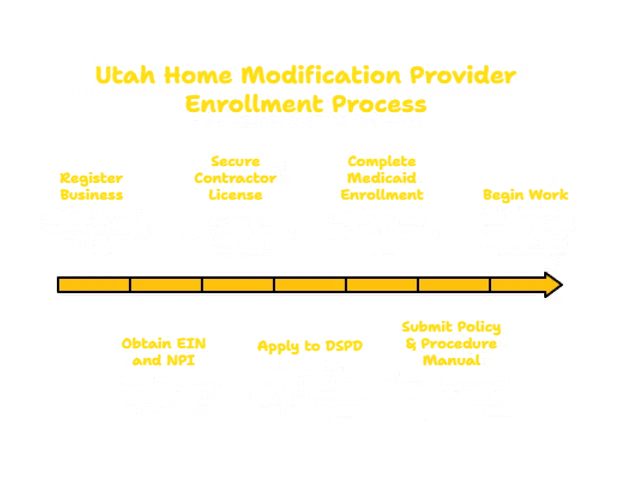
Becoming an approved Home Modification provider involves a structured sequence of business and professional registrations. Before a business can receive Medicaid funding, it must establish legal standing by registering with the Utah Division of Corporations and obtaining a federal Employer Identification Number (EIN). Furthermore, the entity must secure a Type 2 NPI (National Provider Identifier) specifically for organizational billing purposes.
For the physical execution of work, the business must ensure that all structural modifications are performed by individuals holding a valid Utah General Contractor License (specifically B100 or R100). Once the business entity and professional licenses are in order, the provider must complete the enrollment process through the Utah Medicaid Provider Enrollment Portal. This process includes proving that the agency carries adequate general liability and workers’ compensation insurance to protect both the staff and the participants during the construction phase.
How Is the Policy and Procedure Manual Structured?
A comprehensive Policy & Procedure Manual is a mandatory component for agency approval. This document serves as the operational roadmap for the provider, ensuring that every project meets state standards for documentation and safety. Agencies must define how they handle the intake of modification requests, the initial environmental assessment, and the subsequent approval process from the DSPD.
The manual should contain detailed protocols regarding:
- Standardized scope-of-work templates and project-specific inspection checklists.
- Strict adherence to safety and liability protocols, including job site safety during construction.
- Financial documentation processes, such as the generation of cost estimates, billing, and receipt tracking.
- Protection of participant rights, including grievance procedures and HIPAA-compliant data management.
- Recordkeeping requirements, including the mandatory maintenance of before-and-after photos of the modified spaces.
What Are the Staffing and Training Requirements?
Staffing for home modification services requires a blend of construction expertise and a clear understanding of the needs of individuals with disabilities. At a minimum, the personnel performing the work must hold the appropriate contractor licensure for structural modifications. It is highly recommended that staff also possess specific knowledge regarding ADA (Americans with Disabilities Act) accessibility standards and DSPD-specific compliance mandates.
All staff members, including those in project coordination roles who act as the primary point of contact for case managers, must undergo mandatory training. This includes receiving instruction on client rights, HIPAA regulations, and the specific service orientations required by the DSPD. Ongoing training in documentation and billing protocols is necessary to ensure the agency remains in compliance with the fiscal requirements of the Utah Medicaid program.
Which Medicaid Waiver Programs Include Home Modifications?
Home modification coverage is integrated into several specific Utah HCBS Waivers. Each waiver program serves a unique population, and funding is contingent upon the modification being cost-effective and specifically authorized within the participant's ISP. The following waivers currently support these services:
- Community Supports Waiver (CSW) for individuals with intellectual or developmental disabilities.
- Acquired Brain Injury (ABI) Waiver.
- Physical Disabilities Waiver (PDW).
- Medically Complex Children’s Waiver (MCCW).
- New Choices Waiver (NCW), which assists individuals in transitioning from institutional settings to home-based environments.
Frequently Asked Questions
Can I perform cosmetic renovations if the client is willing to pay the difference?
No. Medicaid HCBS waivers strictly prohibit the use of program funds for cosmetic or non-disability-related renovations. All modifications must be directly tied to a demonstrated medical or accessibility need as documented in the ISP.
What is the typical timeline to launch a home modification service in Utah?
The timeline varies based on business readiness but generally takes 1–3 months to complete the DSPD and Medicaid enrollment process, after an initial 2–4 week phase for business formation and licensing.
Are before-and-after photos required for billing?
Yes. Providing visual evidence of the modification is a standard expectation in documentation to verify that the service was completed according to the authorized scope of work and adheres to safety and accessibility standards.
Key Takeaway: Successful participation as a Utah Home Modification provider requires a meticulous balance of high-level construction licensing, strict adherence to DSPD clinical standards, and robust administrative recordkeeping to ensure Medicaid compliance and participant safety.
Last verified: October 2023. This information is for educational purposes only and does not constitute legal or professional advice. Always check with the Utah Department of Health and Human Services (DHHS) and the Division of Services for People with Disabilities (DSPD) for the most current regulatory requirements.