HOME MODIFICATION & ACCESSIBILITY ADAPTATION SERVICES PROVIDER IN KANSAS
By Fatumata Kaba · 2025-07-24 · 5 min read
MAKING HOMES SAFER AND MORE ACCESSIBLE TO SUPPORT INDEPENDENT LIVING AND COMMUNITY PARTICIPATION
Home Modification and Accessibility Adaptation Services in Kansas are essential interventions that allow individuals with disabilities or functional limitations to remain in their homes, reducing the need for institutional care. These services, which involve structural and physical alterations to a primary residence, are authorized under the Kansas Medicaid (KanCare) program as critical components of Home and Community-Based Services (HCBS) waivers.
By removing environmental barriers, these services foster independence, improve safety, and facilitate greater community inclusion. Successfully providing these services requires a deep understanding of the regulatory environment, from initial Medicaid provider enrollment through project completion and final audit-ready documentation.
Who are the Governing Agencies and Regulatory Stakeholders?
The delivery of home modification services in Kansas is governed by a multi-tiered regulatory framework. At the state level, the Kansas Department for Aging and Disability Services (KDADS) acts as the primary authority, overseeing HCBS waiver program administration and establishing the specific policies that dictate how accessibility adaptations must be performed and billed.
Operations are further managed by the Kansas Department of Health and Environment (KDHE) through the Division of Health Care Finance, which handles the essential tasks of Medicaid provider enrollment, billing approvals, and the processing of reimbursements. Additionally, Managed Care Organizations (MCOs) under the KanCare program play a direct role in the day-to-day coordination of these services. MCOs are responsible for reviewing contractor bids, approving Individualized Service Plans (ISPs), and ensuring that all modifications align with federal and state safety standards set forth by the Centers for Medicare & Medicaid Services (CMS).
What Scope of Work is Included in Accessibility Adaptation Services?
Home modifications are classified as medically necessary services designed to assist participants in maintaining the least restrictive living environment. These modifications are not merely aesthetic; they are structural changes intended to mitigate risks, improve mobility, and enable the participant to perform essential daily tasks without dependency on others.
Approved providers are typically authorized to deliver the following services, provided they are included in the participant's ISP and receive prior authorization from the MCO:
- Installation of wheelchair ramps, grab bars, handrails, and stair lifts.
- Bathroom modifications including roll-in showers, raised toilet seats, and widened doorways.
- Kitchen modifications such as accessible cabinetry, lever handles, and lowered counters.
- Door widening and threshold elimination to improve indoor accessibility.
- Ceiling or wall-mounted lift systems and adaptive lighting or environmental controls.
- General structural changes directly related to the participant’s mobility and safety needs.
How Do You Navigate the Provider Enrollment Process?
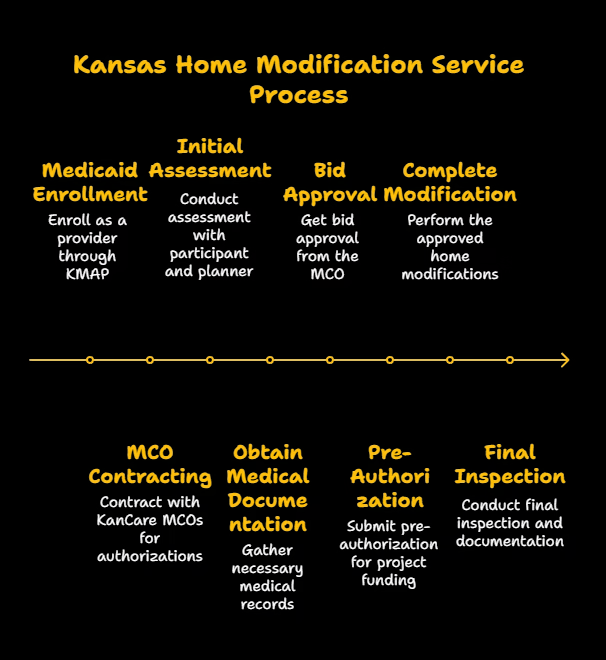
Becoming an approved Kansas HCBS provider is a multi-step process that demands rigorous attention to detail regarding business compliance and credentialing. Before beginning work, a provider must register their business with the Kansas Secretary of State and secure a federal Employer Identification Number (EIN) and a Type 2 National Provider Identifier (NPI). These are the foundational credentials required for any entity seeking to bill Medicaid.
Once registered, the provider must enroll through the Kansas Medical Assistance Program (KMAP) specifically as a Home Modification or Environmental Accessibility Adaptation provider. Following KMAP enrollment, the provider must enter into contracts with the three KanCare MCOs: Sunflower Health Plan, UnitedHealthcare Community Plan, and Aetna Better Health of Kansas. Contracting with these MCOs is vital, as they are the entities that provide service authorizations and facilitate project payments.
What Are the Essential Documentation and Staffing Requirements?
Operational success as an HCBS provider depends on maintaining a comprehensive Policy & Procedure Manual. This manual serves as the backbone of the organization, detailing how the agency manages project planning, competitive bidding, HIPAA compliance, and Medicaid-ready recordkeeping. All modifications must be supported by thorough documentation, including pre-authorization forms, itemized bids, and evidence of final inspection.
Staffing requirements are equally stringent to ensure participant safety and quality of work. Agencies must employ or contract with qualified project managers and construction technicians who possess relevant experience in ADA-accessible remodeling. All staff and contractors must clear thorough background checks and complete specialized training, including:
- HIPAA and data confidentiality protocols.
- Specific training on ADA accessibility standards and home safety.
- Emergency preparedness and protocols for the prevention of abuse and neglect.
- Annual internal reviews to ensure ongoing regulatory compliance.
Which HCBS Waiver Programs Cover These Services?
Home Modification and Accessibility Adaptation Services are available under several specific Kansas HCBS waiver programs. Each program serves a unique demographic, but all share the common goal of facilitating home-based care. These include the Intellectual/Developmental Disability (IDD) Waiver, the Physical Disability (PD) Waiver, the Technology Assisted (TA) Waiver, the Brain Injury (BI) Waiver, and the Frail Elderly (FE) Waiver. The Autism Waiver may also cover these services if the modifications are determined to be medically necessary for sensory or behavioral safety.
Providers should understand that regardless of the specific waiver, all services must be directly linked to the participant's functional needs. The process involves an assessment, a request for funding, approval from the MCO, and rigorous documentation of the completed construction to ensure compliance with Medicaid audit requirements.
Frequently Asked Questions
Are all home improvements covered under the HCBS waivers?
No. Only modifications that are deemed medically necessary for safety, health, and accessibility are covered. General home repairs, upgrades that do not relate to a disability, or aesthetic improvements are generally not reimbursable under HCBS waiver programs.
How long does the provider enrollment process typically take?
The timeline varies, but generally, businesses should anticipate 1–2 months for registration, 1–2 months for staff credentialing, and an additional 60–90 days for full Medicaid and MCO enrollment. The entire launch process often takes between 6 to 9 months.
What role does an Occupational Therapist play in the modification process?
An Occupational or Physical Therapist is often involved in the initial evaluation phase to provide professional recommendations. Their assessment ensures that the proposed modifications are evidence-based and specifically address the participant's unique physical barriers.
Key Takeaway
Launching a Home Modification and Accessibility Adaptation agency in Kansas requires a strategic approach to regulatory compliance, MCO credentialing, and meticulous documentation. Providers must prioritize the development of robust internal policies to ensure that every modification meets both ADA guidelines and the strict requirements of the Kansas HCBS waiver programs, ultimately ensuring the safety and independence of the individuals served.
Last verified: 2024. Waiver Consulting Group provides support for providers seeking to navigate the complex requirements of the Kansas Medicaid HCBS waiver system. For more information, please consult the resources provided by the Kansas Department for Aging and Disability Services (KDADS) or the Kansas Medical Assistance Program (KMAP).