HOME HEALTH SERVICES PROVIDER IN WYOMING
By Fatumata Kaba · 2026-04-14 · 5 min read
Home health services in Wyoming represent a critical component of the healthcare continuum, providing medically necessary, short-term clinical care to individuals recovering from illness, surgery, or managing chronic conditions within their own residences. By delivering professional nursing, therapy, and aide services directly in the home, these agencies play an essential role in preventing unnecessary hospitalizations and long-term institutionalization for Wyoming’s Medicaid population.
Operating a home health agency in Wyoming requires rigorous adherence to state licensing, federal clinical standards, and Medicaid billing requirements. Providers must navigate a complex regulatory landscape overseen by the Wyoming Department of Health, the Centers for Medicare & Medicaid Services (CMS), and state survey authorities to ensure that every participant receives high-quality, compliant care documented through a physician-ordered Plan of Care.
What Are the Primary Regulatory Bodies Overseeing Wyoming Home Health?
The regulatory framework for home health in Wyoming is a multi-tiered system designed to ensure patient safety and fiscal accountability. At the state level, the Wyoming Department of Health’s Division of Healthcare Financing serves as the primary authority, establishing policy and monitoring the compliance of providers who bill through the Medicaid program. Their oversight ensures that services remain within the scope of the State Plan and established waivers.
Compliance is further managed by the Wyoming State Survey Agency, which handles the licensing of agencies and conducts necessary surveys to verify that operational standards are met. Concurrently, Medicaid Provider Services serves as the operational hub for enrollment, billing processes, and prior authorization requirements. On the federal level, the Centers for Medicare & Medicaid Services (CMS) sets the overarching clinical documentation and service delivery benchmarks that providers must meet to participate in federally funded programs.
How Do You Successfully Navigate the Provider Enrollment Process?
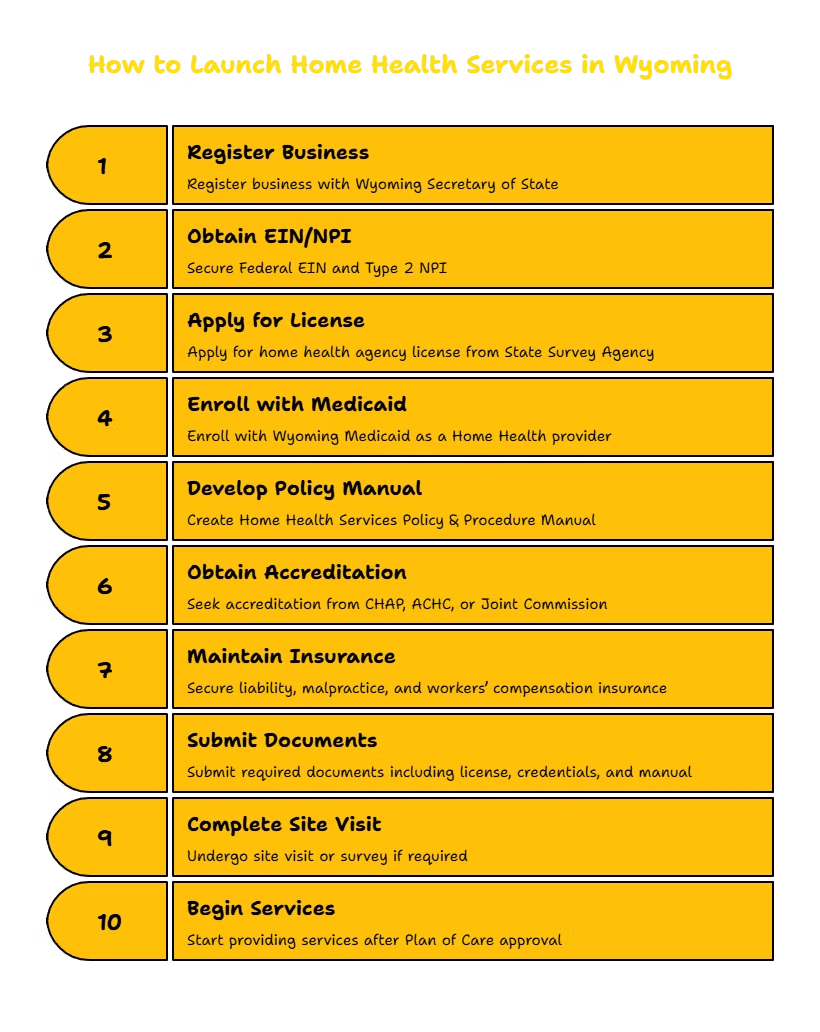
Launching a home health agency is a sequential, multi-phase process that begins with formal business entity formation. An aspiring provider must first register the business with the Wyoming Secretary of State and secure a Federal Employer Identification Number (EIN) and a Type 2 National Provider Identifier (NPI). These foundational steps are necessary before any healthcare-specific applications can be submitted to state or federal authorities.
Once the business is legally established, the provider must obtain a formal Home Health Agency license from the state survey authority. Following licensure, the provider must enroll with Wyoming Medicaid under the designated Home Health provider category. This process involves submitting comprehensive organizational documentation, including staff credentials, internal policy manuals, and, if the agency is pursuing Medicare certification, proof of accreditation from an organization such as CHAP, ACHC, or the Joint Commission.
What Clinical Services and Documentation Are Mandatory for Medicaid Compliance?
Home health services focus on clinical interventions that must be deemed medically necessary by a physician. Covered services generally include skilled nursing for tasks like wound care or medication administration, physical, occupational, and speech therapies, medical social work, and home health aide support for basic care needs. Each of these services must be explicitly tied to a Plan of Care (POC) that is reviewed and updated at least every 60 days to reflect the participant’s current health status.
Documentation is the backbone of Medicaid reimbursement and audit defense. Providers must maintain a comprehensive Policy & Procedure Manual that covers clinical standards, infection control, medication administration protocols, HIPAA compliance, and emergency procedures. Every visit must be documented with precision, including nursing notes, therapy logs, and supervisory reports. Agencies must be prepared to demonstrate that all care provided aligns with the physician's orders and serves the ultimate goal of improving or stabilizing the patient's condition.
How Are Staffing Requirements and Competency Standards Structured?
The quality of care in a home health setting is inherently tied to the expertise of the clinical staff. Registered Nurses (RNs) are central to the agency's operations, as they are responsible for performing initial assessments, designing the POC, and providing ongoing clinical oversight. All RNs must be licensed by the Wyoming Board of Nursing and must complete specific agency-required training on documentation, HIPAA, and emergency response.
Therapists—including physical, occupational, and speech therapists—must maintain active Wyoming licenses and work strictly within the scope of the physician's orders. Home health aides, who often provide the bulk of day-to-day functional support, must be supervised by an RN or a licensed therapist. All personnel, regardless of their role, are required to undergo consistent competency assessments and training in universal precautions and infection control to ensure the safety of both the staff and the program participants.
Which Medicaid Programs Support Home Health Delivery?
Wyoming Medicaid offers several avenues for covering home health services, primarily through the Medicaid State Plan. This covers the essential nursing, therapy, and aide services required for acute or chronic health management. For participants with more complex, long-term needs, the Community Choices Waiver (CCW) may provide additional home health aide support, provided the participant meets specific functional eligibility requirements.
Pediatric care is also a major focus, facilitated through programs like Early and Periodic Screening, Diagnostic, and Treatment (EPSDT) and the Katie Beckett Program. These programs provide vital home health support for children with disabilities or complex medical needs. It is important for administrators to note that duplicate services—such as simultaneous billing for personal care and home health aide services for the same tasks—are typically prohibited, and all services require prior authorization and strict adherence to the POC.
Frequently Asked Questions
How often must the Plan of Care be updated?
The Plan of Care must be reviewed and updated at least every 60 days to remain valid and ensure continued coverage for medically necessary services under Wyoming Medicaid.
Is accreditation required for a home health agency?
While state licensing is mandatory, accreditation by bodies such as CHAP, ACHC, or the Joint Commission is generally required if the agency intends to pursue Medicare certification.
Can home health aides work independently?
No, home health aides must work under the supervision of a Registered Nurse or a licensed therapist and operate according to the specific instructions outlined in the participant's Plan of Care.
WAIVER CONSULTING GROUP’S START-UP ASSISTANCE SERVICE — WYOMING HOME HEALTH PROVIDER
WCG supports home health agencies and entrepreneurs with launching fully compliant, patient-focused care services in Wyoming through comprehensive start-up consulting and documentation solutions. Our scope of work includes state licensing and Medicaid enrollment support, Home Health Policy & Procedure Manual development, creation of POC and nursing documentation templates, and staff onboarding and supervision frameworks. We also assist with establishing HIPAA, infection control, and safety protocols, as well as providing guidance on reimbursement and audit readiness.
Key Takeaway: Establishing a successful home health agency in Wyoming requires a disciplined approach to clinical documentation, strict adherence to state licensing and Medicaid enrollment protocols, and a commitment to maintaining professional staffing standards that prioritize patient outcomes and regulatory compliance.
Last verified: August 2024. This content is for informational purposes only and does not constitute legal or professional medical advice. Always consult with the Wyoming Department of Health or qualified legal counsel regarding specific regulatory requirements and compliance obligations.