HOME HEALTH SERVICES PROVIDER IN WISCONSIN
By Fatumata Kaba · 2026-04-10 · 7 min read
Home Health Services in Wisconsin encompass a vital continuum of skilled, intermittent medical care delivered directly to individuals in their homes to support recovery, chronic disease management, and independent living. As a critical component of the state’s healthcare infrastructure, these services allow patients to avoid institutional placement by receiving professional nursing and therapeutic interventions within a familiar environment, all governed by physician-directed Plans of Care and strict Medicaid regulatory standards.
Operating as a Home Health provider in Wisconsin requires navigating a complex landscape involving the Department of Health Services (DHS), ForwardHealth, and the Department of Safety and Professional Services (DSPS). Whether participating through the Medicaid State Plan or specialized Home and Community-Based Services (HCBS) Waivers like IRIS, Family Care, or the Children’s Long-Term Support (CLTS) program, agencies must maintain rigorous clinical documentation, staffing compliance, and operational standards to ensure both patient safety and regulatory eligibility.
What Are the Governing Agencies and Regulatory Frameworks?
The regulatory environment for Wisconsin home health providers is multi-layered, designed to protect participant health while ensuring the integrity of state and federal funding. At the state level, the Wisconsin Department of Health Services (DHS) serves as the primary authority, establishing the fundamental regulations that home health agencies must follow to operate legally. Concurrently, ForwardHealth acts as the administrative arm for the Medicaid program, overseeing provider enrollment, the submission of prior authorizations, and the complex reimbursement processes required for clinical services.
In addition to state oversight, clinical professional standards are mandated by the Wisconsin Department of Safety and Professional Services (DSPS), which governs the licensure of Registered Nurses (RNs), Licensed Practical Nurses (LPNs), and specialized therapists. Furthermore, for agencies choosing to pursue Medicare certification, the federal Centers for Medicare & Medicaid Services (CMS) imposes stringent Conditions of Participation. These federal mandates ensure that the care provided meets national benchmarks for quality, infection control, and emergency preparedness.
- Wisconsin DHS: Oversees state-level regulations and home health policy.
- ForwardHealth: Manages Medicaid provider enrollment and claims processing.
- DSPS: Governs professional licensure for nurses and therapists.
- CMS: Sets federal Conditions of Participation for Medicare-certified entities.
What Constitutes Covered Home Health Services?
Home Health Services are defined by their nature as intermittent, medically necessary, and physician-ordered interventions focused on clinical recovery or stabilization. Because these services are meant to support the participant's health goals in the home, they must be tied explicitly to a physician-certified Plan of Care (POC). This document is not merely a administrative requirement but serves as the legal blueprint for every skilled intervention provided by the agency.
The scope of these services is broad, covering both acute clinical needs and long-term management requirements. Agencies must be prepared to integrate their services with the patient’s wider medical team, ensuring seamless communication between therapists, primary care physicians, and family caregivers. Documentation is critical, as every visit note must demonstrate the medical necessity of the intervention and show measurable progress toward the goals established in the POC.
- Skilled nursing, including wound care, complex injections, and comprehensive medication management.
- Physical therapy, occupational therapy, and speech-language pathology services.
- Medical social work services to assist with patient needs and coordination.
- Home health aide services performed under the direct supervision of a nurse or therapist.
- Patient and caregiver education to foster independence and safe chronic disease management.
How Do You Navigate the Provider Enrollment Process?
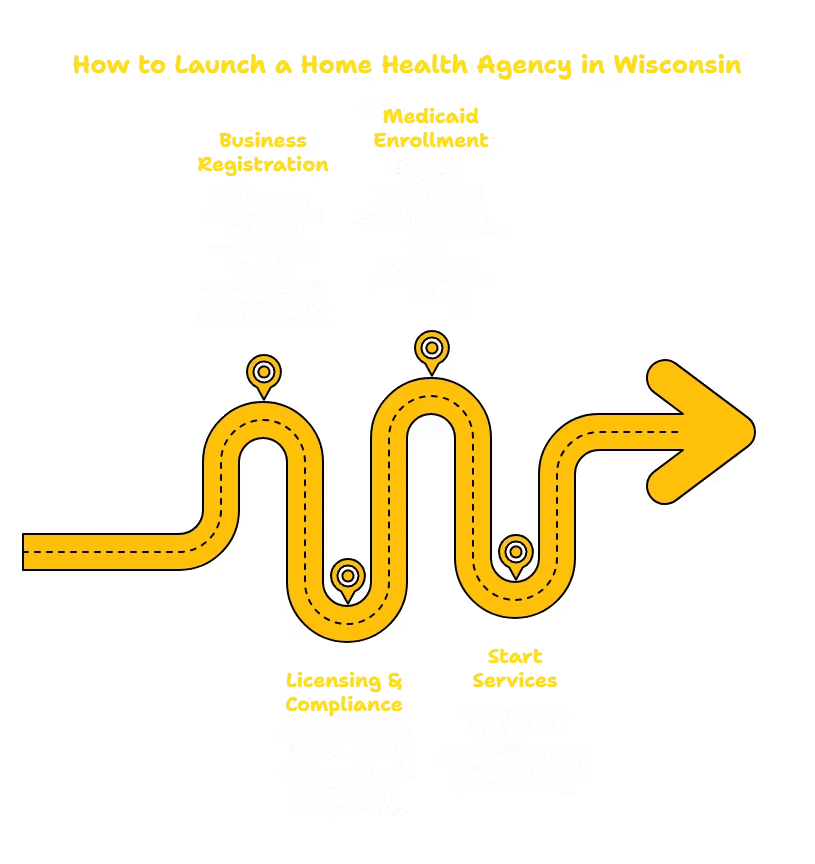
Launching a home health agency is a sequential process that begins with formal business organization and ends with active enrollment across various payer networks. The first step involves standard business registration with the Wisconsin Department of Financial Institutions (DFI), securing a Federal Employer Identification Number (EIN), and obtaining a Type 2 National Provider Identifier (NPI). These foundational credentials are mandatory before applying for any state-level healthcare programs.
Once the legal entity is established, the agency must apply for ForwardHealth enrollment. This application requires the submission of detailed agency credentials, including staff rosters, proof of professional licensure for all clinical personnel, and a comprehensive Policy and Procedure (P&P) Manual. Following initial enrollment, agencies aiming to serve participants within the waiver system must also coordinate with Managed Care Organizations (MCOs) and IRIS Fiscal Employer Agents (FEAs) to ensure they are authorized to accept referrals from those specific programs.
- Register the business entity and obtain all necessary tax and identification numbers.
- Complete the ForwardHealth enrollment application specifically for Home Health Agencies.
- Develop and submit a robust P&P manual that meets all DHS and CMS compliance requirements.
- Enroll with specific MCOs and IRIS FEAs to expand the scope of service reach.
- Maintain all professional liability, malpractice, and workers’ compensation insurance policies.
What Are the Essential Staffing and Clinical Documentation Requirements?
The credibility and quality of a home health agency depend entirely on the caliber of its staff. Every clinical role—from the RN overseeing the care plan to the Home Health Aide delivering personal care—requires specific Wisconsin licensure and documentation of competency. Registered Nurses are responsible for the critical tasks of developing the Plan of Care, supervising the work of LPNs and aides, and ensuring that all interventions are clinically sound and compliant with state protocols.
Documentation standards remain one of the most scrutinized areas during state audits. Agencies must maintain detailed staff files that include current licenses, cleared background checks, and documented evidence of continuing education. Furthermore, internal policies must strictly outline protocols for medication administration, HIPAA compliance, incident tracking, and emergency response. Clinical charting must be accurate, consistent, and reflective of the specific instructions dictated in the physician’s Plan of Care.
- Registered Nurse (RN): Licensed via DSPS; manages care plans and clinical supervision.
- Licensed Practical Nurse (LPN): Operates under RN delegation for specific skilled duties.
- Therapists (PT/OT/SLP): Must maintain state licensure in their specific discipline.
- Home Health Aide: Must complete at least 75 hours of state-approved training.
How Do Medicaid and Waiver Programs Interface with Home Health?
Wisconsin offers several pathways for home health service delivery, catering to diverse populations with varying medical requirements. The ForwardHealth Medicaid State Plan serves as the base, covering services for individuals who meet specific clinical criteria. For participants with more complex, long-term needs, the waiver programs offer flexibility. The IRIS (Include, Respect, I Self-Direct) program, for example, allows for participant-directed services, while the Family Care and Partnership programs utilize MCOs to authorize care based on a participant's comprehensive clinical assessment.
Additionally, the Children’s Long-Term Support (CLTS) Waiver and the Katie Beckett Program provide vital support for children with complex medical needs. These programs ensure that children who might not otherwise qualify for traditional Medicaid can still access essential in-home nursing and therapy. Regardless of the funding source, the core requirement remains the same: the services must be medically necessary, documented in a current Plan of Care, and delivered by a qualified provider.
Frequently Asked Questions
How long does the licensing and enrollment process typically take?
The timeline varies based on the agency's readiness. Business registration and policy development generally take 2–4 weeks, while licensing and compliance setup usually takes 45–60 days. Full enrollment with Medicaid, MCOs, and IRIS can take 2–4 months before services can officially commence.
Is Medicare certification mandatory for a Wisconsin Home Health Agency?
Medicare certification is not mandatory for all home health agencies, but it is often pursued by providers who wish to seek dual reimbursement from both Medicare and Medicaid. Agencies must evaluate their specific service population to determine if Medicare certification is a necessary strategic investment.
What must be included in the Policy & Procedure Manual?
A compliant P&P manual must cover physician order management, nursing and therapy documentation standards, medication administration, infection control, staff supervision protocols, emergency/on-call procedures, HIPAA privacy compliance, and quality assurance processes.
WAIVER CONSULTING GROUP’S START-UP ASSISTANCE SERVICE — WISCONSIN HOME HEALTH PROVIDER
WCG helps home health agencies set up high-quality, compliant operations across Wisconsin’s Medicaid and waiver programs, supporting both clinical excellence and regulatory readiness. Our scope of work includes ForwardHealth, Medicare, and waiver enrollment assistance, the development of comprehensive Policy & Procedure Manuals, creation of care plan and charting templates, and staff onboarding tools. We also provide guidance on billing, prior authorization checklists, and audit readiness to ensure your agency is fully prepared to serve its participants.
Key takeaway: Success in the Wisconsin home health market requires a strict adherence to physician-led care plans, detailed documentation practices, and a thorough understanding of the distinct requirements of the ForwardHealth and waiver programs. Agencies that prioritize compliance in their policy development and staff training are better positioned to provide high-quality care while successfully navigating the state's rigorous regulatory landscape.
Last verified: 2024. The information provided in this article is for educational purposes only and does not constitute legal or professional advice. Always refer to the official Wisconsin Department of Health Services (DHS) and ForwardHealth websites for the most current regulations and program requirements.