HOME HEALTH SERVICES PROVIDER IN TEXAS
By Fatumata Kaba · 2026-03-30 · 5 min read
Becoming a Home Health Services provider in Texas requires a structured approach to meeting the stringent clinical, operational, and regulatory standards set by the state. This process involves securing a Home and Community Support Services Agency (HCSSA) license, enrolling with the Texas Medicaid & Healthcare Partnership (TMHP), and establishing comprehensive administrative systems to deliver skilled nursing, therapies, and personal assistance to Medicaid participants.
What Are the Governing Bodies and Regulatory Requirements for Texas Home Health?
The delivery of home health services in Texas is overseen by a multi-tiered regulatory framework designed to ensure participant safety and service quality. The Texas Health and Human Services Commission (HHSC) serves as the primary authority, administering Medicaid and Home and Community-Based Services (HCBS) programs, managing provider contracts, and authorizing service delivery for eligible participants.
Licensing is strictly managed by the Texas Department of State Health Services (DSHS). Any entity aiming to provide home health care must obtain a HCSSA license, which is the official designation for home health agencies in the state. Furthermore, because these services often involve federal funding, providers must adhere to quality standards and regulations established by the Centers for Medicare & Medicaid Services (CMS). Alignment with these agencies is non-negotiable for any provider seeking to maintain their standing within the Texas Medicaid network.
How Do You Structure a Legally Compliant Home Health Agency?
Establishing a home health business begins with standard corporate formation, such as registering a legal entity with the Texas Secretary of State. Once the entity is established, the provider must obtain a Federal Employer Identification Number (EIN) and a Type 2 National Provider Identifier (NPI). These identifiers are the foundation for all subsequent applications with state and federal healthcare programs.
Beyond the legal framework, operational infrastructure is critical. A provider must develop a comprehensive Home Health Services Policy & Procedure Manual. This document serves as the backbone of the organization, outlining clinical protocols, participant rights, HIPAA compliance, and emergency preparedness. Because HHSC and DSHS conduct periodic surveys, these policies must be current, accessible, and strictly followed by all staff members.
- Legal entity formation (Articles of Incorporation)
- EIN and Type 2 NPI registration
- Comprehensive Policy & Procedure Manual development
- Procurement of general, professional liability, and workers’ compensation insurance
What Is the Step-by-Step Process for Medicaid Enrollment?
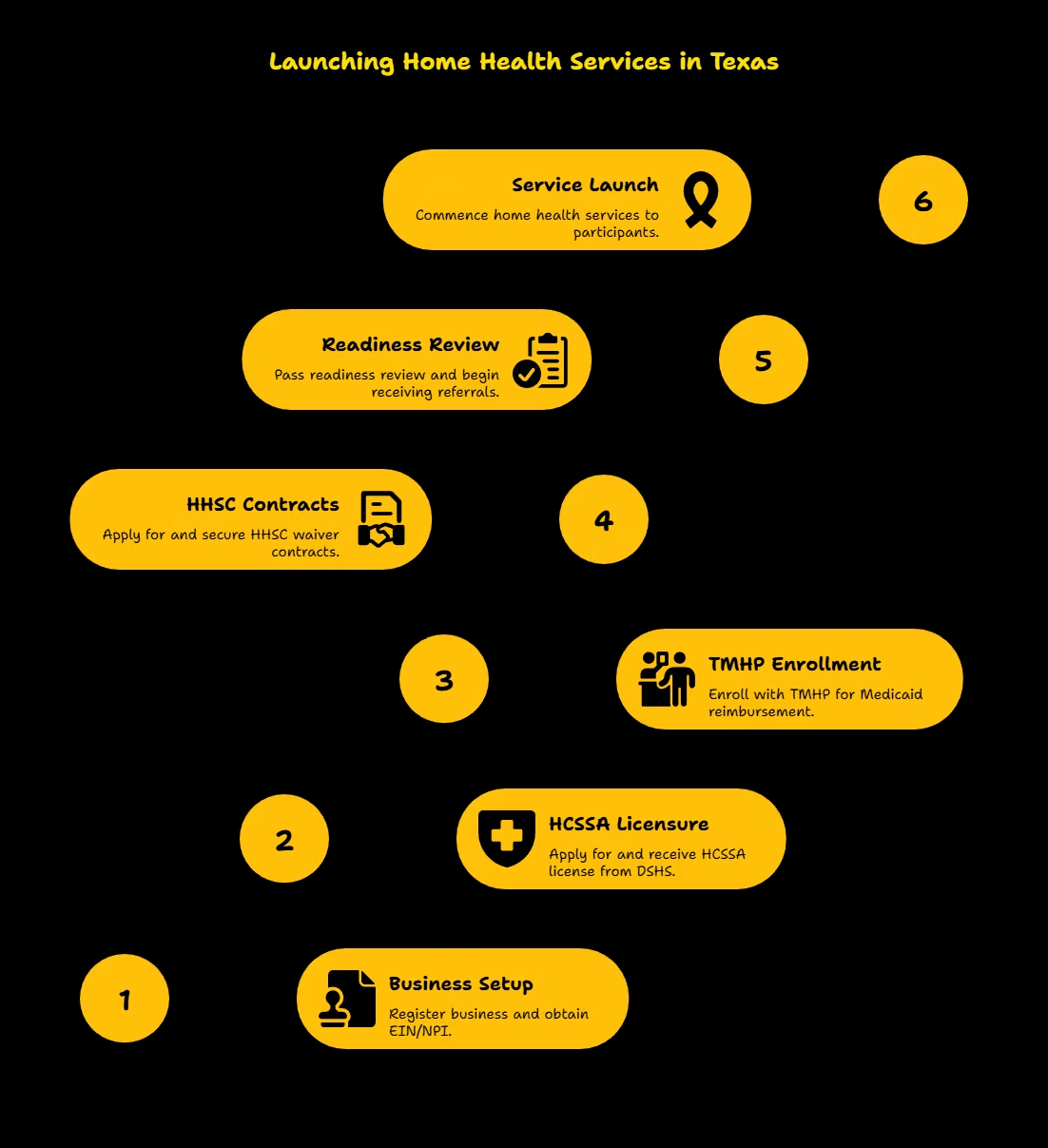
The transition from a licensed entity to a Medicaid-authorized provider follows a specific sequence. First, the agency must secure its HCSSA license through the DSHS, which includes a rigorous survey and fee submission process. Once licensed, the agency must enroll with the Texas Medicaid & Healthcare Partnership (TMHP). This enrollment is the gateway to receiving Medicaid reimbursements for services rendered to eligible participants.
Following TMHP enrollment, the agency must apply for specific HHSC waiver contracts, such as MDCP, CLASS, or STAR+PLUS. This stage often involves a readiness review where the agency must demonstrate that it has the staffing, systems, and clinical oversight required to meet the specific needs of the waiver population. Only after the contract is fully executed can the agency begin receiving referrals and authorizations for care.
How Are Staffing and Clinical Competency Managed?
A home health agency’s quality is measured by its personnel. The DSHS requires a Clinical Administrator, typically a Registered Nurse (RN) with documented supervisory experience, to oversee clinical operations. Registered Nurses are also responsible for conducting initial participant assessments, developing personalized care plans, and providing ongoing supervision of the care team.
Support staff, including Licensed Vocational Nurses (LVNs), Home Health Aides (HHAs), and therapists, must maintain active Texas licensure or certification. Agencies are required to implement thorough orientation programs that cover Medicaid waiver rules, abuse and neglect prevention, and documentation standards. Furthermore, annual competency evaluations and continuing education are mandatory to ensure that the care delivered remains consistent with current clinical best practices.
- Clinical Administrator (RN with supervisory experience)
- RN and LVN clinical care delivery
- Therapists (PT, OT, SLP) with active Texas licenses
- Home Health Aides (CPR/First Aid certified, background checked)
Which Medicaid Programs Utilize Home Health Services?
In Texas, home health services are integrated into several key programs, allowing participants to receive care in their homes rather than in institutional settings. These include the Medically Dependent Children Program (MDCP), the Community Living Assistance and Support Services (CLASS) program, the STAR+PLUS HCBS waiver, and the Deaf Blind with Multiple Disabilities (DBMD) program. Each of these programs has unique eligibility requirements and service authorization processes.
In addition to these waivers, providers may offer services through the traditional Medicaid State Plan for post-hospitalization home health episodes. Success in this sector requires a deep understanding of the specific requirements for each program, as billing codes, authorization frequencies, and documentation standards may vary across different waiver populations and managed care organizations.
Frequently Asked Questions
What is the typical timeline for starting a Texas home health agency?
The process generally takes 6–9 months. Business setup and licensure preparation take 2–4 months, while Medicaid enrollment and HHSC contracting require an additional 2–3 months. Final staff hiring and readiness preparations typically span 30–60 days before the first service is launched.
What must be included in the Home Health Policy & Procedure Manual?
The manual must address the entire scope of agency operations, including physician order processes, plan of care development, medication management, infection control, and clinical protocols. It must also contain sections on electronic documentation, HIPAA compliance, participant rights, abuse prevention, quality assurance, and billing/authorization tracking.
Where can I find official information for program requirements?
Providers should regularly monitor the Texas Health and Human Services Commission (HHSC) website for program rules, the Texas Department of State Health Services (DSHS) for HCSSA licensure updates, and the Texas Medicaid & Healthcare Partnership (TMHP) for billing and enrollment guidance.
Key Takeaway: Successfully launching a home health agency in Texas requires meticulous preparation, strict adherence to DSHS and HHSC regulations, and the establishment of robust clinical and administrative systems. By aligning business operations with the specific requirements of Texas Medicaid waivers, providers can ensure regulatory compliance while delivering essential care to vulnerable populations.
Last verified: October 2023. Disclaimer: This article is for informational purposes only and does not constitute legal or professional advice. Always consult with the Texas Health and Human Services Commission (HHSC), the Texas Department of State Health Services (DSHS), or legal counsel to ensure compliance with current regulations and statutes.