HOME HEALTH SERVICES PROVIDER IN SOUTH CAROLINA
By Fatumata Kaba · 2025-10-13 · 5 min read
Launching a home health services agency in South Carolina requires navigating a rigorous regulatory landscape governed by both state and federal oversight bodies to ensure high-quality patient care. Prospective providers must successfully coordinate licensure through the South Carolina Department of Health and Environmental Control (DHEC) and credentialing through the South Carolina Department of Health and Human Services (SCDHHS) to deliver skilled nursing and therapy services to Medicaid-eligible participants.
What Are the Primary Governing Agencies and Regulatory Requirements?
The South Carolina home health landscape is defined by the integration of state-level health oversight and federal Medicaid administration. Agencies aiming to provide these services must operate in strict compliance with the standards set forth by the Centers for Medicare & Medicaid Services (CMS), which mandate federal quality standards and conditions of participation for all providers receiving federal funding.
At the state level, the South Carolina Department of Health and Environmental Control (DHEC) acts as the primary licensing entity. DHEC is responsible for conducting inspections to ensure that agencies maintain high clinical standards, adequate staffing, and patient safety protocols. Simultaneously, the South Carolina Department of Health and Human Services (SCDHHS) serves as the gatekeeper for Medicaid enrollment. SCDHHS manages the reimbursement framework, ensures provider compliance with Medicaid-specific regulations, and oversees the delivery of services under the various Home and Community-Based Services (HCBS) waivers.
Which Services Are Provided Under South Carolina Medicaid?
Home health services are defined as skilled medical care and supportive monitoring delivered in the client’s private residence. These services are initiated by a physician’s order, which establishes the medical necessity for post-acute care, the management of chronic health conditions, or rehabilitation services. By providing care in the home, these agencies are instrumental in preventing unnecessary institutionalization and supporting the participant’s independence.
Approved providers typically deliver a structured range of medical services tailored to the specific needs identified in the patient’s plan of care. This multidisciplinary approach ensures comprehensive management of the participant’s health status:
- Skilled Nursing Services: Includes complex tasks such as wound care, medication administration, disease-specific education, and ongoing monitoring of vital signs.
- Certified Home Health Aide Services: Provides essential support with Activities of Daily Living (ADLs) performed under the direct supervision of a Registered Nurse.
- Rehabilitative Therapies: Covers physical, occupational, and speech therapy services delivered by licensed professionals to improve functional outcomes.
- Clinical Support: Includes medical social work support where medically indicated and integrated care coordination to ensure continuity between medical providers and in-home staff.
How Do You Navigate the Provider Enrollment Process?
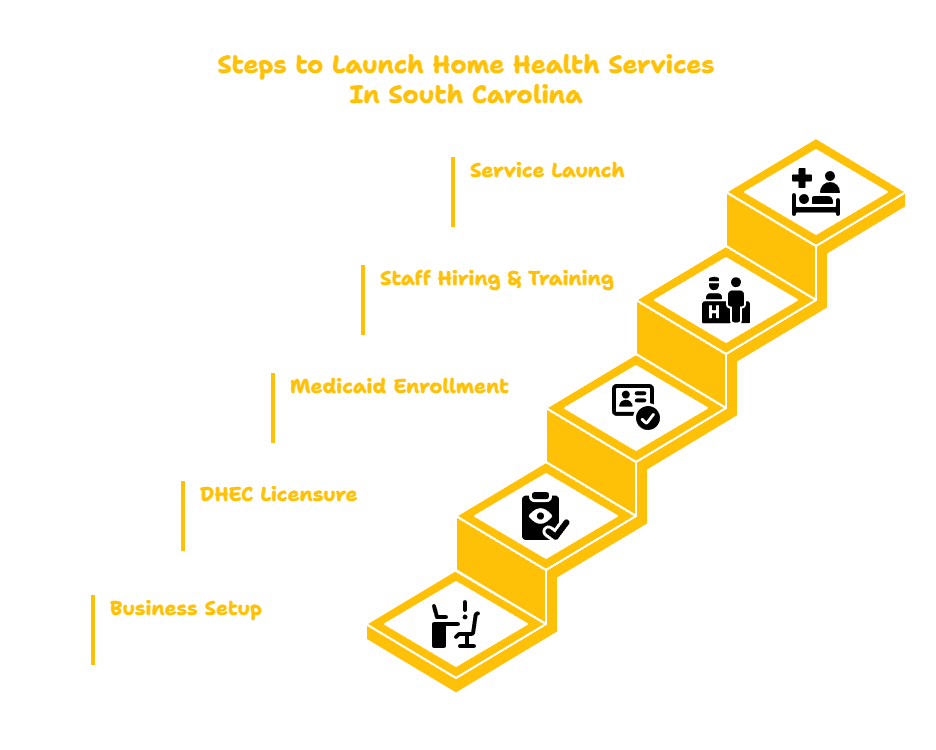
The transition from a business concept to a fully operational Medicaid-enrolled provider follows a sequential, multi-phase path. Founders must first establish their business legally with the South Carolina Secretary of State and secure the necessary federal identifiers, including an Employer Identification Number (EIN) and a Type 2 National Provider Identifier (NPI). These foundational steps are prerequisites for any subsequent state-level applications.
Once the business entity is established, the agency must seek licensure through DHEC. This process involves a formal review of operational readiness, policies, and clinical procedures, often followed by an on-site survey. Upon securing a state license, the agency then applies for enrollment with SCDHHS as a Medicaid home health provider. This stage requires the submission of organizational charts, staff credentials, and documented evidence of the agency’s ability to meet all HCBS waiver standards, culminating in formal certification to begin accepting Medicaid referrals.
What Documentation and Staffing Standards Are Required?
Compliance hinges on the maintenance of a robust Home Health Services Policy & Procedure Manual. This document serves as the regulatory backbone of the agency, outlining protocols for medication management, emergency response, infection control, and HIPAA-compliant data handling. Furthermore, the agency must maintain active insurance coverage, including professional liability, malpractice, and workers’ compensation, to protect both the provider and the patients served.
Staffing requirements are strictly regulated to ensure clinical safety. The following personnel are critical to operations:
- Clinical Supervisor/Director of Nursing: A licensed Registered Nurse (RN) with administrative experience in the home health sector, responsible for overall clinical oversight.
- Registered Nurses (RNs): Responsible for the development of individual care plans, skilled service delivery, and the ongoing supervision of aide staff.
- Certified Home Health Aides (CHHAs): Personnel who have completed a DHEC-approved training program, hold valid CPR certification, and have cleared mandatory background checks.
- Therapists: Licensed physical, occupational, or speech therapists who provide care according to the specific physician-directed plan of care.
Which Medicaid Waiver Programs Support Home Health Services?
South Carolina funds home health services through a variety of streams, including the State Plan Medicaid benefit and several specialized HCBS waivers. These programs are designed to accommodate different populations, ranging from children with medical complexity to adults requiring long-term chronic care. Providers must understand which waiver they are billing under, as each carries specific documentation requirements and service limitations.
Commonly accessed programs include:
- CLTC (Community Long Term Care): Focuses on providing chronic or post-acute care to individuals who would otherwise require institutionalization.
- ID/RD Waiver: Authorizes specific nursing and therapeutic interventions for individuals with intellectual or related disabilities.
- HASCI Waiver: Designed for individuals with traumatic brain or spinal cord injuries, providing intensive nursing and therapy support.
- Community Supports Waiver & EPSDT/TEFRA: Covers medical care for specific participant groups, including children (under 21) who require in-home nursing or therapy to manage health conditions.
Frequently Asked Questions
What is the typical timeline to launch a home health agency?
The total timeline generally spans several months. Business setup and policy creation take approximately 1–2 months, followed by the DHEC licensure process, which takes 3–5 months. SCDHHS enrollment typically takes an additional 2–3 months post-licensure, followed by 1–2 months for final staff training and launch preparation.
Are home health agencies required to have an infection control plan?
Yes. As part of both DHEC licensing and Medicaid compliance, an agency must maintain a written policy and procedure manual that includes comprehensive emergency and infection control procedures. Staff must receive training on these protocols during orientation and through annual competency reviews.
Who is responsible for supervising certified home health aides?
Certified home health aides must work under the direct supervision of a Registered Nurse (RN). The RN is responsible for performing site visits, reviewing documentation, and ensuring that the aide’s work remains in alignment with the patient’s physician-approved plan of care.
Key Takeaway
Succeeding as a home health provider in South Carolina requires precise coordination between DHEC licensing requirements and SCDHHS Medicaid billing standards. Agencies must prioritize the development of comprehensive policy manuals, maintain rigorous staff credentialing, and ensure all services are documented according to the specific criteria of the applicable HCBS waiver program. By maintaining strict audit readiness and operational compliance, agencies can successfully deliver essential, high-quality care to vulnerable populations while ensuring sustainable reimbursement.
Last verified: 2024. This information is provided for educational purposes and should not be considered legal or medical advice. Please consult with the South Carolina Department of Health and Human Services (SCDHHS) or the South Carolina Department of Health and Environmental Control (DHEC) for official regulations and current application packets.