HOME HEALTH SERVICES PROVIDER IN NEW JERSEY
By Fatumata Kaba · 2025-09-05 · 6 min read
Becoming a Home Health Services provider in New Jersey requires navigating a multifaceted regulatory landscape governed by the Department of Human Services (DHS) and the Department of Health (NJDOH). To successfully operate under New Jersey Medicaid Home and Community-Based Services (HCBS) waivers, prospective agencies must secure proper licensure, complete the state’s rigorous provider enrollment process, and establish robust clinical and administrative policies that ensure high-quality patient care and regulatory compliance.
Understanding the Regulatory Environment for Home Health Services
The delivery of medical and personal care in the comfort of a patient's home is a heavily regulated sector designed to protect vulnerable populations. In New Jersey, the Department of Human Services (DHS) serves as the primary entity for administering Medicaid waiver funding and managing the essential provider enrollment and reimbursement functions. Complementing this, the Division of Medical Assistance and Health Services (DMAHS) maintains strict oversight regarding service delivery standards and programmatic compliance.
At the federal level, the Centers for Medicare & Medicaid Services (CMS) provides the overarching framework for all Medicaid-funded programs. Their standards ensure that New Jersey’s HCBS waiver offerings prioritize person-centered planning, participant rights, and rigorous health and safety protections. For any agency founder, establishing a strong relationship with these governing bodies and maintaining alignment with their respective guidelines is the foundation of a sustainable home health business.
Essential Services and Clinical Scope of Practice
Home Health Services represent a vital integration of medical, therapeutic, and personal assistance designed to support individuals with chronic conditions, disabilities, or age-related health needs. By delivering these services in the home, providers help participants maintain their independence while reducing the need for institutionalized care. The clinical scope of practice is broad and must be strictly documented within each participant's Individualized Service Plan (ISP).
Approved providers are authorized to deliver a diverse range of care modalities to ensure comprehensive health management. These services include, but are not limited to, the following:
- Skilled Nursing: Conducting health assessments, wound care, medication management, and ongoing monitoring of chronic diseases.
- Therapeutic Services: Providing physical, occupational, and speech therapy to restore mobility, functional capacity, and communication skills.
- Personal Care Assistance: Assisting with activities of daily living (ADLs), including bathing, grooming, dressing, and safe mobility.
- Clinical Monitoring: Tracking vital signs, glucose levels, and respiratory functions, and administering oral, injectable, or IV medications.
- Supportive Care: Offering post-surgical recovery monitoring, rehabilitation exercises, and patient/family education on health management strategies.
- Care Coordination: Maintaining active communication with the participant’s broader healthcare team to ensure a cohesive approach to health and emergency response planning.
Licensing and Initial Provider Approval Requirements
Before an agency can bill Medicaid, it must complete several foundational steps to establish its legal and clinical legitimacy. The process begins with standard business formation, which includes registering the entity with the New Jersey Division of Revenue and Enterprise Services and obtaining a federal Employer Identification Number (EIN). Additionally, agencies must secure a Type 2 National Provider Identifier (NPI) to function correctly within the healthcare billing ecosystem.
Beyond standard business filings, the New Jersey Department of Health (NJDOH) mandates specific licensure for home health agencies. Once licensed, the agency must enroll as a Medicaid waiver provider through the designated portal. This stage requires the submission of comprehensive documentation, including evidence of general and professional liability insurance, which is critical for mitigating operational risks. Developing internal policies that address clinical care, medication administration, and strict HIPAA compliance is a non-negotiable step toward gaining state authorization.
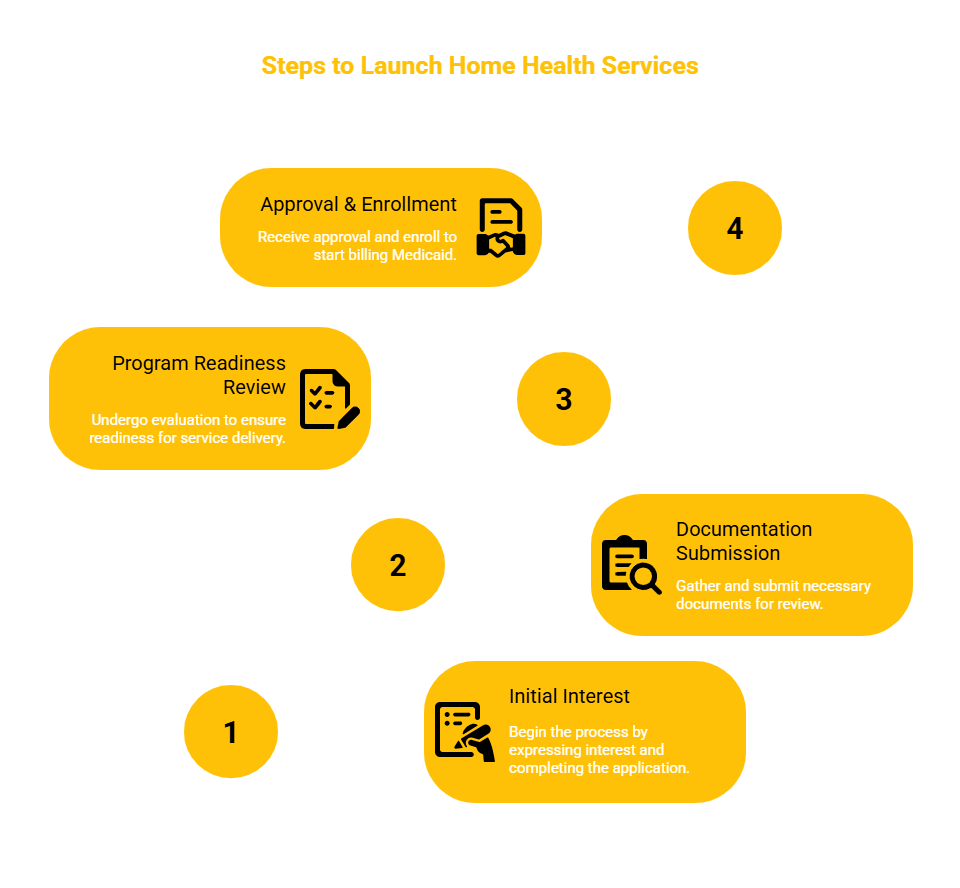
The Provider Enrollment and Readiness Review Process
The transition from a business entity to an active Medicaid provider involves a systematic review by the DHS and DMAHS. This process is designed to ensure that the agency has the capacity, staff qualifications, and safety protocols necessary to serve the Medicaid population. Founders should be prepared for a multi-phase evaluation that scrutinizes both the agency’s administrative structure and its clinical readiness.
The application process generally follows a structured trajectory:
- Initial Application: Submission of the formal enrollment application via the New Jersey Medicaid Provider Enrollment Portal.
- Documentation Review: Providing all required credentials, including business licenses, NPI/EIN verification, and internal policy manuals for clinical and administrative functions.
- Readiness Review: An evaluation by state agencies to assess the provider’s ability to follow care protocols, maintain staff records, and implement safety measures.
- Authorization: Once approved, the provider is officially enrolled and assigned specific billing codes for the delivery of authorized HCBS waiver services.
Staffing, Credentialing, and Professional Training
The quality of a home health agency is defined by its staff. Because these services involve direct patient care, New Jersey requires all personnel—ranging from Home Health Program Directors to Certified Home Health Aides—to meet rigorous credentialing standards. This includes holding valid state licenses, undergoing extensive background checks, and maintaining active certifications in CPR and First Aid.
To remain in compliance, agencies must implement a continuous training program. All employees must receive education on HIPAA protocols, patient rights, and infection control. Furthermore, annual competency evaluations are required to ensure that the care delivered remains consistent with state regulations and the specific needs of the individuals being served. Effective documentation of these credentials and training sessions is a critical component of every agency's audit-readiness strategy.
Navigating Medicaid Waiver Programs and Timelines
Home Health Services operate under several distinct New Jersey Medicaid waivers, including the Community Care Program for the Elderly and Disabled (CCPED), the Supports Program Waiver, the Acquired Brain Injury (ABI) Waiver, and the Personal Care Assistant (PCA) program. Each program has unique requirements and service definitions, requiring agencies to remain agile in their service delivery and billing practices.
For those preparing to launch, the development timeline is substantial. Business formation and initial compliance preparation typically require one to two months, followed by two to three months for staff recruitment and policy development. The Medicaid provider enrollment and readiness review stage generally spans 60 to 90 days. Finally, setting up billing systems for the launch of service delivery can take an additional 30 to 45 days. Proper planning for these phases is essential for avoiding unnecessary delays in operations.
Frequently Asked Questions
What documents are essential for the Medicaid enrollment application?
Agencies must submit their Articles of Incorporation, proof of EIN and NPI, the valid Home Health Agency License issued by the NJDOH, and certificates of insurance. Furthermore, a comprehensive Policy & Procedure Manual is required, covering areas such as patient rights, medication management, staff credentialing, and emergency protocols.
What is the role of the Home Health Program Director?
The Program Director is responsible for overseeing the clinical and administrative integrity of the agency. Requirements typically include a Bachelor’s or Master’s degree in nursing, healthcare administration, or a related field, with a preference for a Registered Nurse (RN) license. They ensure that all services meet the regulatory standards set forth by the DHS and DMAHS.
How does an agency ensure compliance with HIPAA and patient privacy?
Compliance is maintained by integrating HIPAA-compliant data management systems into the agency’s daily operations. This includes rigorous staff training on data privacy, secure storage of clinical records, and clear policies on how patient information is shared and protected. Regular internal audits should be conducted to verify that all documentation and administrative practices adhere to federal and state privacy mandates.
Key Takeaway
Launching a Home Health Services agency in New Jersey is a complex undertaking that demands strict adherence to state licensing requirements, Medicaid enrollment protocols, and federal HCBS standards. By prioritizing administrative compliance, robust clinical policy development, and the meticulous credentialing of professional staff, agency founders can build a sustainable, high-quality care organization that fulfills the critical needs of the Medicaid-enrolled population.
Last verified: October 2023. Disclaimer: This information is for educational purposes only and does not constitute legal or professional advice. Requirements for Medicaid waiver programs and provider enrollment are subject to change. Consult directly with the New Jersey Department of Human Services or the Division of Medical Assistance and Health Services for the most current regulations and guidance.