HOME HEALTH SERVICES PROVIDER IN MONTANA
By Fatumata Kaba · 2025-08-06 · 6 min read
Home Health Services in Montana are specialized medical and supportive care programs delivered directly to an individual's residence, aimed at fostering independence for those with chronic illnesses, disabilities, or post-acute recovery needs. These services are formally authorized and administered through the Montana Medicaid Home and Community-Based Services (HCBS) waiver programs, which prioritize person-centered planning and community-based health management.
For healthcare entrepreneurs and agency administrators, navigating the regulatory environment of Montana’s HCBS landscape requires a precise understanding of state-level oversight and federal compliance. This guide outlines the essential requirements, administrative prerequisites, and operational steps necessary to establish a compliant and effective Home Health Services agency within the state of Montana.
What are the Regulatory Foundations and Governance of Home Health in Montana?
The delivery of Medicaid-funded home health services is governed by a tripartite structure of state and federal oversight. At the state level, the Montana Department of Public Health and Human Services (DPHHS) serves as the primary authority. DPHHS manages the overarching Medicaid waiver funding, oversees the provider enrollment process, and maintains control over service authorization and reimbursement protocols to ensure that state funds are used efficiently and appropriately.
Within DPHHS, the Developmental Disabilities Program (DDP) plays a critical role in ensuring that service delivery meets established quality standards, particularly for populations requiring specialized care. These programs are designed to align with federal mandates set by the Centers for Medicare & Medicaid Services (CMS). CMS provides the overarching federal framework, ensuring that all Medicaid-funded home health services adhere to rigorous standards regarding person-centered planning, participant protections, and health outcome benchmarks.
- Montana Department of Public Health and Human Services (DPHHS): Manages Medicaid waiver funding, enrollment, and reimbursement.
- Developmental Disabilities Program (DDP): Monitors quality standards and operational compliance.
- Centers for Medicare & Medicaid Services (CMS): Provides federal oversight for HCBS quality and patient safety standards.
What Services Comprise a Comprehensive Home Health Program?
Home Health Services in Montana are multifaceted, designed to address the unique medical, rehabilitative, and personal care needs of each participant. These services are not one-size-fits-all; rather, they are structured to respond directly to the physician-ordered Individualized Service Plan (ISP). By delivering care in the home, agencies help prevent unnecessary institutionalization and allow participants to remain in their preferred environment.
Approved providers are authorized to deliver a broad spectrum of care, ranging from clinical nursing to daily living support. These interventions are critical for managing chronic conditions such as diabetes, heart disease, or COPD, and for providing post-acute care that prevents hospital readmission. The multidisciplinary approach ensures that clinical health goals are met alongside functional independence goals.
- Skilled Nursing Care: Health monitoring, complex medication administration, wound care, and chronic disease management.
- Therapeutic Services: Physical, occupational, and speech therapy to restore or maintain functional abilities.
- Personal Care Assistance: Support with Activities of Daily Living (ADLs) including bathing, grooming, dressing, and mobility.
- Medical Social Services: Resource coordination and counseling for emotional and social well-being.
- Home Health Aide Services: Basic caregiving tasks performed under the direct supervision of a nurse or therapist.
What are the Essential Licensing and Provider Enrollment Prerequisites?
The journey to becoming a Medicaid-approved provider begins with establishing a formal legal and business identity. Prospective agencies must first register their business entity with the Montana Secretary of State. Following legal formation, the agency must secure its federal tax identification via an Employer Identification Number (EIN) and obtain a Type 2 National Provider Identifier (NPI), which is required for all organizational billing.
Once the business structure is established, the agency must seek formal licensure as a Home Health Agency from DPHHS. This involves demonstrating that the agency has the necessary operational infrastructure, including professional liability insurance and comprehensive internal policies. These policies must detail how the agency will manage patient care, health monitoring, and staff credentialing to maintain compliance with both state law and Medicaid reimbursement requirements.
- Business Formation: Registration with the Montana Secretary of State and obtaining an EIN and NPI.
- Licensure: Securing a Home Health Agency license through DPHHS.
- Insurance: Maintaining robust general and professional liability coverage.
- Policy Manuals: Development of detailed protocols for patient safety, HIPAA compliance, and care delivery.
How is the Medicaid Enrollment and Readiness Review Process Conducted?
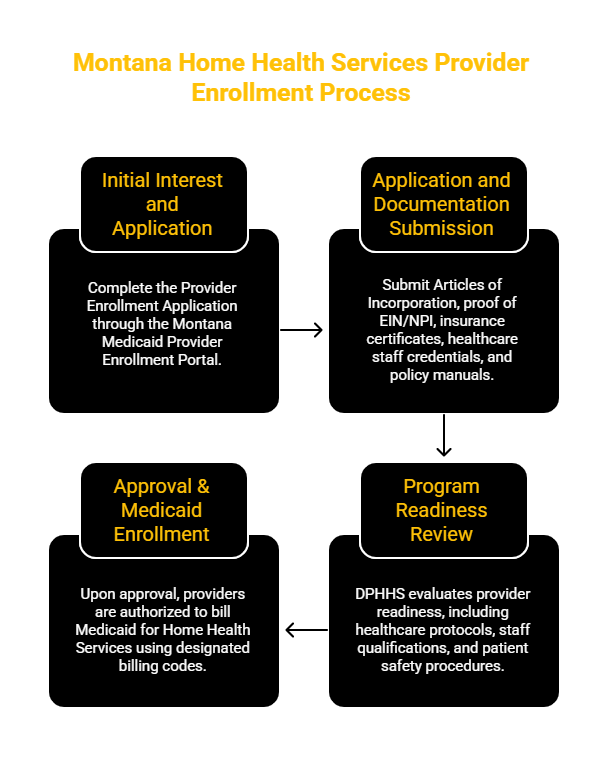
After acquiring the necessary licenses, the agency must navigate the Montana Medicaid Provider Enrollment Portal. This is the primary mechanism through which the state evaluates the provider’s readiness to participate in HCBS waiver programs. The application process requires the submission of all corporate documentation, insurance certificates, and comprehensive policy manuals that outline clinical and administrative procedures.
DPHHS will conduct a program readiness review to ensure the agency is prepared to provide safe and consistent care. This evaluation focuses on staff qualifications, the robustness of healthcare protocols, and the agency’s ability to manage patient safety procedures effectively. Once the state determines the agency meets all qualifications, the provider is officially enrolled and authorized to begin billing for services using the designated Medicaid billing codes.
What Staffing Requirements Must be Maintained?
Maintaining high-quality care requires adherence to strict staffing mandates. The agency must be led by a qualified Home Health Program Director, typically holding a Bachelor’s or Master’s degree in nursing or healthcare administration, along with an active Registered Nurse (RN) license. This role serves as the clinical lead, ensuring that all staff meet the required competency levels for their respective positions.
All clinical staff—including LPNs, HHAs, and therapists—must maintain active Montana state licensure or certification and undergo rigorous background checks. Beyond basic credentials, agencies are responsible for providing ongoing training, including emergency response, infection control, and patient rights education. Regular competency evaluations and annual performance reviews are required to ensure that staff continue to meet the evolving health needs of the waiver participants.
Frequently Asked Questions
Which Medicaid waiver programs cover Home Health Services in Montana?
Home Health Services are available under several key programs, including the Big Sky Waiver (Aged and Disabled), the Comprehensive Waiver for Individuals with Developmental Disabilities, the Traumatic Brain Injury (TBI) Waiver, the Community Supports Waiver for Adults with Physical Disabilities, and the Children's Autism Waiver.
What is the typical timeline for launching a home health agency?
The process generally takes several months: 1–2 months for business formation, 2–3 months for hiring and program development, 60–90 days for Medicaid enrollment and readiness reviews, and 30–45 days for final billing setup and launch.
What must be included in the Home Health Services Policy & Procedure Manual?
The manual must comprehensively cover patient assessment and care planning, physician order documentation, skilled nursing protocols, health and safety monitoring, infection control, staff credentialing, HIPAA compliance, and audit-ready billing practices.
Key Takeaway
Launching a Medicaid-compliant Home Health Services agency in Montana requires a disciplined approach to clinical governance and administrative rigor. By focusing on the integration of federal standards with Montana’s specific DPHHS requirements, agency founders can build a sustainable organization that provides vital care to those enrolled in HCBS waiver programs.
Waiver Consulting Group provides comprehensive support for launching Medicaid-compliant Home Health Services in Montana. Services include business registration, Medicaid enrollment, licensure assistance, policy manual development, staff credentialing templates, and billing system setup. For further guidance on navigating these state requirements, please consult the official resources provided by DPHHS and the Developmental Disabilities Program.
Last verified: 2024. The information provided herein is for general educational purposes only and does not constitute legal or professional consulting advice. Regulations governing Medicaid waiver programs are subject to change. Always consult with the Montana Department of Public Health and Human Services (DPHHS) and relevant federal guidelines for the most current requirements and statutes.