HOME HEALTH SERVICES PROVIDER IN MASSACHUSETTS
By Fatumata Kaba · 2025-08-07 · 5 min read
DELIVERING SKILLED NURSING, THERAPY, AND PERSONAL CARE TO INDIVIDUALS IN THE COMFORT OF THEIR HOMES
Home health services in Massachusetts provide essential medical, therapeutic, and personal care to individuals living with disabilities, chronic illnesses, or those recovering from hospitalizations. These services are strictly regulated by the Massachusetts Department of Public Health (DPH) and are reimbursed through MassHealth (Medicaid) and Medicare, ensuring that patients receive high-quality care within the comfort of their own homes.
What Regulatory Framework Governs Massachusetts Home Health Agencies?
The home health industry in Massachusetts operates under a multi-layered regulatory environment designed to protect patient safety and ensure clinical quality. The primary regulatory body is the Massachusetts Department of Public Health (DPH), which maintains authority over the licensing of home health agencies under 105 CMR 140.000 regulations. Compliance with these standards is a prerequisite for any agency seeking to operate legally within the Commonwealth.
Beyond state licensure, agencies must interact with several federal and state entities. MassHealth, which acts as the Massachusetts Medicaid program, serves as a primary payer for services under the Medicaid State Plan and various community-based waivers. Furthermore, the Centers for Medicare & Medicaid Services (CMS) oversees Medicare-certified agencies, while the Executive Office of Health and Human Services (EOHHS) provides critical policy guidance, provider bulletins, and management of the Long-Term Services and Supports (LTSS) systems that dictate how care is delivered and reimbursed.
What Are the Core Components of Home Health Care Services?
Home health care is a comprehensive service model predicated on a physician’s order and a documented plan of care (POC). This model is designed to transition patients from clinical settings back into their homes safely. Services generally include skilled nursing for complex needs such as wound care, injections, and chronic disease monitoring, alongside home health aide services that assist with bathing, grooming, and mobility.
In addition to nursing and aide services, robust home health programs integrate specialized support to address the holistic needs of the patient. This includes physical, occupational, and speech therapy, as well as medical social work. These services are supported by ongoing patient and caregiver education and meticulous medication management, ensuring that the plan of care is adjusted as the patient’s condition evolves.
How Do Providers Navigate the Licensure and Approval Process?
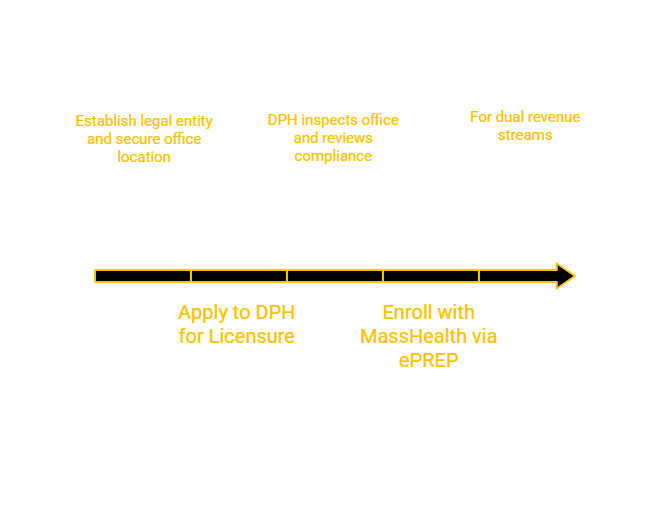
Establishing a licensed home health agency in Massachusetts is a multi-step process that requires significant administrative preparation. Founders must first register their business entity with the Massachusetts Secretary of State and secure necessary identifiers, including an EIN, a Type 2 NPI, and a Medicaid ID. The licensure pathway formally begins with an application to the DPH Determination of Need (DoN) program, which serves as the gateway to operating a health care facility.
Following the submission of a comprehensive application package and a detailed policy and procedure manual, applicants must undergo a rigorous DPH survey inspection. This site visit ensures that the agency’s physical location, staff files, and clinical protocols meet state requirements. Once licensed, providers must enroll with MassHealth via the ePREP portal to begin submitting claims for services rendered to Medicaid-eligible populations.
- Register business entity with MA Secretary of State.
- Obtain federal EIN and Type 2 NPI.
- Submit DPH Home Health Agency licensure application.
- Undergo DPH site survey and clinical compliance inspection.
- Enroll in MassHealth via ePREP and gain access to the LTSS Provider Portal.
What Are the Essential Staffing and Clinical Requirements?
Success in the home health sector relies on a qualified, compliant workforce. At the helm of clinical operations, agencies must employ a Director of Nursing (RN) who holds an active Massachusetts license and possesses documented supervisory experience. This individual is responsible for overseeing the clinical operations and ensuring all staff adhere to the established plan of care.
Supporting roles, such as Licensed Practical Nurses (LPNs) and Home Health Aides (HHAs), must also meet strict state benchmarks. HHAs, for example, are required to complete at least 75 hours of state-approved training and maintain active CPR certification. Furthermore, all staff must undergo ongoing training in HIPAA compliance, infection control, and mandatory abuse and neglect reporting. These requirements ensure that the agency maintains a high standard of care and remains compliant during periodic audits.
What Is the Expected Timeline for Launching Operations?
The timeline for launching a home health agency is influenced by the complexity of the application and the efficiency of the review process. Generally, the initial business registration and planning phase takes approximately one to two weeks. Once the legal structure is in place, founders should allocate four to six weeks to draft the mandatory policy manuals and complete the DPH application.
The most intensive phase is the DPH survey and licensure process, which typically spans six to ten weeks. Because the DPH survey is exhaustive, agencies should prioritize absolute compliance in their documentation. Medicaid enrollment and final service authorization often take an additional four to six weeks, though this process can overlap with the final stages of the licensing period, allowing agencies to prepare for their first patient admissions.
Frequently Asked Questions
What documentation is essential for initial licensure?
Applicants must provide Articles of Organization, an EIN, a Type 2 NPI, and a comprehensive policy manual. This manual must address admission/discharge criteria, RN supervision protocols, HHA documentation, HIPAA and infection control policies, grievance procedures, and emergency preparedness plans.
How does MassHealth reimburse for home health services?
MassHealth reimburses agencies for skilled nursing, HHA visits, physical therapy, occupational therapy, speech therapy, and social work assessments. All billing must be conducted through the MassHealth LTSS Provider Portal, and claims must strictly align with the physician-approved plan of care.
Is Medicare certification mandatory?
Medicare certification is not required for state licensure; however, many providers choose to pursue it. Obtaining Medicare certification allows agencies to capture a dual revenue stream by serving both Medicaid and Medicare-eligible patients, thereby broadening the agency's potential market reach.
Key Takeaway: Establishing a home health agency in Massachusetts requires strict adherence to DPH licensing regulations, robust clinical oversight, and meticulous Medicaid billing practices via the LTSS provider portal. Providers who prioritize structured policy development and timely, accurate documentation will be best positioned to meet both state requirements and the needs of their patients.
Last verified: May 2024. This information is for educational purposes only and does not constitute legal or professional regulatory advice. Regulations are subject to change; always consult the Massachusetts Department of Public Health (DPH) and the Executive Office of Health and Human Services (EOHHS) for the most current statutes and guidance.