HOME HEALTH SERVICES PROVIDER IN KENTUCKY
By Fatumata Kaba · 2025-07-25 · 6 min read
Home Health Services in Kentucky provide essential clinical care and recovery support to individuals managing chronic conditions or recovering from acute illness within their own homes. By delivering medically necessary skilled interventions, these services allow participants to remain in their communities, effectively reducing unnecessary hospitalizations and promoting long-term health independence.
What Are the Governing Agencies and Regulatory Frameworks?
The delivery of home health care in Kentucky is governed by a multi-tiered regulatory structure designed to ensure patient safety and fiscal accountability. At the state level, the Kentucky Cabinet for Health and Family Services (CHFS) acts as the primary authority, with the Department for Medicaid Services (DMS) overseeing Medicaid reimbursement, clinical standards, and state plan compliance. Providers must also maintain active licensure through the Kentucky Office of Inspector General (OIG), which is responsible for the rigorous inspection and certification of Home Health Agencies (HHAs).
On a federal level, the Centers for Medicare & Medicaid Services (CMS) establishes the overarching federal regulations for agencies participating in Medicare and Medicaid programs. Additionally, most Medicaid beneficiaries in Kentucky receive services through Managed Care Organizations (MCOs). These organizations serve as the primary point of contact for providers, as they are responsible for authorizing individualized care plans, credentialing agencies within their provider networks, and processing the billing claims for eligible Medicaid members.
How Does the Service Model Function Under Medicaid?
Home Health Services are categorized as medically necessary, time-limited interventions that focus on clinical stabilization and health maintenance. Because these services are prescribed by a licensed physician, they must be tied to a documented clinical need. All care is delivered according to a formal Plan of Care (POC), which must be reviewed by the managing physician every 60 days—or more frequently if the patient's medical condition changes—to ensure that the treatment remains appropriate and effective.
The scope of services is multidisciplinary and requires a coordinated clinical approach. Approved services typically include the following:
- Skilled nursing, including complex wound care, medication administration, and chronic disease management.
- Physical therapy to improve mobility and functional capacity.
- Occupational therapy to assist with daily living skill development.
- Speech-language pathology for communication and swallowing disorders.
- Medical social services to address psychosocial barriers to recovery.
- Home health aide services, which provide assistance with Activities of Daily Living (ADLs) under the direct supervision of a registered nurse.
What Are the Prerequisites for Licensure and Enrollment?
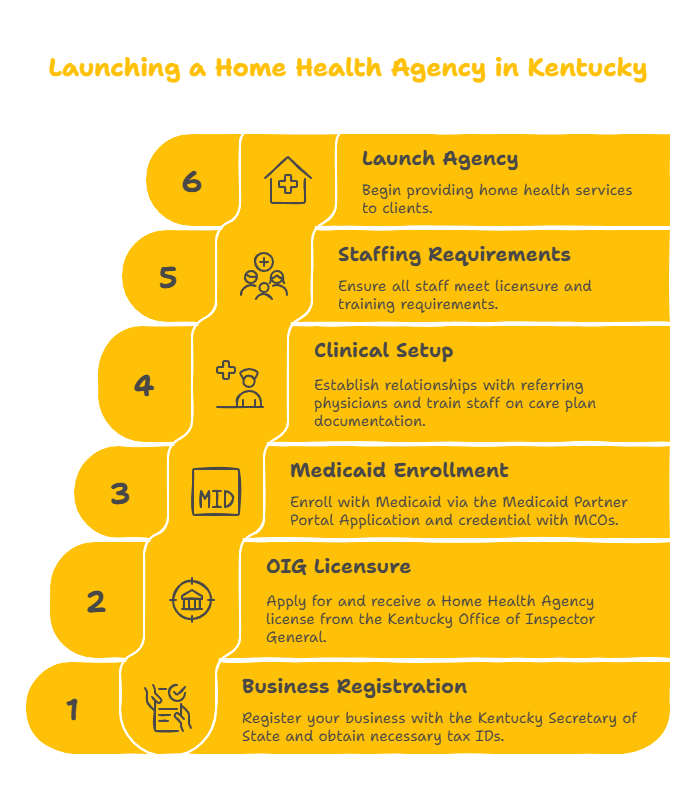
Launching a Home Health Agency requires strict adherence to both business and clinical regulatory standards. Before an agency can accept its first patient, it must be legally established in the state. This begins with registering the business entity with the Kentucky Secretary of State and obtaining a federal Employer Identification Number (EIN) and a Type 2 National Provider Identifier (NPI). These foundational steps are necessary to establish the agency as a legitimate business entity in the eyes of state and federal regulators.
Beyond standard business formation, agencies must develop a comprehensive Home Health Services Policy & Procedure Manual. This manual serves as the operational blueprint for the agency, outlining clinical protocols, HIPAA compliance measures, and quality assurance standards. Furthermore, owners must secure professional liability and general business insurance to protect the organization and its participants. Once these internal systems are in place, the agency must ensure it is staffed by appropriately licensed clinicians and trained home health aides who meet both state and federal credentialing requirements.
What Is the Step-by-Step Provider Enrollment Process?
The path to becoming an active Medicaid provider involves a structured, sequential process. First, the agency must apply for a license through the Kentucky Office of Inspector General. This stage includes a comprehensive site inspection, a thorough review of the agency's staffing qualifications, and a deep-dive audit of the internal policy manuals to ensure all regulations are met. Licensure is the critical "gatekeeper" step that allows an agency to proceed with health service operations.
Following successful state licensure, the agency must navigate the Medicaid enrollment process using the Medicaid Partner Portal Application (MPPA). Once enrolled in the state Medicaid program, the agency must initiate the credentialing process with every individual Managed Care Organization (MCO) operating in their specific geographic service region. Success in this phase is dependent upon maintaining clear communication with referring physicians, as these relationships are vital for obtaining the valid physician orders and care plan oversight required for every Medicaid beneficiary.
What Documentation Is Required for Ongoing Compliance?
Maintaining a high standard of clinical documentation is essential for audit readiness and clinical continuity. An agency’s documentation system must be robust enough to track the full lifecycle of a patient’s care, from initial referral to discharge. This includes maintaining copies of Articles of Incorporation, proof of NPI and EIN status, and active OIG licensure. Staffing files must also be meticulously managed to track current licensure, continuing education logs, and clinical supervision notes for every member of the care team.
Operational documentation must be organized into secure, accessible systems, preferably using Electronic Health Records (EHRs) to ensure HIPAA compliance. Key documentation categories include:
- Intake assessments, physician orders, and standardized Plan of Care (POC) templates.
- Visit documentation logs for nurses, therapists, and aides.
- Medication administration records and wound care tracking logs.
- Standardized templates for HIPAA-compliant communication and informed consent.
- Audit-ready Medicaid billing tools and service authorization forms.
Frequently Asked Questions
Who is responsible for authorizing Home Health services for a Medicaid member?
For the majority of Medicaid members in Kentucky, services are authorized by the specific Managed Care Organization (MCO) in which the member is enrolled. The MCO reviews the physician-ordered Plan of Care to ensure the requested services meet medical necessity criteria.
Can Home Health services be provided in an assisted living facility?
Home Health services are designed for private homes and non-institutional supported living environments. They are generally not covered in facilities where equivalent care is already provided, such as hospitals or nursing homes, as those settings are already responsible for providing skilled clinical oversight.
How long does the provider enrollment timeline typically last?
The timeline varies based on the agency's readiness. Generally, business and policy development takes 1–2 months, OIG licensure takes 2–3 months, and the final enrollment with Medicaid and MCO credentialing adds another 60–90 days. Staff hiring and referral development occur on a rolling basis throughout these phases.
Key Takeaway: Establishing a successful Home Health Agency in Kentucky requires meticulous adherence to OIG and DMS regulations, a robust internal policy manual, and a proactive approach to MCO credentialing. By aligning clinical documentation with Medicaid medical necessity requirements, providers can ensure sustainable operations and deliver high-quality care to their participants.
WAIVER CONSULTING GROUP’S START-UP ASSISTANCE SERVICE — KENTUCKY HOME HEALTH PROVIDER
WCG assists nurse entrepreneurs, clinics, and health systems in launching fully licensed, Medicaid-compliant Home Health Agencies across Kentucky.
Scope of Work:
- OIG licensure prep and policy manual development
- MPPA Medicaid enrollment and MCO credentialing
- Staff onboarding templates, visit note logs, and clinical protocols
- HIPAA documentation systems and audit readiness tools
- Billing setup for nursing, therapy, and aide services
- Marketing materials and referral strategies for physicians and discharge planners
Our Client Portal offers a wealth of resources that you can explore related to various programs and state requirements.
Last verified: October 2023. This content is for informational purposes only and does not constitute legal or professional advice. Always verify current state regulations and policy updates through the official Kentucky Cabinet for Health and Family Services (CHFS) and Department for Medicaid Services (DMS) websites.