HOME HEALTH SERVICES PROVIDER IN KANSAS
By Fatumata Kaba · 2025-07-24 · 5 min read
Establishing a home health services provider in Kansas requires navigating a complex regulatory framework governed by both state and federal authorities to ensure the delivery of high-quality, medically necessary care. Organizations must successfully integrate state licensure through the Kansas Department of Health and Environment (KDHE) with Medicaid enrollment via the Kansas Medical Assistance Program (KMAP) to provide skilled nursing, therapies, and personal care services within the KanCare managed care environment.
Understanding the Kansas Regulatory Landscape for Home Health Agencies
The provision of home health services in Kansas is a highly regulated endeavor designed to protect vulnerable populations and ensure standardized care delivery. Oversight is shared between state and federal entities: the KDHE Division of Health Care Finance manages state-level provider licensure and reimbursement, while the Kansas Department for Aging and Disability Services (KDADS) coordinates services across various Home and Community Based Services (HCBS) waiver programs. This dual-agency approach ensures that providers remain compliant with both state licensing requirements and specialized waiver-specific quality standards.
Furthermore, the federal Centers for Medicare & Medicaid Services (CMS) sets the overarching framework for Home Health Agencies (HHAs) through established Conditions of Participation (CoPs). Because Kansas operates its Medicaid program through Managed Care Organizations (MCOs), providers must also align their operations with the specific credentialing and authorization protocols of these private entities. Mastering the intersection of KDHE, KDADS, CMS, and MCO requirements is the fundamental prerequisite for any agency seeking to operate successfully in the state.
Core Service Offerings and Clinical Requirements
Home health services are defined by the delivery of intermittent or short-term skilled interventions in a participant’s home, strictly governed by a physician-directed Plan of Care (POC). These services are designed to manage chronic conditions, facilitate recovery from acute medical events, and support activities of daily living (ADLs) to delay or prevent institutionalization. Successful providers must demonstrate the capacity to deliver a multidisciplinary range of services that meet stringent documentation standards.
Approved agencies are authorized to provide the following essential services, provided they are supported by a written physician order:
- Skilled nursing care including medication administration, wound care, injections, and comprehensive health monitoring.
- Physical, occupational, or speech therapy services focused on functional improvement.
- Home health aide services assisting with personal hygiene, bathing, and dressing.
- Medical social work to assist with care coordination and complex discharge planning.
- Chronic disease management education and medical equipment monitoring.
The Licensing and Enrollment Path for Providers
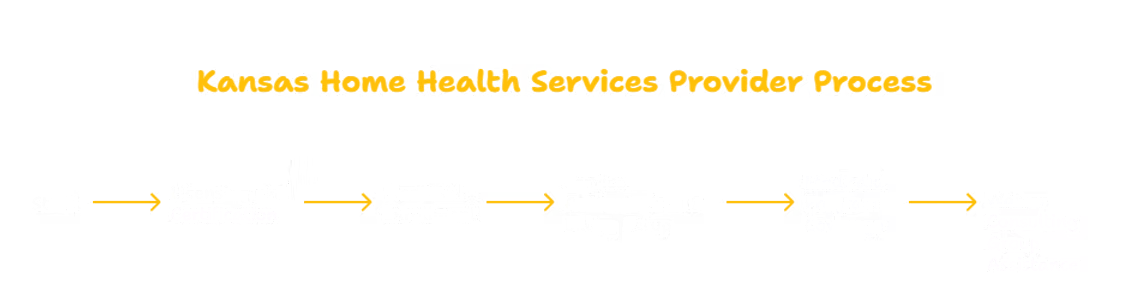
The journey to becoming a fully operational Kansas home health provider follows a structured, sequential path. The process begins with basic business formation, including registration with the Kansas Secretary of State and obtaining a federal Employer Identification Number (EIN) and a Type 2 National Provider Identifier (NPI). These foundational steps allow the business to initiate the formal licensure and enrollment applications required to bill for services.
Providers must navigate a phased enrollment process to achieve full eligibility:
- Phase 1: Licensing and Certification: Submit the application to KDHE for a state home health agency license and undergo a mandatory Life Safety Code and health inspection survey. If dual Medicare-Medicaid billing is desired, a separate application must be filed with CMS.
- Phase 2: Medicaid Enrollment: Enroll through the Kansas Medical Assistance Program (KMAP) as a designated Home Health Services provider and secure credentialing and service contracts with the three KanCare MCOs: Sunflower Health Plan, UnitedHealthcare, and Aetna Better Health of Kansas.
- Phase 3: Billing and Authorization: Establish internal systems to submit participant Plans of Care to MCOs for clinical authorization and initiate billing using the appropriate HCPCS codes.
Maintaining Compliance through Documentation and Staffing
Administrative and clinical excellence is maintained through a robust Policy and Procedure Manual that addresses every aspect of care delivery. This manual must be audit-ready and include comprehensive sections on admission assessments, physician order management, HIPAA compliance, infection control protocols, and formal grievance procedures. Ensuring that all clinical documentation matches the services billed is the primary defense against recoupment and audit findings.
Staffing requirements are equally rigorous, requiring a qualified workforce capable of meeting Kansas-specific clinical standards:
- Administrator/Director of Nursing: A Registered Nurse (RN) with an active Kansas license, proven supervisory experience, and a clean background check.
- Registered Nurses (RNs) and Licensed Practical Nurses (LPNs): Must hold active Kansas nursing licenses, maintain current CPR certification, and ideally possess prior home health experience.
- Home Health Aides: Must have successfully completed a KDADS-approved nurse aide training program and be actively listed on the Kansas CNA/HHA registry.
- Therapists and Social Workers: Must hold appropriate current Kansas licensure for their specific discipline and have documented experience in home-based service delivery.
Frequently Asked Questions
What are the primary HCBS waiver programs that utilize home health services?
Home health services are integrated into several Kansas HCBS waivers to support aging and disabled populations. Primary programs include the Physical Disability (PD) Waiver, Technology Assisted (TA) Waiver, Frail Elderly (FE) Waiver, and the Brain Injury (BI) Waiver. In limited capacities, these services may also be accessed through the Intellectual/Developmental Disability (IDD) Waiver.
How often must a Plan of Care be reviewed for a home health patient?
Under current Kansas Medicaid and standard regulatory guidelines, every patient’s Plan of Care (POC) must be reviewed by the physician at least every 60 days. This review ensures that services remain medically necessary and aligned with the participant's current health status.
What is the typical timeline to launch a new home health agency?
Launching a compliant agency is a multi-month process. Business registration and initial policy development typically take 1–3 months, followed by 2–3 months for staff hiring and credentialing. CMS certification and Medicaid/MCO enrollment can add another 60–120 days, with final billing system setup requiring an additional 30–45 days.
Key Takeaway for Prospective Providers
Success as a home health provider in Kansas relies on a strict adherence to the regulatory interplay between KDHE licensure, KMAP enrollment, and MCO service authorization. By building a comprehensive, audit-ready clinical documentation system and ensuring all staff meet state-mandated training and background requirements, agencies can provide essential medical support while remaining sustainable in the KanCare marketplace.
Last verified: 2024. The information provided herein is for educational purposes only and does not constitute legal or financial advice. We recommend verifying current Kansas Medicaid policies and regulatory requirements directly through the official KMAP, KDHE, and KDADS portals before initiating your agency's startup or enrollment process.