HOME HEALTH SERVICES PROVIDER IN IOWA
By Fatumata Kaba · 2025-07-22 · 5 min read
Becoming a home health services provider in Iowa requires a rigorous commitment to clinical standards, regulatory compliance, and administrative oversight. By obtaining the necessary licensure from the Iowa Department of Inspections, Appeals, and Licensing (DIAL) and enrolling with the Iowa Medicaid Enterprise (IME), agencies can deliver essential skilled nursing, therapy, and supportive care that enables patients to recover and age with dignity in their own homes.
Understanding the Regulatory Landscape for Iowa Home Health Agencies
The Iowa home health industry operates under a multi-layered regulatory framework designed to protect vulnerable populations and ensure the delivery of high-quality, medically necessary care. Compliance is not merely a legal requirement; it is the foundation for operational viability and the ability to bill Medicaid and Medicare for services rendered. Providers must align their clinical and administrative processes with both state-specific statutes and federal Conditions of Participation (CoPs).
The Iowa Department of Inspections, Appeals, and Licensing (DIAL) serves as the primary gateway for licensure, while the Iowa Department of Health and Human Services (HHS) and its Iowa Medicaid Enterprise (IME) oversee the enrollment and reimbursement processes. Furthermore, agencies seeking to participate in federal programs must satisfy the rigorous oversight criteria mandated by the Centers for Medicare & Medicaid Services (CMS). Navigating these agencies requires a systematic approach to policy development, clinical documentation, and staff credentialing.
Developing the Foundational Infrastructure for Your Agency
Before an agency can accept its first patient, it must establish a formal business structure and operational infrastructure. This involves registering the entity with the Iowa Secretary of State, securing a federal Employer Identification Number (EIN), and obtaining a National Provider Identifier (NPI) Type 2. These identifiers are essential for all subsequent state and federal applications, including Medicaid provider enrollment and potential Medicare certification.
Equally important is the creation of a comprehensive policy and procedure manual. This document serves as the "source of truth" for agency operations, detailing internal protocols for intake, assessment, the development of the Plan of Care (POC), infection control, and emergency preparedness. An agency’s ability to pass a DIAL survey is directly linked to its ability to demonstrate that these policies are not only written but are consistently practiced by all clinical and administrative personnel.
The Licensing and Enrollment Lifecycle
The path to becoming an active provider involves a phased approach that starts with the DIAL licensure process. Applicants must submit detailed documentation, including service descriptions, evidence of staff qualifications, and robust operational policies. Following the application submission, the agency will undergo a pre-licensure survey and a Life Safety Code review to ensure the physical environment and administrative systems meet safety and quality standards.
Once licensure is obtained, the focus shifts to enrollment with the Iowa Medicaid Enterprise via the Medicaid Provider Portal. For agencies intending to serve a broader patient base, the submission of a CMS 855A application through the Provider Enrollment, Chain, and Ownership System (PECOS) is the necessary step toward Medicare certification. This phase concludes with the implementation of sophisticated billing systems capable of managing the unit-based and episodic payment structures common in home health reimbursement.
Defining Scope of Services and Clinical Staffing
Home health services are defined by their medically necessary, intermittent nature and are provided under the direct orders of a physician. A successful agency must be equipped to deliver a range of services, including skilled nursing for wound care and medication management, physical, occupational, and speech-language therapy, and home health aide services. These services must be documented within a patient-specific Plan of Care, which is subject to mandatory review and updates every 60 days to reflect the patient's changing health status.
Staffing requirements are stringent to ensure the safety and wellbeing of patients. Agencies must recruit licensed professionals, including Registered Nurses (RNs), Licensed Practical Nurses (LPNs), and certified therapists, who all require active Iowa licenses and verified clinical experience. Furthermore, Home Health Aides (HHAs) must successfully complete a 75-hour state-approved training program and undergo regular competency evaluations. Ongoing training in HIPAA, infection control, and abuse prevention is mandatory for all team members to maintain compliance.
Strategic Implementation and Launch Timeline
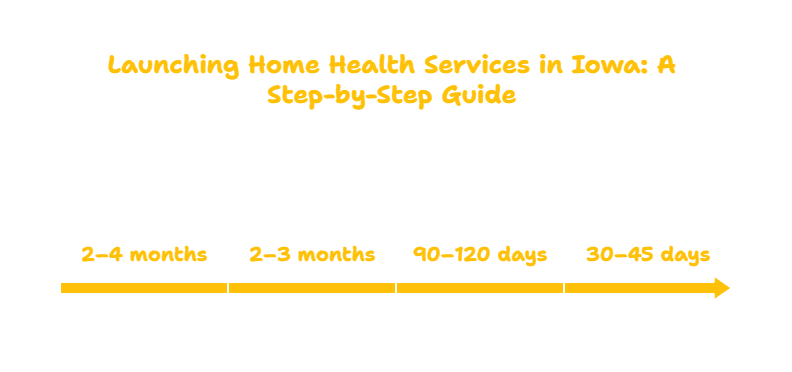
Launching a home health agency is an intensive process that typically spans nine to twelve months. The initial 2–4 months should be dedicated to business formation, licensing submissions to DIAL, and the drafting of essential internal policies. This is followed by a period of 2–3 months focused on active recruiting, credentialing staff, and preparing for the inevitable regulatory surveys.
The final phase involves the actual DIAL and CMS survey process, which can take between 90 to 120 days depending on agency readiness and surveyor availability. Once licensed and enrolled in Medicaid, the final 30–45 days should be utilized to finalize billing workflows, test software integrations, and conduct a final "mock survey" to ensure the agency is prepared for day-to-day operations and future quality audits.
Frequently Asked Questions
What are the primary requirements for a physician-ordered Plan of Care?
A Plan of Care must be developed in collaboration with a physician and must outline the specific medical needs, frequency of visits, and intended outcomes for the patient. It must be signed by the physician and formally reviewed and updated at least every 60 days to ensure that the services remain medically necessary.
How does an agency ensure it remains compliant with Medicaid audit requirements?
Compliance is maintained through rigorous clinical documentation that mirrors the services provided in the home. Agencies must keep accurate records of nurse and aide visits, clinical progress notes, and clear evidence of communication with the patient’s primary care team, ensuring that all claims submitted for reimbursement are fully substantiated by the patient's medical record.
What is the difference between DIAL licensure and CMS certification?
DIAL licensure is the state-level requirement to legally operate a home health agency within Iowa, while CMS certification is the federal requirement to receive payment for services provided to Medicare beneficiaries. While many agencies pursue both, they involve distinct application processes and separate sets of federal and state oversight standards.
Key Takeaway: Establishing a successful home health agency in Iowa is a long-term investment that requires strict adherence to DIAL licensing standards, consistent clinical documentation, and a proactive approach to Medicaid and Medicare enrollment. By focusing on high-quality care delivery and robust administrative oversight, providers can successfully navigate the regulatory complexities and build a sustainable, compliant organization.
Last verified: 2024. Waiver Consulting Group provides professional information and consulting services related to home health and Medicaid waiver programs. The information contained in this article is for educational purposes only and does not constitute legal or professional medical advice. Always consult with state regulatory agencies and legal counsel to ensure your business operations comply with current Iowa and federal laws.