HOME HEALTH SERVICES PROVIDER IN IDAHO
By Fatumata Kaba · 2025-07-18 · 5 min read
DELIVERING SKILLED NURSING, THERAPEUTIC, AND PERSONAL SUPPORT SERVICES IN THE COMFORT OF PARTICIPANTS’ HOMES
Home Health Services in Idaho provide essential medical care, rehabilitation therapy, and supportive clinical oversight to individuals who require professional intervention to remain safely in their own residences. These services are authorized under the Idaho Medicaid State Plan and various Home and Community-Based Services (HCBS) waiver programs, playing a critical role in promoting long-term health, facilitating recovery, and preventing unnecessary institutionalization for Idaho’s vulnerable populations.
Understanding the Regulatory Landscape and Governing Agencies
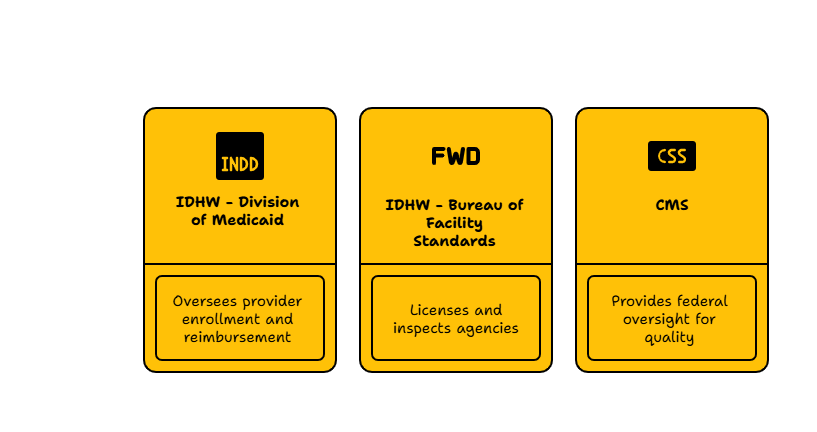
Operating a home health agency in Idaho requires strict adherence to oversight provided by multiple layers of state and federal government. The Idaho Department of Health and Welfare (IDHW) — Division of Medicaid manages provider enrollment, ensures service authorization compliance, and oversees the reimbursement mechanisms for all Home Health Services. Concurrently, the IDHW Bureau of Facility Standards holds the authority to license and inspect home health agencies, ensuring that all operations meet state-mandated safety and quality-of-care standards.
Beyond the state level, the Centers for Medicare & Medicaid Services (CMS) maintains federal oversight. Their involvement ensures that Home Health Services delivered within the state align with established national standards for quality, safety, and operational excellence. Prospective providers must maintain transparency and compliance across these three primary regulatory pillars to remain in good standing.
Defining the Scope of Home Health Services
Home Health Services consist of medically necessary skilled care delivered to participants who are considered homebound or who otherwise require intermittent skilled services. These services are designed to stabilize a participant's condition, facilitate rehabilitation, or prevent further health decline. All services must be ordered by a physician and strictly adhere to an individualized Plan of Care (POC) that sets measurable goals for the participant.
Approved providers are authorized to deliver a diverse range of clinical and therapeutic support, including:
- Skilled nursing services, such as health monitoring, complex medication administration, and wound care.
- Physical therapy (PT) for mobility training and strength rehabilitation.
- Occupational therapy (OT) focused on activities of daily living (ADL) support and adaptive techniques.
- Speech-language pathology (SLP) for speech, language, or swallowing therapy.
- Home health aide services, providing basic personal care under the direct supervision of a registered nurse.
- Medical social work to assist with counseling, discharge planning, and essential resource linkage.
Navigating Licensing and Provider Approval Requirements
Establishing an agency is a multi-step process that begins with foundational business registration. Providers must register their business entity with the Idaho Secretary of State, obtain an Employer Identification Number (EIN) from the IRS, and secure a Type 2 National Provider Identifier (NPI). These are the prerequisites that allow an entity to operate legally before seeking healthcare-specific licensure.
The transition into healthcare provision requires obtaining a Home Health Agency License through the IDHW Bureau of Facility Standards. While Medicare certification is technically optional, it is highly recommended for agencies aiming to maximize their reach, especially when serving dual-eligible participants. Following licensure, agencies must complete the formal enrollment process through Idaho’s Medicaid Provider Enrollment system. Throughout this phase, the agency must maintain robust general liability, professional liability, and malpractice insurance to mitigate risks associated with clinical service delivery.
The IDHW Provider Enrollment and Licensing Sequence
The enrollment sequence is a rigorous, structured path. It begins with the initial license application to the Bureau of Facility Standards, which triggers a comprehensive pre-licensure inspection. This inspection evaluates the agency’s capacity to handle staffing, patient care protocols, infection control, and emergency planning. Agencies must be prepared to demonstrate that their operational policies are not merely written, but actively implemented in their daily workflows.
Following the inspection, the agency must submit exhaustive documentation, including Articles of Incorporation, staff credentialing records, and detailed emergency response plans. Once the Bureau of Facility Standards grants the license and the agency completes any necessary Medicare surveys, they must finalize their enrollment in the Idaho Medicaid Management Information System (MMIS). Only after this final configuration of billing codes can an agency begin to submit claims for skilled nursing, therapy, and medical social work services.
Essential Operational Documentation and Policy Requirements
Operational success relies heavily on the creation of a comprehensive, HCBS-compliant Policy & Procedure Manual. This document serves as the backbone of the agency's audit readiness and daily clinical operations. It must clearly outline the processes for participant intake, physician order verification, and the development of ongoing care plans.
Beyond intake, the manual must detail specific service delivery protocols for every discipline provided. It should also house policies regarding HIPAA confidentiality, the protection of participant rights, and formal grievance procedures. Finally, it must include a framework for staff credentialing, regular background checks, and documentation that shows consistent clinical supervision. Establishing these systems early prevents common administrative errors during the critical first year of operation.
Staffing Standards and Clinical Competency
High-quality home health care is contingent upon the qualifications and training of the clinical staff. The Administrator or Director of Nursing (DON) must be a licensed Registered Nurse (RN) in Idaho with verified management experience and a clear background screening. All skilled nursing staff, including LPNs, must hold active Idaho licenses and maintain current CPR certification.
Licensed therapists (PTs, OTs, and SLPs) and medical social workers must also maintain active Idaho licensure in their respective disciplines. Home Health Aides are required to hold certification from an approved training program and must operate under the oversight of an RN. All personnel, regardless of their role, are required to undergo comprehensive training in HIPAA compliance, participant rights, infection control, and emergency incident management to ensure the safety and privacy of the participants served.
Frequently Asked Questions
What are the primary Medicaid programs that authorize Home Health Services?
Home Health Services are authorized through the Medicaid State Plan Home Health Benefit, the Aged and Disabled (A&D) Waiver, and the Developmental Disabilities (DD) Waiver for specific skilled interventions.
How long should an agency expect the entire startup process to take?
The timeline is typically segmented into phases: 2–4 months for business formation, 2–3 months for clinical development, 3–6 months for licensure and certification, and 45–60 days for final Medicaid enrollment and billing configuration.
What is the role of the IDHW Bureau of Facility Standards?
The Bureau of Facility Standards is responsible for licensing and inspecting home health agencies operating in Idaho, ensuring that they comply with state quality and safety regulations before and during their period of operation.
Key Takeaway
Launching a home health agency in Idaho is a complex, multi-agency process that requires meticulous attention to licensing, clinical policy development, and Medicaid billing standards. Success is predicated on the agency’s ability to build a compliant infrastructure that supports high-quality patient outcomes while adhering to the stringent requirements set by the Idaho Department of Health and Welfare and federal guidelines.
Last verified: September 2023. Disclaimer: This information is for educational purposes only and does not constitute legal or professional advice. Always consult with the Idaho Department of Health and Welfare or a qualified consultant before making business decisions.