HOME HEALTH SERVICES PROVIDER IN HAWAII
By Fatumata Kaba · 2025-07-16 · 5 min read
Home Health Services in Hawaii provide essential clinical, therapeutic, and supportive care for individuals who require medical oversight but prefer the comfort and independence of remaining in their own homes. These services, authorized under the Hawaii Medicaid State Plan, Home and Community-Based Services (HCBS) waiver programs, and Medicare, are vital for managing chronic conditions, facilitating recovery, and preventing unnecessary institutionalization.
Launching a Home Health Agency in Hawaii requires navigating a rigorous regulatory landscape governed by both state and federal agencies. Prospective providers must demonstrate clinical competence, operational readiness, and strict adherence to documentation standards to secure licensure through the Hawaii Department of Health and provider status with the Med-QUEST Division.
Understanding the Governing Regulatory Framework
The Hawaii home health landscape is shaped by the intersection of state-specific licensing and federal oversight. The Hawaii Department of Health (DOH), through the Office of Health Care Assurance (OHCA), serves as the primary regulatory body for licensure. OHCA is responsible for inspecting agencies to ensure they meet the specific health and safety standards mandated for clinical care delivery in the home setting.
Simultaneously, the Hawaii Department of Human Services (DHS) Med-QUEST Division manages the Medicaid aspect of the business. Med-QUEST oversees provider enrollment, the authorization of services, and the eventual reimbursement for claims. Finally, the Centers for Medicare & Medicaid Services (CMS) provides the overarching federal framework, ensuring that services provided under Medicaid and Medicare meet consistent, high-quality standards of care across the country.
Defining the Scope of Home Health Services
Home Health Services represent a multifaceted approach to care, combining professional medical intervention with personal support. Approved providers offer a diverse range of disciplines, ensuring that participants receive care tailored to their unique medical, physical, and psychological needs as outlined in their individualized Plan of Care (POC).
To ensure clinical integrity, all services must be initiated by a physician’s order. The following services form the core of a compliant home health program:
- Skilled Nursing: Including wound care, complex medication administration, and chronic disease monitoring.
- Physical Therapy (PT): Focusing on mobility training, strength rehabilitation, and injury prevention.
- Occupational Therapy (OT): Assisting with ADL (Activities of Daily Living) skill-building and the use of adaptive equipment.
- Speech-Language Pathology (SLP): Providing therapy for speech, language, and swallowing disorders.
- Medical Social Work (MSW): Offering psychosocial assessments and counseling to address barriers to health.
- Home Health Aide Services: Delivering basic personal care under the direct supervision of a registered nurse.
Licensing and Initial Provider Requirements
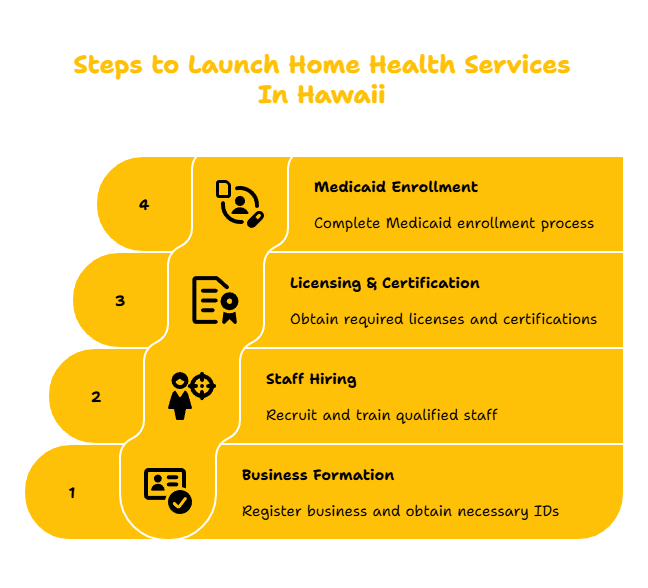
Establishing a legally compliant agency begins with fundamental business formation and moves into clinical credentialing. Founders must register their business with the Hawaii Department of Commerce and Consumer Affairs (DCCA) and secure an Employer Identification Number (EIN) from the IRS. Additionally, a Type 2 National Provider Identifier (NPI) is necessary to facilitate billing and professional identification.
Following business registration, the agency must apply for a license through OHCA. This phase involves preparing for a Pre-Licensure Survey, which evaluates the agency’s physical readiness, staffing qualifications, and internal protocols. While Medicare certification is voluntary, it is strongly recommended for agencies seeking to optimize their revenue cycle by serving the dual-eligible population. Throughout this process, agencies must maintain comprehensive insurance coverage, including general liability, professional liability, and malpractice insurance.
Navigating the Med-QUEST Provider Enrollment Process
The transition from a licensed entity to an active Medicaid provider requires a structured approach to the Med-QUEST enrollment process. Once the OHCA license is secured, the provider must submit the necessary documentation to the DHS, which includes proof of licensure, staffing credentialing, and detailed operational policies. The agency’s documentation must demonstrate that they have robust quality assurance and emergency preparedness systems in place.
Once enrolled, the agency must configure its internal systems for proper billing. This includes mapping services to the correct billing codes for Skilled Nursing, therapy, and aide services. Success in this phase is contingent upon audit readiness; agencies must prove that every unit of service billed is substantiated by a corresponding physician’s order, a current Plan of Care, and documented clinical progress notes.
Staffing, Training, and Clinical Compliance
Clinical excellence is non-negotiable in home health. The Director of Nursing (DON) or Administrator must hold an active Hawaii RN license and possess significant experience in home care operations. All clinical staff, including PTs, OTs, SLPs, and MSWs, are required to hold active professional licenses in their respective disciplines. Home Health Aides must complete a state-approved training program to be eligible for placement.
Beyond initial hiring, agencies must maintain a culture of ongoing education. Mandatory training requirements include:
- HIPAA confidentiality and rigorous protection of participant rights.
- Infection control protocols and emergency disaster response.
- Proactive abuse and neglect prevention.
- Annual continuing education focusing on evolving clinical best practices and Medicaid compliance.
Frequently Asked Questions
What is the difference between HCBS waiver services and Medicaid State Plan services?
The Medicaid State Plan provides standard home health benefits that are typically short-term or recovery-focused, whereas HCBS waiver programs are designed for individuals who require long-term supports to remain in the community, often providing a broader scope of services tailored to chronic needs.
Is Medicare certification mandatory for Hawaii Home Health providers?
Medicare certification is not legally required for basic Medicaid enrollment, but it is highly recommended. It allows providers to bill for a wider range of patients and typically signals a higher level of institutional compliance to state auditors and managed care organizations.
How long does the licensing and enrollment process typically take?
The entire launch lifecycle, from business formation to active billing, generally spans 9 to 15 months. This includes 2–4 months for business setup, 3–6 months for OHCA and CMS surveys, and 60–90 days for final Med-QUEST enrollment.
Key Takeaways for Agency Founders
Success in the Hawaii home health market depends on a clear understanding of the regulatory timeline and a disciplined approach to documentation. By aligning business operations with the specific requirements of the Hawaii Department of Health and the Med-QUEST Division, providers can build a sustainable model that meets the high clinical standards expected in home-based care. Prioritize the development of a robust Policy and Procedure Manual early in the process to ensure all staff and administrative systems are audit-ready from day one.
Last verified: 2024. The information provided in this article is for educational purposes only and does not constitute legal or professional consulting advice. Regulations regarding Medicaid, HCBS waivers, and home health licensure are subject to change; always consult with the Hawaii Department of Human Services (DHS) or the Office of Health Care Assurance (OHCA) for the most current regulatory requirements.