HOME HEALTH SERVICES PROVIDER IN GEORGIA
By Fatumata Kaba · 2025-07-14 · 5 min read
DELIVERING SKILLED NURSING, THERAPY, AND PERSONAL CARE SERVICES TO INDIVIDUALS IN THE COMFORT OF THEIR OWN HOMES
Home Health Services in Georgia provide medically necessary clinical care, therapeutic interventions, and supportive assistance to individuals with disabilities, chronic illnesses, or post-acute medical needs. These services are authorized under Georgia’s Medicaid State Plan, certain HCBS waiver programs, and Medicare, ensuring individuals receive high-quality care at home, promoting health, safety, and independence.
What Are the Governing Agencies for Home Health in Georgia?
The regulatory landscape for home health providers in Georgia is multifaceted, requiring coordination between state-level licensing authorities and federal oversight bodies. The primary state entity is the Georgia Department of Community Health (DCH), specifically the Healthcare Facility Regulation Division (HFRD). This division is responsible for the licensing of home health agencies and the ongoing monitoring of their compliance with state and federal health and safety standards.
Beyond state licensure, agencies seeking reimbursement through government-funded programs must interface with the DCH Medicaid Division, which oversees Medicaid enrollment, service authorization, and payment processing. Furthermore, for providers pursuing Medicare certification, the Centers for Medicare & Medicaid Services (CMS) provides federal oversight. CMS ensures that agencies adhere to the strict Conditions of Participation (CoPs), which dictate the minimum standards for clinical quality and operational governance.
How Do Providers Deliver Clinical and Rehabilitative Care?
Home Health Services are defined by the delivery of intermittent clinical and rehabilitative care to individuals who are homebound or require structured medical support within their personal residence. To be eligible for these services, a participant must have a physician’s prescription, a formalized comprehensive care plan, and documentation of ongoing medical necessity. This ensures that every intervention is targeted toward improving the patient's health outcomes or maintaining their functional independence.
Approved providers are authorized to deliver a specific suite of clinical services designed to support complex recovery and health management needs. These services include:
- Skilled Nursing: Provision of specialized care, including medication management, wound care, IV therapy, and chronic disease management.
- Therapy Services: Physical Therapy (PT) for mobility and strength; Occupational Therapy (OT) for ADL skill training; and Speech-Language Pathology (SLP) for communication and swallowing therapy.
- Ancillary Support: Medical Social Worker services for psychosocial assessments and resource referrals, alongside Certified Home Health Aide services for personal care under nurse supervision.
What Are the Prerequisites for Licensure and Provider Approval?
Establishing a Home Health Agency in Georgia is a rigorous process that begins with formal business formation. Prospective providers must first register their business entity with the Georgia Secretary of State and secure necessary identifiers, including an Employer Identification Number (EIN) from the IRS and a Type 2 National Provider Identifier (NPI). These are foundational steps that precede the specialized healthcare-specific approvals.
Following business registration, the agency must apply for a license through the DCH Healthcare Facility Regulation Division (HFRD). While Medicare certification is technically optional, it is a critical requirement for agencies intending to pursue dual Medicare/Medicaid billing. Providers must also secure comprehensive insurance coverage, including general liability, professional liability, and workers’ compensation, to protect both the organization and the patients they serve.
How Is the DCH Provider Enrollment Process Sequenced?
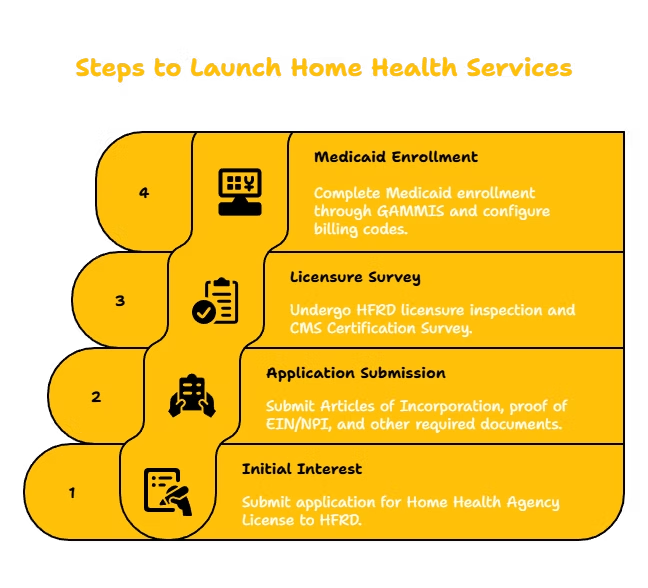
The enrollment process for Georgia Medicaid is structured to ensure that only compliant and prepared agencies enter the provider network. The journey begins with the submission of the licensure application to the HFRD. Once the application is under review, the agency must prepare for a rigorous Pre-Licensure Survey. This assessment evaluates the agency’s physical readiness, the completeness of its clinical policies, and the adequacy of its staff credentialing protocols.
After the initial documentation submission—which includes Articles of Incorporation, proof of EIN/NPI, and comprehensive clinical protocols—the HFRD conducts a formal licensure inspection. If the agency is seeking Medicare participation, it must also undergo a separate CMS Certification Survey. Upon successful completion of these surveys and issuance of the license, the final phase involves completing the enrollment through the Georgia Medicaid Management Information System (GAMMIS) and configuring the appropriate billing codes for service reimbursement.
What Are the Mandatory Documentation and Staffing Standards?
Compliance is centered on a robust Policy & Procedure Manual that addresses every facet of daily operations. Essential documentation includes protocols for participant intake, physician orders, care planning, medication management, and infection control. Furthermore, agencies must maintain detailed records regarding emergency preparedness, HIPAA compliance, and a formalized Quality Assurance and Performance Improvement (QAPI) program, which is essential for audit readiness.
Staffing requirements are equally stringent to ensure patient safety and quality of care. Key personnel, such as the Administrator or Director of Nursing (DON), must possess an active Georgia RN license and proven experience in healthcare operations. All clinical staff, including RNs, LPNs, PTs, OTs, SLPs, and Certified Home Health Aides, must undergo background screening clearance and maintain current professional certifications. Training requirements include:
- HIPAA confidentiality, participant rights, and mandatory abuse prevention training.
- Emergency response and infection control protocols specific to home settings.
- Annual competency assessments and continuous professional education.
- Compliance training regarding specialized documentation and care plan execution.
Frequently Asked Questions
What is the timeline for launching a Home Health Agency in Georgia?
The timeline typically spans 8 to 16 months. Business formation and initial licensing take 1–2 months, followed by 3–6 months for facility setup and survey preparation. If pursuing CMS certification, an additional 3–6 months may be required, with a final 1–2 months for Medicaid billing system setup.
Which Medicaid programs cover Home Health Services?
Home Health Services are covered under the Medicaid State Plan for those meeting skilled need criteria, the Elderly and Disabled Waiver Program (EDWP) for personal support extensions, and the Georgia Pediatric Program (GAPP) for medically fragile children.
What documentation is needed for the Medicaid enrollment portal?
Providers must submit their Articles of Incorporation, EIN confirmation, NPI confirmation, valid HFRD Home Health Agency License, proof of professional and general liability insurance, and evidence of Medicare certification if applicable.
Key Takeaways for Prospective Providers
Launching a Home Health Agency in Georgia requires strict adherence to state licensing via the DCH HFRD and federal standards via CMS. Success is predicated on the development of a comprehensive Policy & Procedure Manual, the hiring of credentialed clinical staff, and the successful completion of the GAMMIS enrollment process. By maintaining a focus on quality assurance and rigorous documentation, agencies can ensure long-term compliance and sustainability in the Medicaid provider network.
Last verified: [Current Date]. Disclaimer: This information is for educational purposes only and does not constitute legal or professional consulting advice. Requirements for healthcare providers in Georgia are subject to change; always verify current regulations directly with the Georgia Department of Community Health and the Centers for Medicare & Medicaid Services.