HOME HEALTH SERVICES PROVIDER IN FLORIDA
By Fatumata Kaba · 2025-07-09 · 5 min read
Launching a Home Health Services agency in Florida requires navigating a rigorous regulatory landscape governed by both state and federal authorities to ensure the delivery of high-quality, person-centered medical and personal care. As a provider, your organization must secure appropriate licensure through the Florida Agency for Health Care Administration (AHCA) and maintain continuous compliance with the Centers for Medicare & Medicaid Services (CMS) standards to participate in Florida’s Medicaid and Home and Community-Based Services (HCBS) programs.
What Are the Governing Agencies and Regulatory Requirements?
The operational framework for Florida home health providers is anchored by three primary entities, each serving a distinct role in oversight and quality assurance. The Florida Agency for Health Care Administration (AHCA) acts as the primary licensing body, responsible for the initial issuance of the Home Health Agency license and the ongoing monitoring of regulatory compliance across the state. Without AHCA approval, an agency cannot legally operate or bill for services within the Florida Medicaid ecosystem.
Complementing this, the Florida Department of Health (DOH) oversees the professional practice standards of the clinicians—nurses, therapists, and aides—who provide the actual patient care. Finally, the Centers for Medicare & Medicaid Services (CMS) provides the federal guidelines that dictate reimbursement protocols and clinical documentation requirements. Adherence to these multi-layered regulations is non-negotiable for agencies seeking to remain in good standing.
How Do You Obtain a Home Health Agency License in Florida?
The path to licensure begins with the formal registration of the business entity via the Florida Division of Corporations (Sunbiz). Following corporate formation, providers must secure an Employer Identification Number (EIN) from the IRS and a Type 2 National Provider Identifier (NPI). These identifiers are fundamental to establishing the business as a legal entity capable of entering contracts and submitting claims for medical services.
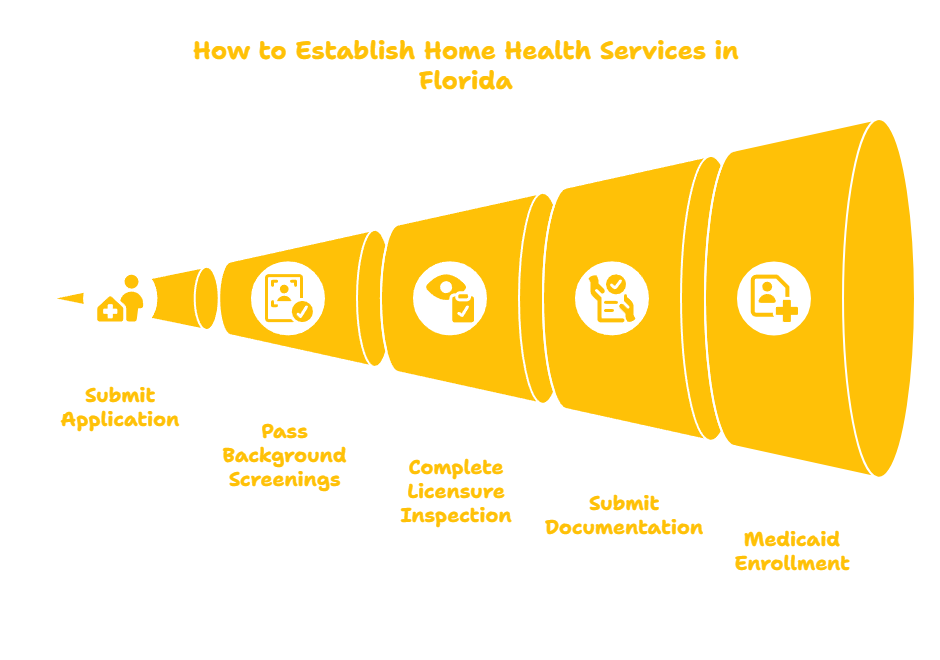
Once registered, the applicant must complete the AHCA Home Health Agency licensing application. This process involves a comprehensive review of the agency’s operational infrastructure, including proof of liability insurance—specifically general, professional, and worker’s compensation—and verification that the physical location meets all local zoning, fire safety, and health ordinances. The culmination of this phase is a mandatory licensure inspection by AHCA, which serves as the final barrier to operational entry.
- Register with Florida Sunbiz and obtain federal EIN and Type 2 NPI.
- Submit comprehensive AHCA Home Health Agency application and fee.
- Provide proof of insurance coverage: general liability, professional malpractice, and worker’s compensation.
- Complete the initial AHCA licensure inspection for facility compliance.
- Secure and maintain site-specific zoning and fire safety approvals.
What Clinical and Administrative Infrastructure Is Required?
A successful provider must maintain a robust Policy & Procedure manual that covers the entire spectrum of service delivery. This includes standardized protocols for participant intake, clinical assessment, and the development of personalized plans of care. Because services must always be rendered under a physician’s order, administrative systems must be designed to track and verify these orders consistently to ensure compliance during audits.
Beyond clinical oversight, agencies must implement rigid internal controls for HIPAA compliance, grievance resolution, and infection control. Recordkeeping is a cornerstone of the Florida Medicaid program; therefore, every agency must maintain meticulous documentation of skilled nursing services, therapy logs, and aide-provided Activities of Daily Living (ADLs). Establishing these systems before the agency begins operations ensures that the quality assurance and incident management workflows are ready for state review.
How Do You Navigate the Medicaid Enrollment Process?
Licensure is the prerequisite for Medicaid enrollment, not the final step. Once the AHCA license is in hand, the provider must navigate the Florida Medicaid Provider Enrollment Portal to gain status as an authorized Medicaid provider. This step involves configuring the agency’s billing system to align with specific Medicaid codes for the services the agency intends to offer, such as intermittent skilled nursing, occupational therapy, or personal care support.
During the enrollment phase, the provider must demonstrate the capacity to manage billing, service documentation, and authorization tracking accurately. It is common for the Medicaid program to require a Readiness Review. This process ensures that the provider understands the nuances of the Statewide Medicaid Managed Care (SMMC) Long-Term Care (LTC) program, as well as the documentation requirements for the iBudget Florida Waiver, should the agency choose to serve the developmental disability population.
What Are the Essential Staffing and Competency Standards?
Quality of care is inextricably linked to the credentials of the agency’s staff. The Administrator must possess at least two years of supervisory or administrative experience, while the Director of Nursing (DON) is required to be an active Florida-licensed Registered Nurse (RN) with at least two years of relevant experience. Every staff member, from skilled nurses to home health aides, must undergo rigorous background screenings before providing direct care.
Continuous education is a regulatory requirement in Florida. Agencies are responsible for ensuring that all staff receive ongoing training in emergency preparedness, infection control, HIPAA confidentiality, and patient rights. Documenting these annual competency evaluations is not just a clinical best practice; it is a critical component of maintaining licensure and successfully passing AHCA surveys.
- Administrator: Requires two years of management experience and background clearance.
- Director of Nursing: Requires active Florida RN license and two years of clinical experience.
- Skilled Nurses: Must hold current, active Florida licenses and maintain CPR certification.
- Aides: Must be certified as a CNA or have completed at least 75 hours of state-approved HHA training.
- Mandatory Training: All staff must complete HIPAA, infection control, and emergency preparedness modules.
Frequently Asked Questions
What is the typical timeline for launching a home health agency?
The launch process is divided into phases: business formation (2–4 weeks), AHCA licensure (90–120 days), Medicaid enrollment (45–60 days), and staff readiness (30–45 days). These timelines are estimates based on standard processing times and may vary based on application accuracy and agency responsiveness.
Are home health services covered by the Florida iBudget Waiver?
Yes, the Florida iBudget Florida Waiver authorizes specific services for participants, including limited skilled nursing services. These services are typically tied to behavioral or developmental needs and must be clearly defined within the participant's individual support plan and authorized by the Agency for Persons with Disabilities (APD).
Can a home health agency provide both medical and personal care?
Yes, licensed Home Health Agencies in Florida are authorized to provide a spectrum of services, including skilled nursing (e.g., wound care, medication management), therapy (PT, OT, ST), and personal care services provided by CNAs or Home Health Aides, provided the services are part of an authorized physician’s plan of care.
Key Takeaway
Starting a Home Health Services provider in Florida is a complex undertaking that demands strict adherence to AHCA, DOH, and CMS regulations. By prioritizing rigorous policy development, credentialing, and systematic documentation, agencies can position themselves to successfully navigate the licensing and Medicaid enrollment processes, ultimately delivering essential care to those in need.
Last verified: October 2023. Disclaimer: This article is for informational purposes only and does not constitute legal or professional advice. Always consult with the Florida Agency for Health Care Administration (AHCA) and legal counsel for specific regulatory requirements and updates.