HOME HEALTH SERVICES PROVIDER IN DELAWARE
By Fatumata Kaba · 2025-07-07 · 6 min read
Establishing a Home Health Services provider in Delaware requires navigating a rigorous regulatory landscape designed to ensure high-quality clinical care for vulnerable populations. This process involves aligning business operations with the standards set by the Delaware Division of Public Health (DPH) and the Delaware Division of Medicaid and Medical Assistance (DMMA) to deliver medically necessary, skilled nursing and therapeutic services in a home-based setting.
Home health providers in Delaware play a critical role in the state's healthcare infrastructure by preventing institutionalization and supporting individuals within the least restrictive environment possible. Whether serving participants under the Delaware Medicaid State Plan or the Lifespan Waiver, agencies must demonstrate institutional stability, clinical oversight, and strict adherence to state and federal protocols to maintain eligibility and reimbursement status.
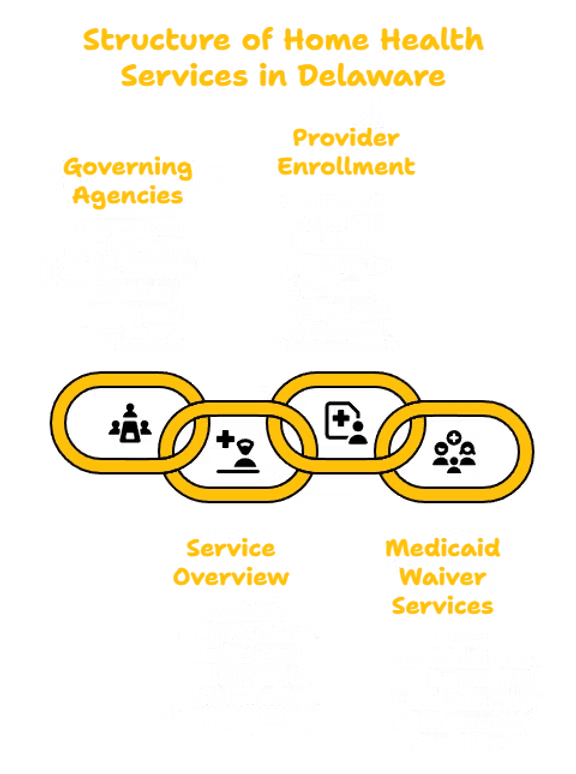
What Are the Governing Agencies for Delaware Home Health Providers?
The regulatory framework for home health care in Delaware is multifaceted, involving several state and federal bodies to ensure participant safety and fiscal integrity. The Delaware Division of Medicaid and Medical Assistance (DMMA) serves as the primary authority for Medicaid reimbursement and eligibility, setting the standards for how services are billed and who qualifies for coverage. Simultaneously, the Delaware Division of Public Health (DPH), specifically the Office of Health Facilities Licensing and Certification, is responsible for the licensure and ongoing inspection of Home Health Agencies (HHAs) to verify compliance with safety and care standards.
Beyond these state entities, the Delaware Division of Developmental Disabilities Services (DDDS) manages the authorization of services for individuals enrolled in the Lifespan Waiver, necessitating close coordination between providers and state case management teams. Finally, at the federal level, the Centers for Medicare & Medicaid Services (CMS) provides the overarching regulatory oversight, ensuring that state-level programs meet national standards for Home and Community-Based Services (HCBS) and public health outcomes.
What Clinical Services Can a Licensed Home Health Agency Provide?
Home Health Services are defined by the delivery of medically necessary, skilled care that must be prescribed by a physician and integrated into a person-centered plan of care. These services focus on stabilizing health conditions, promoting recovery, and fostering independence. Providers authorized under Delaware Medicaid are expected to supply a continuum of care that addresses the complex needs of their patients while maintaining detailed documentation of all clinical interactions.
Approved providers commonly deliver the following skilled medical services:
- Skilled nursing provided by Registered Nurses (RNs) and Licensed Practical Nurses (LPNs)
- Physical therapy (PT), occupational therapy (OT), and speech-language therapy (SLP)
- Medical social work services to assist with psychosocial and resource management needs
- Certified nursing assistant (CNA) support provided under direct nurse supervision
- Chronic disease monitoring, medication administration, and routine wound or catheter care
- Integrated care coordination with primary care physicians and multi-disciplinary waiver teams
- Comprehensive documentation of clinical visits, vital signs, and progress toward treatment goals
What Are the Essential Steps for Licensure and Enrollment?
The path to becoming an operational Home Health Services provider in Delaware is a sequential process that begins with formalizing the business entity and ends with Medicaid enrollment. Before an agency can serve its first client, it must complete the necessary legal filings, obtain state licensure, and establish the administrative systems required to manage patient health data securely and efficiently.
The sequence for launching a program generally follows this progression:
- Business Formation: Registering the entity with the Delaware Division of Corporations and obtaining an Employer Identification Number (EIN) from the IRS.
- Provider Identification: Securing a Type 2 National Provider Identifier (NPI) essential for billing and identification in the healthcare system.
- DPH Licensure: Applying for a Home Health Agency license through the Division of Public Health, which includes submitting clinical protocols and staffing plans for regulatory inspection.
- Medicaid Enrollment: Completing the enrollment process via the Delaware Medicaid (DMAP) portal to become an authorized provider eligible for reimbursement.
- Coordination Readiness: Establishing communication channels with the DDDS for referral alignment, specifically for providers supporting Lifespan Waiver participants.
What Documentation Is Required for Regulatory Compliance?
Maintaining a compliant agency requires an organized system of documentation that satisfies both licensing inspectors and Medicaid auditors. Failure to maintain accurate, up-to-date records can lead to suspension of services or loss of licensure. Consequently, administrators must prioritize the development of a comprehensive policy and procedure manual that serves as the foundation for daily agency operations.
Key documentation requirements include:
- Foundational records: Articles of Incorporation, EIN confirmation, and NPI registration.
- Licensing proof: Valid Delaware Home Health Agency license and active Medicaid provider approval.
- Policy and procedure manuals: Must cover clinical care planning, infection control, medication administration, emergency response, and HIPAA-compliant privacy procedures.
- Clinical templates: Standardized forms for physician orders, nursing documentation, treatment logs, and incident reporting.
- Compliance logs: Records of staff credentialing, annual CEUs, background checks, and internal audit tracking.
How Do Staffing Requirements Impact Program Operations?
The quality of home health care is intrinsically linked to the qualifications and training of the staff. Agencies are responsible for ensuring that all personnel hold valid Delaware licenses or certifications in their respective disciplines and that they remain updated on best practices regarding clinical care and documentation. Because home health providers operate in an autonomous, community-based setting, rigorous background checks and consistent supervision of clinical staff are mandatory.
Staff must satisfy the following criteria:
- Nursing Staff: Must hold an active Delaware nursing license and maintain current CPR certification.
- Therapists: Must be licensed in their specific discipline (PT, OT, or SLP) with experience in community-based rehabilitation.
- CNAs: Must maintain active Delaware CNA certification and operate under the direct oversight of a Registered Nurse.
- General Compliance: All employees must receive training in HIPAA compliance, infection control, emergency procedures, abuse prevention, and the proper use of electronic health records (EHR).
Frequently Asked Questions
How long does the licensing and enrollment process typically take?
Business formation generally requires 1–2 weeks, while obtaining HHA licensure from the DPH takes approximately 45–90 days. Medicaid enrollment via the DMAP can take between 30–60 days, though these timelines are dependent on the completeness of the initial application and the speed of regulatory processing.
Is physician oversight required for all home health services?
Yes, all home health services must be medically necessary and prescribed by a physician. The physician must sign the plan of care, and the agency is responsible for ensuring that all documentation supports the physician's orders and the patient’s clinical goals.
What is the difference between Delaware State Plan services and the Lifespan Waiver?
The Delaware Medicaid State Plan provides home health services to eligible individuals based on general medical necessity. The Lifespan Waiver is a specific program for individuals with developmental disabilities; it requires additional coordination with the DDDS and must align with the participant’s specific person-centered plan.
WAIVER CONSULTING GROUP'S START-UP ASSISTANCE SERVICE — DELAWARE HOME HEALTH SERVICES PROVIDER
Waiver Consulting Group assists agencies in navigating the complex licensure and enrollment phases of launching a Home Health Services program. The scope of work includes business registration, policy and procedure development, clinical template design, Medicaid billing setup, and guidance on referral networking with state divisions to ensure agency readiness.
Key takeaway: Success in the Delaware home health market depends on a clear understanding of the distinct roles played by the DPH, DMMA, and DDDS, coupled with a robust internal system for clinical documentation and staff credentialing that satisfies both licensing requirements and Medicaid reimbursement standards.
Last verified: 2024. The information provided in this article is for educational purposes and does not constitute legal or professional advice. Always consult with the relevant Delaware state agencies and qualified legal counsel to ensure compliance with current state and federal regulations.