HOME HEALTH SERVICES PROVIDER IN ALABAMA
By Fatumata Kaba · 2025-06-26 · 5 min read
Operating a Home Health Services agency in Alabama requires a sophisticated blend of clinical oversight, regulatory compliance, and administrative precision. These services provide physician-directed, in-home medical and therapeutic care for individuals with acute or chronic health conditions, acting as a critical bridge between hospital stays and independent community living.
Home Health Services in Alabama are governed by rigorous state and federal standards, necessitating formal licensing through the Alabama Department of Public Health (ADPH) and enrollment through the Alabama Medicaid Agency. By maintaining adherence to both State Plan requirements and Home and Community-Based Services (HCBS) waiver mandates—such as the Community Waiver Program, ID Waiver, and Living at Home (LAH) Waiver—providers help individuals remain in their own homes while receiving essential medical support.
What Regulatory Bodies Govern Alabama Home Health Agencies?
The operational framework for home health providers in Alabama is established by three primary entities, each serving a specific role in ensuring quality of care and financial accountability. The Alabama Department of Public Health (ADPH) Bureau of Health Provider Standards serves as the primary licensing authority. This agency monitors agency operations, conducts survey inspections, and ensures that providers meet state-specific health and safety standards for the delivery of in-home services.
Financial oversight and program participation are managed through the Alabama Medicaid Agency, which administers Medicaid reimbursement and sets the credentialing requirements for HCBS waiver funding. Furthermore, the Centers for Medicare & Medicaid Services (CMS) provides the federal foundation for these programs. CMS ensures that both state-specific HCBS and federal Medicare Conditions of Participation are satisfied, creating a unified standard of care for patients across the state.
How Do I Obtain Licensure and Medicaid Enrollment?
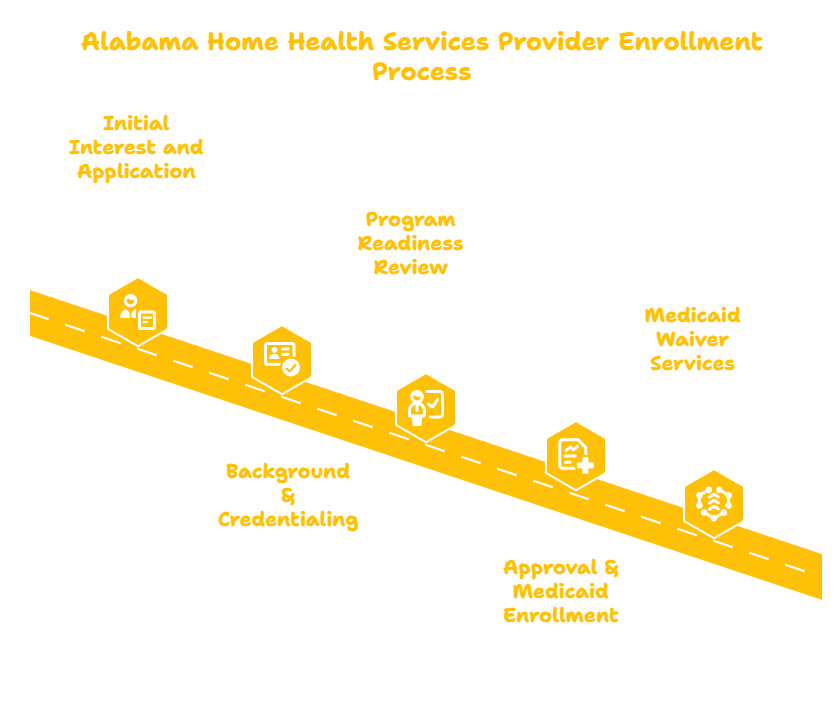
The provider enrollment process is a structured, multi-phase undertaking that begins with foundational business registration. Prospective agencies must first register the business with the Alabama Secretary of State, secure an Employer Identification Number (EIN) from the IRS, and obtain a Type 2 National Provider Identifier (NPI). These credentials serve as the bedrock for all subsequent state and federal applications.
Following business formation, the agency must apply for a Home Health Agency license through the ADPH. This phase involves submitting comprehensive administrative documentation, including detailed staffing charts and policy manuals, followed by a mandatory survey inspection to verify compliance. Once licensed, the agency must complete the Alabama Medicaid provider enrollment process. If the agency intends to serve waiver participants, it must specifically request and complete the credentialing process for the Community Waiver, ID Waiver, or LAH Waiver as appropriate.
- Register legal entity with the Alabama Secretary of State.
- Obtain IRS EIN and Type 2 NPI.
- Submit ADPH Home Health Agency licensure application and undergo survey.
- Complete Alabama Medicaid enrollment as a Home Health provider.
- Submit supplemental applications for specific HCBS waivers.
What Clinical Services Must an Agency Be Prepared to Deliver?
Home Health Agencies are responsible for delivering intermittent, skilled care designed to prevent institutionalization and promote recovery. All services must be initiated by a formal physician’s order and carried out by licensed medical professionals. Providers must demonstrate the capacity to manage complex clinical needs, including wound care, catheter management, intravenous therapy, and the monitoring of vital signs to assess patient stability.
Beyond nursing tasks, a robust agency should integrate therapeutic services and social support. Physical, occupational, and speech therapy are essential components of rehabilitation, while medical social workers assist in chronic care education and coordination. All aide-level services must be performed under the direct supervision of a Registered Nurse (RN), ensuring that care plans are followed, documentation is accurate, and patient progress is effectively communicated to the medical team.
What Are the Essential Staffing and Credentialing Requirements?
High-quality home health delivery depends on a well-vetted, licensed, and trained staff. Registered Nurses (RNs) must possess an active Alabama nursing license, current CPR certification, and documentation of TB screening. Their role is central to the care model, requiring proficiency in both clinical assessment and the navigation of community-based health environments. Licensed Practical Nurses (LPNs) operate under the scope of RN supervision, handling daily care protocols and medication administration.
Therapists—including physical, occupational, and speech therapists—must maintain active licenses in their respective disciplines within the state of Alabama. Regardless of role, all staff members require training in HIPAA compliance, infection control, and emergency preparedness. Furthermore, employees must be proficient in the specific documentation requirements necessary for Medicaid and waiver audits, as precise clinical notes are vital for reimbursement and regulatory compliance.
Which Documentation Protocols Ensure Compliance and Audit Readiness?
Operational success hinges on the strength of the agency’s policy and procedure manual. This document must cover intake procedures, physician order management, and templates for skilled nursing documentation. Agencies must establish clear systems for care plan tracking, supervisory visits, and incident reporting. Because Home Health Services are subject to rigorous audits, every service log must clearly correlate with the patient’s goals and medical necessity requirements.
The administrative burden of maintaining these records is substantial but non-negotiable. Agencies should implement robust systems for staff credentialing, orientation, and continuing education. Protecting patient confidentiality through strict HIPAA-compliant protocols is mandatory. By maintaining an organized system for audit preparation, agencies can effectively navigate state and federal inquiries, ensuring that every service delivered is supported by the necessary clinical and administrative evidence.
Frequently Asked Questions
Can a Home Health agency provide both state plan services and waiver services?
Yes. Many providers are enrolled to deliver services under the Alabama Medicaid State Plan as well as through various HCBS waivers, such as the Community Waiver, ID Waiver, and LAH Waiver, provided they meet the specific credentialing requirements for each program.
What is the typical timeline for launching a Home Health agency?
While business formation can take less than a week, the regulatory path is more intensive. ADPH licensure and Alabama Medicaid enrollment each generally require 60 to 90 days, followed by several weeks for staff hiring and final operational readiness.
What role does the ADPH play in daily agency operations?
The ADPH Bureau of Health Provider Standards is responsible for licensing home health agencies and performing periodic survey inspections to ensure that agencies maintain compliance with state health and safety regulations.
Key Takeaway
Launching and maintaining a Home Health Services agency in Alabama is a multi-disciplinary effort that requires strict adherence to ADPH licensing, Medicaid enrollment, and federal CMS guidelines. Agencies must prioritize clinical excellence, thorough documentation, and rigorous staff training to succeed in the HCBS landscape, ensuring that all services directly support patient recovery and community-based independence.
Last verified: 2024. This content is for informational purposes only and does not constitute legal or professional medical advice. Always consult with the Alabama Department of Public Health or the Alabama Medicaid Agency for the most current regulatory guidance and requirements.