HOME HEALTH CARE SERVICES PROVIDER IN WASHINGTON
By Fatumata Kaba · 2026-04-06 · 5 min read
Operating a home health care agency in Washington requires navigating a complex regulatory landscape to provide essential skilled nursing and therapeutic services to individuals in their own homes. Home health care services provide intermittent, medically necessary support to those recovering from illness, managing chronic health conditions, or requiring short-term care following a hospital discharge, ensuring they can remain independent and avoid unnecessary institutionalization.
To succeed as a provider in Washington, organizations must align their operations with standards set by the Department of Health (DOH) for licensing and the Health Care Authority (HCA) for Medicaid reimbursement. By integrating clinical excellence with administrative compliance, providers help clients achieve better health outcomes while adhering to the rigorous demands of state and federal regulatory frameworks.
What are the foundational regulatory requirements for Washington home health agencies?
The Washington State Department of Health (DOH) serves as the primary regulatory body, licensing and overseeing home health agencies to ensure they meet mandatory state health standards. Before delivering services, an agency must secure a formal license through the DOH Facility Licensing and Certification Division. This process verifies that the agency has the infrastructure to deliver safe, high-quality care, including established clinical oversight and emergency protocols.
Beyond state licensure, agencies intending to serve patients covered by government programs must coordinate with the Health Care Authority (HCA), which manages Apple Health (Medicaid). If an agency aims to accept Medicare, it must also satisfy federal Conditions of Participation (CoPs) established by the Centers for Medicare & Medicaid Services (CMS). Achieving Medicare certification is a significant milestone that signifies the agency meets national standards for patient rights, clinical quality, and administrative accountability.
How is the provider enrollment process structured in Washington?
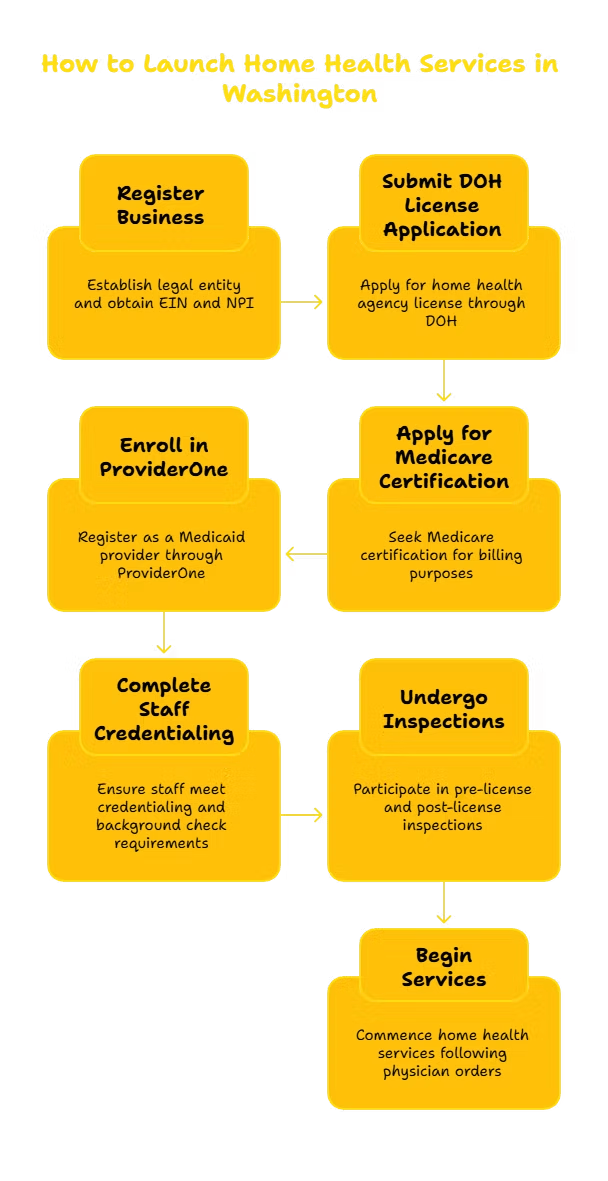
Launching a home health agency is a sequential process that begins with formal business registration and concludes with clinical service authorization. First, founders must register the business entity with the Washington Secretary of State, obtain an Employer Identification Number (EIN), and secure a Type 2 National Provider Identifier (NPI). These are the baseline credentials required to interact with both state and federal healthcare portals.
Once business registration is complete, the focus shifts to licensure and enrollment. Providers must submit their Home Health Agency license application to the DOH and, if applicable, initiate the Medicare certification process. Simultaneously, the agency must register via the ProviderOne Portal to become a Medicaid-authorized provider. This phased approach, followed by rigorous staff credentialing and pre-license inspections, ensures that the agency is fully prepared to manage clinical care under a physician-approved Plan of Care upon opening.
What constitutes a compliant clinical documentation and policy framework?
A successful home health agency relies on a robust Policy & Procedure Manual that addresses every aspect of clinical and administrative operations. This manual is not merely a reference document; it is a fundamental requirement during inspections and audits. It must explicitly detail the scope of skilled nursing, physical therapy, occupational therapy, speech-language pathology, and home health aide services, ensuring that every service delivered is within the professional scope of practice for the assigned staff member.
The documentation framework must also include precise templates for the Plan of Care (POC), physician communication logs, and clinical progress notes. Because home health services are intermittent and strictly based on medical necessity, documentation must demonstrate that the patient’s condition requires professional intervention. Furthermore, policies governing infection control, emergency preparedness, HIPAA compliance, and medication administration must be clearly articulated and rigorously practiced to ensure patient safety and regulatory adherence.
How do agencies manage staffing requirements and competency?
Staffing a home health agency involves balancing clinical licensure requirements with the need for high-quality, compassionate care. Registered Nurses (RNs) are the cornerstone of the agency, responsible for conducting comprehensive clinical assessments and overseeing the implementation of the POC. Licensed Practical Nurses (LPNs) may also provide skilled nursing care but must operate under the direct supervision of an RN to ensure clinical protocols are followed consistently.
Beyond nursing staff, agencies must manage a multidisciplinary team including physical, occupational, and speech therapists, as well as medical social workers and certified home health aides. To ensure quality, all staff members must undergo rigorous training, including:
- HIPAA and client rights training to ensure privacy and dignity.
- Abuse prevention and emergency preparedness protocols.
- Infection control and universal safety precautions.
- Regular competency assessments and ongoing continuing education to stay updated with clinical standards.
Which Medicaid programs cover home health services?
Home health care is a vital component of the support systems for many Washington residents, covered by several different programs depending on the patient's eligibility and specific needs. Apple Health (State Plan Medicaid) provides coverage for short-term skilled home care provided that the services are medically necessary and ordered by a physician. This is the baseline for many Medicaid-funded home health interactions.
For individuals with more complex needs, home health services are often integrated into Home and Community-Based Services (HCBS) Waivers. The Community Options Program Entry System (COPES) includes home health within its broader service package, and the Developmental Disabilities Administration (DDA) waivers, such as Basic Plus and Core, provide skilled care authorized through a person’s Person-Centered Service Plan (PCSP). In cases of dual-eligible patients, Medicare may also provide coverage for post-acute care, requiring the provider to navigate both federal and state billing requirements.
Frequently Asked Questions
Is home health care considered 24/7 care?
No, home health services are specifically defined as intermittent and medically necessary. They are intended to support patients who require skilled nursing or therapy following a hospitalization or for chronic disease management, rather than providing continuous, round-the-clock custodial care.
What is the role of the physician in home health care?
The physician acts as the gatekeeper for services. Every home health service delivered must be ordered by a physician, who also approves and regularly reviews the Plan of Care to ensure that the services remain medically necessary and appropriate for the patient’s health status.
What are the primary differences between Apple Health and DDA waiver coverage?
Apple Health (State Plan) generally covers short-term skilled services for the broader Medicaid population based on acute medical need. DDA waiver coverage is specifically tailored to the long-term support needs of individuals with developmental disabilities and is authorized as part of their comprehensive Person-Centered Service Plan.
Key takeaway: Launching a home health care agency in Washington requires a disciplined focus on regulatory compliance, clinical documentation, and strategic coordination with both the DOH and HCA. By building a solid administrative foundation and maintaining strict adherence to physician-led Plans of Care, providers can ensure high-quality outcomes for their patients while meeting the essential requirements for state and federal participation.
Last verified: 2024. The information provided is for educational purposes only and does not constitute legal or professional consulting advice. For specific regulatory interpretations or program enrollment requirements, consult directly with the Washington Department of Health or the Health Care Authority.