HOME HEALTH CARE SERVICES PROVIDER IN VIRGINIA
By Fatumata Kaba · 2026-04-07 · 5 min read
Establishing a Home Health Care Services agency in Virginia requires navigating a rigorous regulatory landscape governed by the Virginia Department of Health (VDH) and the Virginia Department of Medical Assistance Services (DMAS). Providers must secure state licensure as a Home Care Organization (HCO) and demonstrate clinical compliance to deliver skilled nursing and therapeutic services that prevent unnecessary hospitalizations and support patient recovery within the home environment.
Understanding the Regulatory Landscape for Virginia Home Health
Home health services in the Commonwealth are defined by their short-term or long-term clinical necessity, focusing on skilled interventions for individuals recovering from surgery, injury, or managing chronic conditions. Oversight is split between two primary entities: the VDH Office of Licensure and Certification (OLC), which enforces operational and safety standards, and the DMAS, which manages the financial and enrollment aspects of Medicaid-funded care. Understanding this dual-agency relationship is the first step for any prospective provider.
Beyond state licensure, agencies must interact with Managed Care Organizations (MCOs) under the Commonwealth Coordinated Care Plus (CCC Plus) program. Because most Medicaid recipients are enrolled in managed care, your agency’s ability to secure referrals and receive reimbursement depends heavily on establishing contracts with these MCOs. All services must be predicated on a physician’s order, documented via a formal Plan of Care (POC), and delivered by licensed personnel, ensuring that care remains intermittent rather than continuous.
How Do I Secure Licensure and Provider Enrollment?
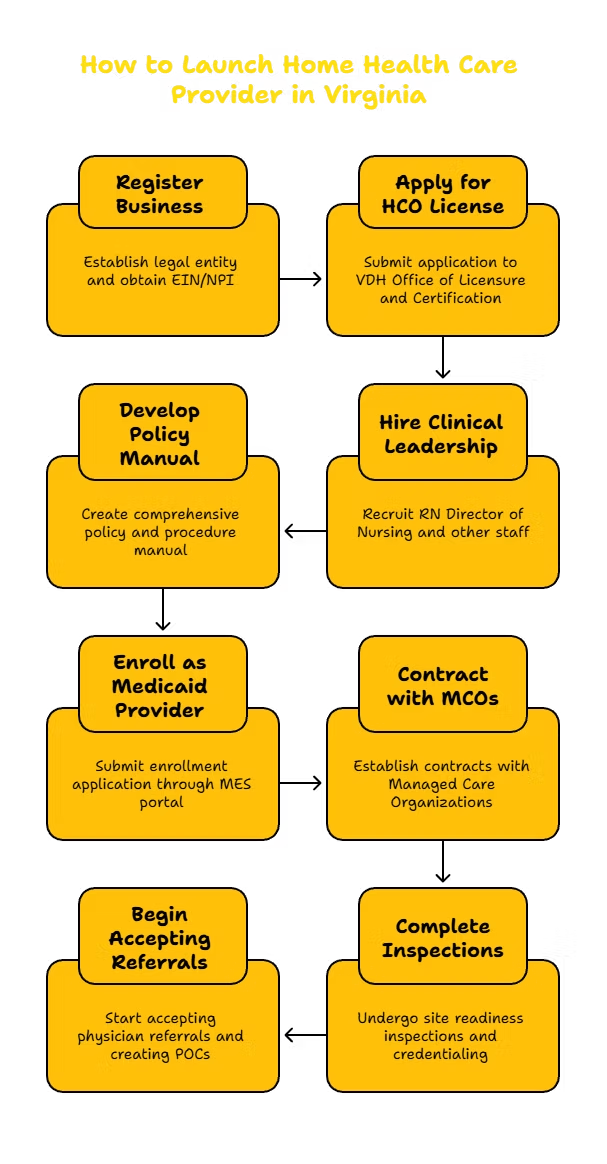
The provider enrollment process is a multi-phased journey that begins with establishing your business as a legal entity through the Virginia State Corporation Commission (SCC). Once the business entity is formed, you must secure an EIN and a Type 2 NPI. These foundational elements are required before you can submit an application for an HCO license through the VDH OLC. The VDH will conduct inspections to ensure your agency meets specific regulatory requirements regarding physical infrastructure, clinical management, and emergency preparedness.
Following state licensure, the focus shifts to Medicaid enrollment via the Medicaid Enterprise System (MES) portal. This process confirms your eligibility to bill for services provided to Medicaid beneficiaries. Concurrently, you should initiate the contracting process with the various MCOs operating in your region. Without these contracts, your agency will be unable to accept referrals for the majority of the state’s Medicaid population under the CCC Plus waiver or EPSDT program.
- Register entity with the Virginia State Corporation Commission (SCC).
- Obtain Employer Identification Number (EIN) and Type 2 NPI.
- Submit HCO license application to VDH Office of Licensure and Certification.
- Develop a comprehensive Policy & Procedure Manual meeting DMAS and CMS standards.
- Enroll as a Medicaid provider through the MES portal.
- Execute service contracts with regional Managed Care Organizations (MCOs).
What Are the Staffing and Clinical Leadership Requirements?
A compliant home health agency must be managed by qualified clinical professionals. Central to this is the role of the Registered Nurse (RN) as the Director of Nursing. This individual is responsible for overseeing patient assessments, the development of the Plan of Care, and the ongoing supervision of all field staff. The Director of Nursing ensures that every intervention—whether skilled nursing, physical therapy, or occupational therapy—is medically necessary and properly documented.
Field staff, including Licensed Practical Nurses (LPNs) and Certified Home Health Aides (CHHAs), must hold active, valid Virginia licenses or certifications. Furthermore, all staff must undergo rigorous training protocols, including annual clinical competency validations. This training covers critical areas such as HIPAA compliance, infection control, wound care management, and emergency response procedures to ensure that high standards of care are maintained consistently across all patient interactions.
Which Medicaid Programs Support Home Health Services?
Medicaid reimbursement for home health in Virginia is structured across several key programs, each designed to meet specific population needs. The Virginia State Plan provides the foundation for standard skilled services, while the CCC Plus Waiver serves individuals with complex medical needs who require integrated care coordination. Additionally, the Early and Periodic Screening, Diagnostic, and Treatment (EPSDT) program provides vital coverage for children under the age of 21, ensuring they receive the skilled care necessary for their development.
In limited instances, other waivers such as the CL (Community Living) and FIS (Family and Individual Support) waivers may authorize in-home skilled services. Regardless of the funding stream, the requirement remains absolute: services must be included in a physician-authorized Plan of Care and receive approval from the appropriate payer—either the DMAS, an MCO, or a Community Services Board (CSB). Failure to maintain these authorizations can result in claim denials and audit findings.
Essential Documentation and Operational Compliance
Successful agencies maintain a centralized, highly organized document management system. Your internal records must be audit-ready at all times. This includes proof of SCC registration, your HCO license, and VDH inspection reports. Operationally, you must maintain a robust Policy & Procedure Manual that addresses everything from staff credentialing and supervision policies to complex clinical protocols like medication management and infection control.
Documentation for every patient must be exhaustive. A proper patient file should include the initial physician referral, a signed and dated Plan of Care, shift notes, Medication Administration Records (MARs), billing logs, and discharge summaries. Every entry must align with federal Conditions of Participation (CoPs) if you intend to pursue Medicare certification, providing a clear audit trail that links skilled interventions to the patient’s health outcomes.
Frequently Asked Questions
What is the typical timeline to launch a home health agency?
The total timeline generally spans several months. Business formation and VDH licensing typically take 2–3 months. Medicaid enrollment and MCO contracting require an additional 1–2 months, while finalizing clinical readiness and staff training takes 30–60 days. Operations begin following the completion of these steps and the receipt of the first physician referral.
Are home health agencies required to be Medicare certified?
Medicare certification is optional in Virginia. However, many agencies pursue it to broaden their revenue streams and qualify for additional reimbursement pathways beyond state Medicaid and MCO contracts. Agencies seeking certification must adhere to federal Conditions of Participation (CoPs) in addition to state-specific VDH and DMAS requirements.
How are referrals obtained for Medicaid patients?
Referrals are typically generated by physicians who determine that a patient has a medical need for skilled care. Once the referral is received, the agency submits the required clinical documentation and the Plan of Care to the relevant MCO (for CCC Plus members) or the DMAS for service authorization. Once approved, the agency can begin providing the authorized services.
Key Takeaway
Launching a home health care agency in Virginia is a complex, multi-stage process that demands strict adherence to both clinical standards and administrative regulations. By securing proper licensure through the VDH, establishing essential contracts with MCOs, and maintaining a robust documentation system, entrepreneurs can build a sustainable, compliant organization dedicated to providing high-quality care to the Commonwealth’s most vulnerable populations.
Last verified: October 2023. This information is provided for educational purposes and does not constitute legal or professional consulting advice. Regulatory requirements are subject to change; always refer to the official Virginia Department of Medical Assistance Services (DMAS) and Virginia Department of Health (VDH) websites for the most current statutes and policy guidance.