HOME HEALTH CARE SERVICES PROVIDER IN VERMONT
By Fatumata Kaba · 2026-04-09 · 6 min read
DELIVERING SKILLED NURSING AND THERAPEUTIC CARE IN THE COMFORT OF HOME TO PROMOTE HEALING, SAFETY, AND INDEPENDENCE
Home Health Care services in Vermont provide essential, medically necessary skilled care to individuals who are recovering from an illness or injury, managing chronic health conditions, or requiring rehabilitation within their own homes. By delivering professional clinical care in a home setting, these agencies help patients maintain independence, avoid unnecessary institutionalization, and achieve safer health outcomes through structured, physician-directed support.
These services are covered under the Vermont Medicaid State Plan and are frequently integrated into Home and Community-Based Services (HCBS) Waivers to ensure a seamless continuum of care. Regulatory oversight for these operations is distributed across the Vermont Department of Disabilities, Aging and Independent Living (DAIL), the Department of Vermont Health Access (DVHA), and the Division of Licensing and Protection (DLP), all of which work in conjunction with federal standards set by the Centers for Medicare & Medicaid Services (CMS).
How Are Home Health Agencies Regulated in Vermont?
The regulatory landscape for home health providers in Vermont is multi-layered, ensuring that agencies meet rigorous clinical and safety standards before they are permitted to bill for Medicaid or Medicare services. The Division of Licensing and Protection (DLP) acts as the primary state authority for licensing and certification, conducting surveys to ensure that agencies maintain compliance with state regulations and federal Conditions of Participation.
Simultaneously, the Department of Vermont Health Access (DVHA) is the entity responsible for the administration of Medicaid enrollment and the management of reimbursement workflows. Agencies must also work closely with the Department of Disabilities, Aging and Independent Living (DAIL), which coordinates the broader scope of home- and community-based care programs, ensuring that Home Health services are correctly integrated into the participant's holistic care plan.
What Services Fall Under Home Health Care Coverage?
To be eligible for reimbursement, Home Health services must be prescribed by a physician and delivered according to a formal, documented Plan of Care. It is critical for administrators to note that these services are strictly defined as intermittent; they are not intended to provide 24-hour custodial care, but rather skilled interventions that require the oversight of licensed medical professionals.
Covered services typically include the following clinical and rehabilitative offerings:
- Skilled nursing, including complex wound care, IV therapy, and medication injections.
- Home health aide assistance focused on Activities of Daily Living (ADLs).
- Physical Therapy (PT), Occupational Therapy (OT), and Speech-Language Pathology (SLP).
- Medical social services and counseling support.
- Chronic disease monitoring, health education, and symptom management.
- Care coordination and comprehensive discharge planning to bridge hospital-to-home transitions.
What Are the Prerequisites for Licensure and Certification?
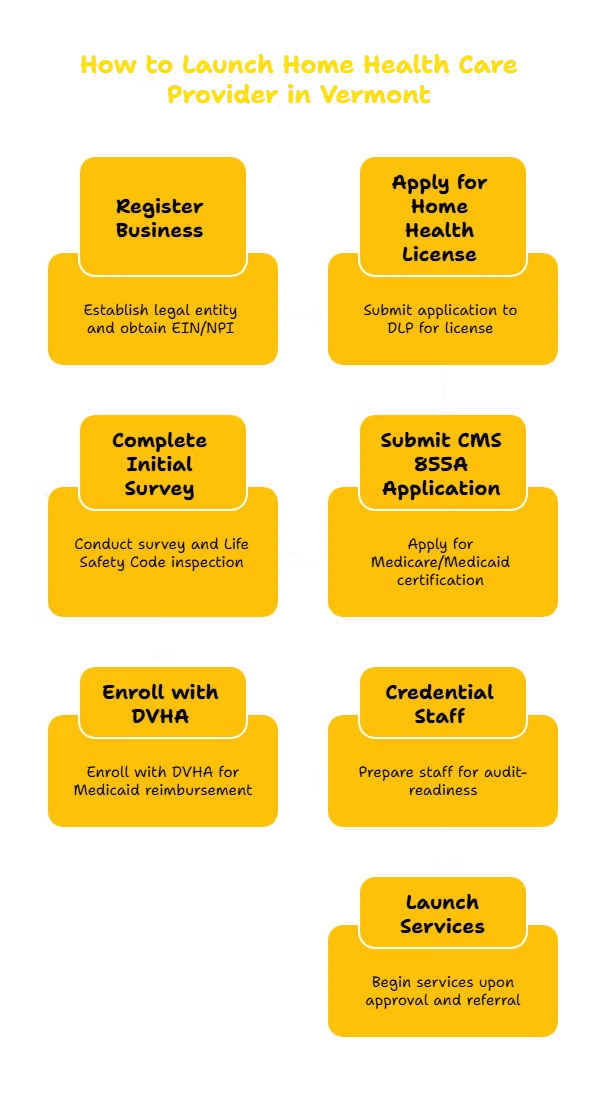
Launching a Home Health Agency requires a systematic approach to business formation and regulatory compliance. Before providing care, an agency must be formally registered with the Vermont Secretary of State and possess a valid EIN and a Type 2 National Provider Identifier (NPI). These foundational steps allow the agency to move forward with the state-level licensing process managed by the DLP.
Beyond state licensure, agencies must undergo the CMS survey process to be eligible for federal Medicare and Medicaid certification. This process involves submitting the CMS 855A application and preparing for a formal survey and Life Safety Code inspection. Additionally, agencies must maintain adequate clinical liability and workers’ compensation insurance, as well as develop a comprehensive Policy & Procedure Manual that adheres to federal and state standards for patient care, privacy, and incident reporting.
What Is the Required Documentation for Compliance?
Maintaining audit-readiness is a primary obligation for every Vermont Home Health provider. Documentation serves as the evidence of compliance during state surveys and billing audits. Agencies must maintain organized records for all aspects of operations, ranging from corporate formation documents to clinical encounter notes.
Essential documentation includes, but is not limited to, the following:
- Corporate records: Articles of Incorporation, EIN, and NPI confirmation.
- Regulatory approvals: DLP Home Health license, CMS survey reports, and official certification letters.
- Administrative policies: A master Policy & Procedure Manual covering nursing protocols, infection control, HIPAA standards, and emergency response plans.
- Operational records: Physician orders, active Plans of Care, patient shift notes, billing templates, and outcome tracking tools.
- Staffing logs: Credentialing files, training records, and supervision logs for all clinical personnel.
How Are Staffing Requirements Managed?
The quality of a Home Health Agency is defined by its clinical staff. All roles must be filled by professionals who hold active, valid Vermont licensure and meet the specific scope-of-practice requirements for their designation. Registered Nurses (RNs) are responsible for the initial patient assessment and the ongoing development and oversight of the Plan of Care, while Licensed Practical Nurses (LPNs) and Certified Home Health Aides (HHAs) provide direct care under that established supervision.
In addition to standard licensure, agencies must ensure that staff members complete ongoing mandatory training. This includes instruction on HIPAA and CMS documentation requirements, universal precautions for infection control, and annual skills validation. For clinical aides, current CPR and First Aid certifications are mandatory prerequisites to ensure patient safety in the home environment.
How Do HCBS Waivers Integrate with Home Health Services?
Home Health services frequently function as a vital component within broader Medicaid waiver programs. These programs are designed to keep individuals in their homes rather than in institutional settings. Integration requires that the Home Health services be directly linked to a physician’s order and explicitly included in the participant’s Individual Support Plan or formal Plan of Care.
Specific programs that may integrate Home Health services include:
- Choices for Care (CFC) Waiver: Providing skilled nursing and therapies for older adults and individuals with physical disabilities.
- Children with High-Tech Needs Program: Focused on pediatric patients with specialized clinical requirements.
- Brain Injury Program: Offering in-home skilled rehabilitation and nursing support.
- Developmental Disabilities Services (DDS) Waiver: Applicable in specific cases where the participant has medically complex needs.
Frequently Asked Questions
What is the typical timeline to launch a Home Health Agency?
The launch process generally follows a multi-phase trajectory. Entity formation and manual development take 2–4 weeks, while state licensing and CMS certification typically span 3–6 months. Medicaid enrollment and staff credentialing require an additional 1–2 months, with service launch commencing once licensure and authorization are secured.
What agencies are involved in the oversight of Vermont home care providers?
Four primary agencies oversee the sector: the Vermont Department of Disabilities, Aging and Independent Living (DAIL) for waiver integration; the Department of Vermont Health Access (DVHA) for Medicaid billing; the Division of Licensing and Protection (DLP) for state licensing; and the Centers for Medicare & Medicaid Services (CMS) for federal certification.
Are Home Health Aides required to have specific certifications?
Yes, all staff must meet credentialing standards. For Certified Home Health Aides (HHAs), this includes mandatory training in ADLs, infection control, and safety monitoring, as well as maintaining current CPR and First Aid certifications. All aide activity must be performed under the supervision of a Registered Nurse.
Key Takeaway
Launching a Home Health Agency in Vermont is a rigorous undertaking that requires strict adherence to state and federal regulatory frameworks. Success is predicated on the ability to maintain meticulous documentation, ensure robust clinical staffing, and align service delivery with the specific requirements of Vermont’s Medicaid State Plan and its associated Home and Community-Based Services (HCBS) waivers.
Last verified: 2024. The information provided here is for general educational purposes and does not constitute legal or professional advice. Always consult with the Vermont Department of Disabilities, Aging and Independent Living (DAIL) or the Division of Licensing and Protection (DLP) for the most current regulatory updates.