HOME HEALTH CARE SERVICES PROVIDER IN UTAH
By Fatumata Kaba · 2026-04-01 · 6 min read
DELIVERING SKILLED NURSING AND THERAPEUTIC CARE IN THE COMFORT OF HOME TO SUPPORT HEALTH, HEALING, AND INDEPENDENCE
Home Health Care Services in Utah provide intermittent skilled nursing, rehabilitative therapy, and specialized medical support to individuals recovering from injury, illness, or managing complex chronic conditions. By delivering clinical care directly in the patient's residence, these agencies enable individuals to avoid institutionalization, expedite recovery, and maintain a higher quality of life while meeting essential healthcare needs.
Home Health is a core benefit covered under Utah Medicaid’s State Plan, and these services may also be authorized through Home and Community-Based Services (HCBS) waivers for participants who require skilled clinical support as part of their Individual Support Plan (ISP). Oversight for these programs is strictly managed by the Utah Department of Health and Human Services (DHHS), specifically through the Division of Integrated Healthcare (DIH) and the Office of Licensing (OL), ensuring that all care meets both state standards and federal CMS conditions of participation.
What Are the Governing Agencies and Regulatory Bodies in Utah?
The operation of a Home Health Agency (HHA) in Utah requires alignment with several regulatory bodies that oversee provider conduct, clinical standards, and Medicaid reimbursement. Understanding the specific role of each agency is critical for maintaining compliance and securing the necessary permits to operate within the state healthcare ecosystem.
The Utah Department of Health and Human Services (DHHS) serves as the primary authority. Within this department, the Division of Integrated Healthcare (DIH) is responsible for administering Medicaid benefits, including the authorization of home health coverage, management of provider enrollment, and oversight of claims. Concurrently, the Office of Licensing (OL) acts as the regulatory body that issues the specific HHA licenses required for any entity providing skilled medical services.
At the federal level, the Centers for Medicare & Medicaid Services (CMS) establishes the overarching federal guidelines for home health services. Compliance with CMS standards is mandatory for agencies seeking to participate in Medicaid or Medicare programs. These standards ensure that patient care, documentation, and administrative protocols meet uniform safety and clinical benchmarks across the state.
How Does the Home Health Care Service Delivery Model Function?
Home Health services must be medically necessary, meaning they are delivered by licensed healthcare professionals based on a physician’s specific order. This service delivery model is structured around a physician-ordered Plan of Care, which serves as the blueprint for all clinical interventions provided to the patient. Every visit and clinical action must be documented rigorously to satisfy both medical necessity requirements and billing standards.
The scope of care typically provided by these agencies includes a diverse range of medical interventions designed to stabilize and improve the patient’s condition. These services are vital for preventing hospital readmissions and managing health in a non-institutional setting:
- Skilled Nursing Care: Includes wound care, IV administration, and chronic disease management.
- Home Health Aide Services: Provides essential personal care delivered under the direct supervision of a Registered Nurse (RN).
- Rehabilitative Therapies: Includes Physical Therapy (PT), Occupational Therapy (OT), and Speech-Language Pathology (SLP).
- Medical Social Work and Counseling: Supporting patients and families in addressing the social determinants of health.
- Patient & Family Education: Training on medication management, injection techniques, and coordination of care with primary physicians.
What Are the Prerequisites for Licensing and Provider Approval?
Launching a Home Health Agency in Utah involves a multifaceted registration and certification process. Before an agency can begin billing Medicaid, it must establish a formal business entity, obtain federal identifiers, and demonstrate compliance with state licensing laws. This foundation ensures that the agency is legally recognized and prepared to handle the clinical and administrative burdens of home health delivery.
Initial steps include registering the business with the Utah Division of Corporations and obtaining an EIN and a Type 2 NPI. Once the corporate structure is in place, the agency must apply for its Home Health Agency license through the Utah Office of Licensing (OL). If the agency intends to seek reimbursement from multiple sources, it should also prepare for Medicare/Medicaid certification.
Beyond administrative registration, agencies must maintain adequate clinical liability, malpractice, and workers’ compensation insurance to protect both the staff and the patients. Additionally, the development of a comprehensive Home Health Services Policy & Procedure Manual—tailored specifically to CMS guidelines—is a foundational requirement for both licensing and operational integrity.
What Is the Step-by-Step Utah Provider Enrollment Process?
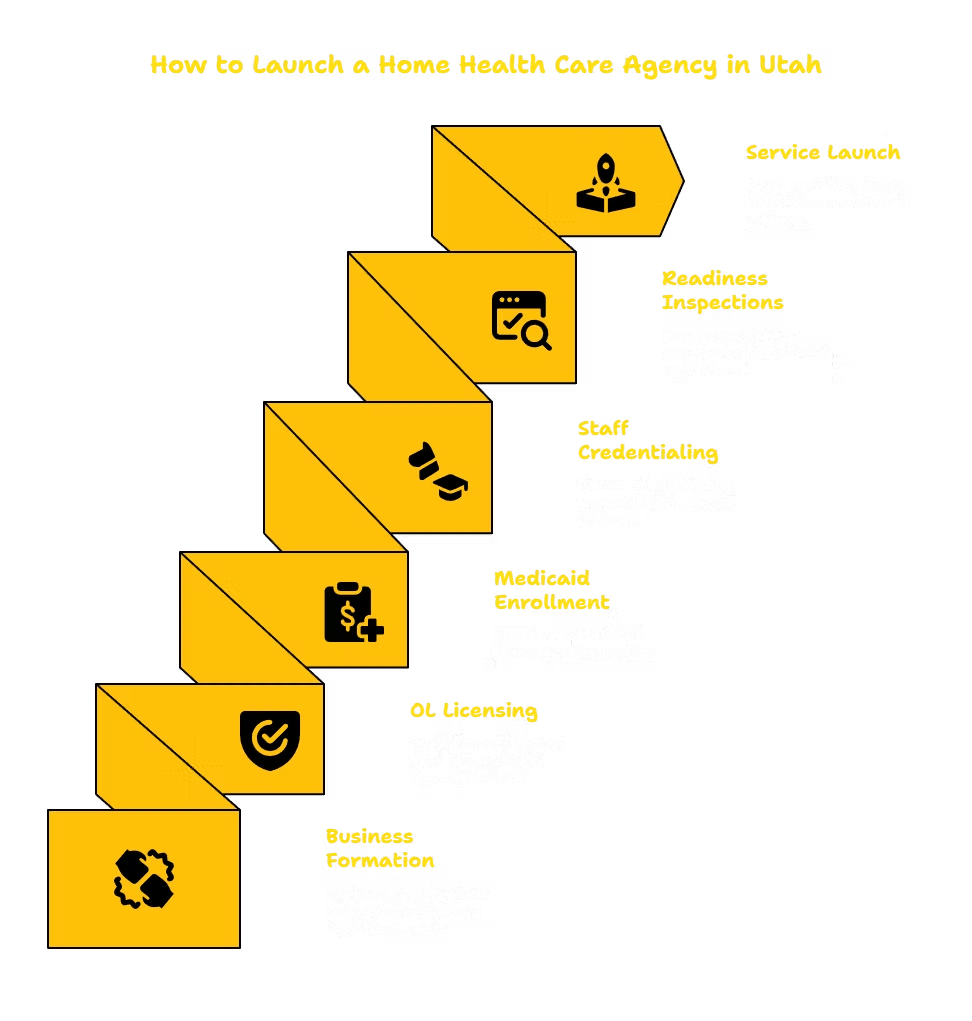
The provider enrollment journey is a sequenced progression that requires attention to detail at every phase. Failure to align these steps can result in significant delays in licensure or service authorization. Agencies should follow this trajectory to ensure readiness for the Medicaid portal application and subsequent inspections:
- Step 1: Register the business entity with the state and obtain all necessary tax identifiers and the Type 2 NPI.
- Step 2: Submit a formal application for a Home Health Agency license via the Utah Office of Licensing.
- Step 3: Initiate the Medicaid enrollment process as a Home Health provider through the Utah Medicaid Portal.
- Step 4: Undergo and pass all state site inspections and clinical compliance audits.
- Step 5: Complete formal credentialing for all nursing, therapy, and support staff.
- Step 6: Finalize service authorization and Plan of Care approvals before beginning to accept client referrals.
What Staffing and Documentation Protocols Are Required?
Operational success in home health is predicated on the qualifications of the clinical team and the quality of the agency's documentation. The agency is responsible for ensuring that all staff—including Registered Nurses, Licensed Practical Nurses, Certified Home Health Aides, and various therapists—possess valid Utah licensure and maintain active CPR certifications. Ongoing supervision by an RN is a non-negotiable requirement for all aide-level services.
Equally important is the maintenance of a robust Policy & Procedure Manual. This document must clearly outline the agency’s protocols for infection control, wound care, medication administration, and chronic care procedures. Furthermore, every patient encounter requires precise documentation. Agencies must implement standardized templates for:
- Physician orders and active tracking of the Plan of Care.
- Infection control, universal precautions, and incident reporting.
- Staff credentialing, annual competency evaluations, and continuing education.
- Patient rights, grievance procedures, and strict HIPAA compliance protocols.
Frequently Asked Questions
How does Home Health differ from waiver-specific personal care services?
Home Health focuses on skilled medical interventions performed by licensed professionals like nurses and therapists, whereas many HCBS waiver personal care services focus on activities of daily living (ADLs) and instrumental activities of daily living (IADLs) provided by non-licensed aides. Both may coexist in a patient's ISP if clinically justified.
What is the typical timeline to launch an agency in Utah?
The entire process generally spans from 4 to 8 months. Business formation and policy development typically take 1–2 months, while the licensing and Medicaid enrollment phases range from 2–4 months. Final staff credentialing and readiness inspections usually add another 30–60 days to the launch timeline.
Which HCBS waivers incorporate Home Health as a covered service?
Home Health services may be integrated into several programs, including the Community Supports Waiver (CSW) for individuals with ID/DD, the New Choices Waiver (NCW) for those transitioning from institutions, the Acquired Brain Injury (ABI) Waiver, the Medically Complex Children’s Waiver (MCCW), and, on a case-by-case basis, the Physical Disabilities Waiver (PDW).
Key Takeaway
Establishing a Home Health Agency in Utah requires strict adherence to both state licensing requirements managed by the Office of Licensing and federal mandates governed by CMS. By prioritizing clinical excellence, thorough documentation, and rigorous staff credentialing, providers can successfully integrate into the Utah Medicaid landscape and support the essential health needs of the community.
Last verified: 2024. This information is provided for educational purposes and does not constitute legal or professional consulting advice. Requirements are subject to change based on updates from the Utah Department of Health and Human Services (DHHS) and the Centers for Medicare & Medicaid Services (CMS).