HOME HEALTH CARE SERVICES PROVIDER IN PENNSYLVANIA
By Fatumata Kaba · 2025-10-08 · 6 min read
DELIVERING CLINICAL CARE AT HOME TO SUPPORT RECOVERY, CHRONIC CONDITION MANAGEMENT, AND INDEPENDENT LIVING
Home Health Care services in Pennsylvania represent a vital component of the state’s long-term care infrastructure, providing clinical, physician-ordered care directly in the patient's residence. These services are essential for individuals managing chronic conditions, recovering from surgeries, or requiring skilled intervention to maintain independence and avoid unnecessary institutionalization.
Operating a home health agency in the Commonwealth requires rigorous adherence to regulatory standards set by the Pennsylvania Department of Health (DOH) and the Department of Human Services (DHS). Providers must navigate a complex ecosystem of Medicaid-funded clinical services, including the Community HealthChoices (CHC) program, to ensure that medically necessary care is delivered to eligible participants effectively and compliantly.
What Are the Governing Agencies and Oversight Bodies?
The regulatory landscape for Pennsylvania home health care is multi-layered, involving both state-level licensing and federal oversight. The Pennsylvania Department of Health (DOH) serves as the primary licensing entity for Home Health Agencies (HHAs), responsible for ensuring that all agencies meet state and federal safety and quality standards through ongoing compliance monitoring.
Beyond licensing, the Pennsylvania Department of Human Services (DHS) and the Office of Long-Term Living (OLTL) manage the fiscal and programmatic aspects of Medicaid-funded services. These agencies coordinate with Community HealthChoices (CHC) Managed Care Organizations (MCOs), which authorize and reimburse for services provided to the vast majority of Medicaid participants. Additionally, the Centers for Medicare & Medicaid Services (CMS) establishes the overarching federal regulations that guide reimbursement and quality metrics across the board.
- Pennsylvania Department of Health (DOH): Licenses HHAs and ensures compliance with state/federal regulations.
- Pennsylvania Department of Human Services (DHS) / OLTL: Oversees Medicaid-funded services, waivers, and CHC coordination.
- Community HealthChoices (CHC) MCOs: Responsible for authorizing and reimbursing home health care visits.
- Centers for Medicare & Medicaid Services (CMS): Sets federal standards for Medicare and Medicaid reimbursement.
- Pennsylvania Department of State: Manages the legal registration and entity status of the provider business.
How Are Clinical Services Structured for Patients?
Home health care is defined by intermittent, short-term, or ongoing skilled care delivered under a formal plan of care signed by a physician. The clinical services provided must be deemed medically necessary to treat an illness or injury. These services are delivered by a multidisciplinary team of licensed professionals who coordinate closely to improve patient outcomes and support recovery.
Effective care delivery requires meticulous documentation and care coordination. Every visit must be tracked via electronic charting, with clear plan-of-care updates that reflect the patient’s progress. Agencies are responsible for maintaining a comprehensive medical record for each patient, ensuring that clinical notes and outcomes are readily available for audit purposes and interdisciplinary communication.
- Skilled Nursing: Provision of wound care, medication administration, IV therapy, and chronic disease monitoring.
- Home Health Aide Services: Assistance with Activities of Daily Living (ADLs) under the supervision of a registered nurse.
- Therapy Services: Physical Therapy (PT) for mobility; Occupational Therapy (OT) for ADL skill-building; Speech Therapy (ST) for communication and swallowing.
- Medical Social Services: Counseling and the coordination of community services to support the patient’s psychosocial needs.
What Is the Required Path for Licensing and Enrollment?
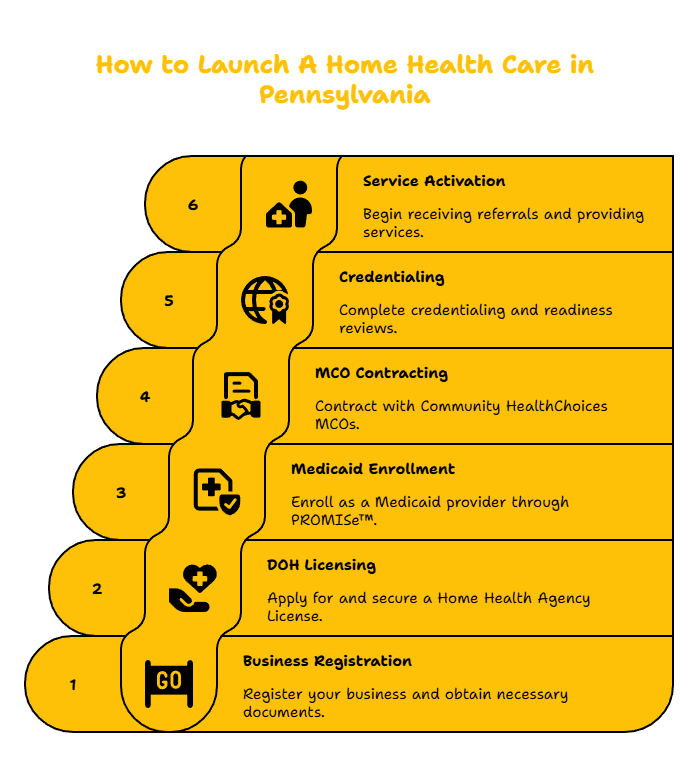
The launch of a home health agency begins with formal business entity registration through the Pennsylvania Department of State, followed by the acquisition of a federal EIN and a Type 2 NPI. Once the legal structure is established, the agency must apply for a formal Home Health Agency license through the DOH. This process includes rigorous inspection and verification of the agency's operational readiness.
After licensing, the agency must enroll as a Medicaid provider through the PROMISe™ system. This enrollment is a prerequisite for contracting with CHC Managed Care Organizations such as UPMC, Keystone First, and PA Health & Wellness. Providers are also strongly encouraged to seek third-party accreditation from bodies like CHAP, ACHC, or the Joint Commission, as this often streamlines the contracting process and validates the agency’s commitment to quality.
What Are the Essential Documentation and Policy Requirements?
A compliant home health agency must maintain a robust Policy & Procedure Manual that addresses every aspect of clinical and administrative operations. These documents must align strictly with DOH and CMS standards, covering everything from patient admission and discharge criteria to emergency preparedness and infection control protocols. Staff training on these policies is not optional; it is a fundamental requirement for maintaining licensure.
Documentation must be precise, timely, and HIPAA-compliant. This includes the management of physician orders, the development of individualized plans of care, and the consistent use of visit note templates. Agencies should implement electronic charting formats that facilitate audit readiness, allowing them to quickly produce records verifying that all services rendered were authorized and consistent with the physician's prescribed plan.
- Governance: Articles of Incorporation, NPI/EIN confirmation, and insurance certificates (liability, malpractice, workers' compensation).
- Operational Policies: Detailed procedures for medication administration, nursing protocols, and patient safety.
- Compliance: HIPAA compliance documentation, audit readiness tools, and formal billing processes.
- Training: Records of staff training on infection control, universal precautions, and clinical documentation standards.
What Are the Staffing and Training Mandates?
Staffing a home health agency requires strict adherence to licensure requirements for each role. A Registered Nurse (RN) must typically serve in a clinical supervisor capacity, responsible for developing care plans and overseeing the work of home health aides. Aides themselves must have completed a state-approved training program, hold CPR certification, and have cleared thorough background checks.
All staff members, including therapists and social workers, must maintain active Pennsylvania licensure. Beyond clinical qualifications, the agency is responsible for ensuring that all personnel participate in ongoing education. This includes annual training on patient rights, infection control, and the specific billing and documentation requirements necessary to maintain compliance with both state and federal Medicaid guidelines.
Frequently Asked Questions
How long does the licensing and enrollment process typically take?
The timeline varies but generally spans several months. Business registration and manual development take approximately 1–2 months. DOH licensing and Medicaid enrollment typically require 3–4 months, depending on inspection schedules. Finally, MCO contracting and staff credentialing usually take an additional 1–2 months before the agency can begin accepting referrals.
Is accreditation mandatory for Pennsylvania home health providers?
While accreditation by organizations such as CHAP, ACHC, or the Joint Commission is not strictly required by the state for initial licensure, it is highly recommended. Many MCOs and health plans look favorably upon accredited agencies, and it serves as a robust tool for ensuring adherence to federal quality and safety standards.
Which Medicaid waiver programs cover home health services?
Home health services are provided through the State Plan Medicaid benefit as well as through several waiver programs, including the Aging Waiver, the OBRA Waiver, and the Independence Waiver managed by the Office of Long-Term Living (OLTL). Additionally, the Act 150 program provides state-funded support for individuals who meet specific criteria.
WAIVER CONSULTING GROUP’S START-UP ASSISTANCE SERVICE — PENNSYLVANIA HOME HEALTH CARE PROVIDER
WCG provides comprehensive guidance to help launch and scale compliant Home Health Agencies across Pennsylvania, including support for business formation, Medicaid enrollment, MCO contract navigation, policy manual development, and audit preparation.
Key Takeaway: Establishing a successful home health care agency in Pennsylvania requires a phased approach that prioritizes rigorous compliance with DOH licensing, DHS/OLTL waiver requirements, and MCO contracting standards. By maintaining precise clinical documentation and ensuring all staff meet state training and licensure mandates, providers can build a sustainable, high-quality operation that effectively serves the Medicaid population.
Last verified: August 2024. This information is intended for educational purposes and does not constitute legal or professional advice. Always consult with the Pennsylvania Department of Health or the Office of Long-Term Living for the most current regulatory requirements, as state policies and procedures are subject to change.