HOME HEALTH CARE SERVICES PROVIDER IN OREGON
By Fatumata Kaba · 2025-10-06 · 6 min read
DELIVERING SKILLED NURSING AND THERAPEUTIC CARE TO OREGONIANS IN THE COMFORT OF THEIR HOMES
Home Health Care Services in Oregon are Medicaid-funded medical services provided to individuals who require skilled nursing or therapy care at home due to illness, injury, or disability. These services are essential for supporting patient recovery, promoting independence, and successfully avoiding or reducing the need for costly institutional care settings.
Providers operating in this sector must navigate a complex regulatory landscape to ensure compliance with the Oregon Health Plan (OHP), the K Plan (1915(k)), and various Home and Community-Based Services (HCBS) waivers. By meeting the stringent clinical and operational standards set forth by the Oregon Health Authority (OHA) and federal partners, providers can deliver vital, physician-ordered care while maintaining eligibility for Medicaid reimbursement.
Who are the primary agencies governing home health in Oregon?
The regulatory framework for home health agencies is multifaceted, involving federal oversight and several state-level authorities. The Oregon Health Authority (OHA) serves as the primary agency overseeing the Oregon Health Plan, managing Medicaid reimbursement for home health services, and facilitating the provider enrollment process. Within the OHA, the Health Care Regulation and Quality Improvement (HCRQI) section is responsible for the licensing and inspection of home health agencies to ensure they meet minimum standards of care.
Supporting these efforts is the Oregon Department of Human Services (ODHS), specifically the Aging and People with Disabilities (APD) division. APD plays a critical role in coordinating patient referrals and securing service authorizations for Medicaid-eligible adults who require medical intervention in their homes. Furthermore, the Oregon State Board of Nursing (OSBN) maintains oversight of all nursing staff, ensuring that those providing direct care possess valid, active licenses in accordance with state law.
The federal government, through the Centers for Medicare & Medicaid Services (CMS), sets the foundational requirements for Medicaid programs across the United States. Compliance with these federal standards is non-negotiable, as it dictates the eligibility of services for federal financial participation. Locally, the Oregon Secretary of State (SOS) handles the foundational legal and business registration, which is the required first step for any entity intending to offer professional health services.
What services are authorized under Oregon Home Health regulations?
Home health care is defined by clinical intervention delivered in a patient's residence under the explicit direction of a physician. Providers are required to maintain high clinical standards, as the care delivered is often complex and requires meticulous documentation. Services are categorized by the professional discipline providing the care, with each modality intended to achieve specific patient health outcomes.
The spectrum of approved services includes:
- Skilled Nursing Services: Includes wound care, catheter maintenance, IV therapy, comprehensive health assessments, and ongoing disease management.
- Home Health Aide Services: Basic personal care tasks such as bathing, dressing, and hygiene, performed under the direct supervision of a Registered Nurse (RN).
- Therapeutic Services: Physical Therapy (PT) for mobility and rehabilitation, Occupational Therapy (OT) for activities of daily living (ADLs), and Speech Therapy (ST) for communication and swallowing support.
- Supportive Services: Medical social services including crisis support and resource navigation, alongside essential care coordination involving case review and physician communication.
How do providers navigate the licensure and enrollment process?
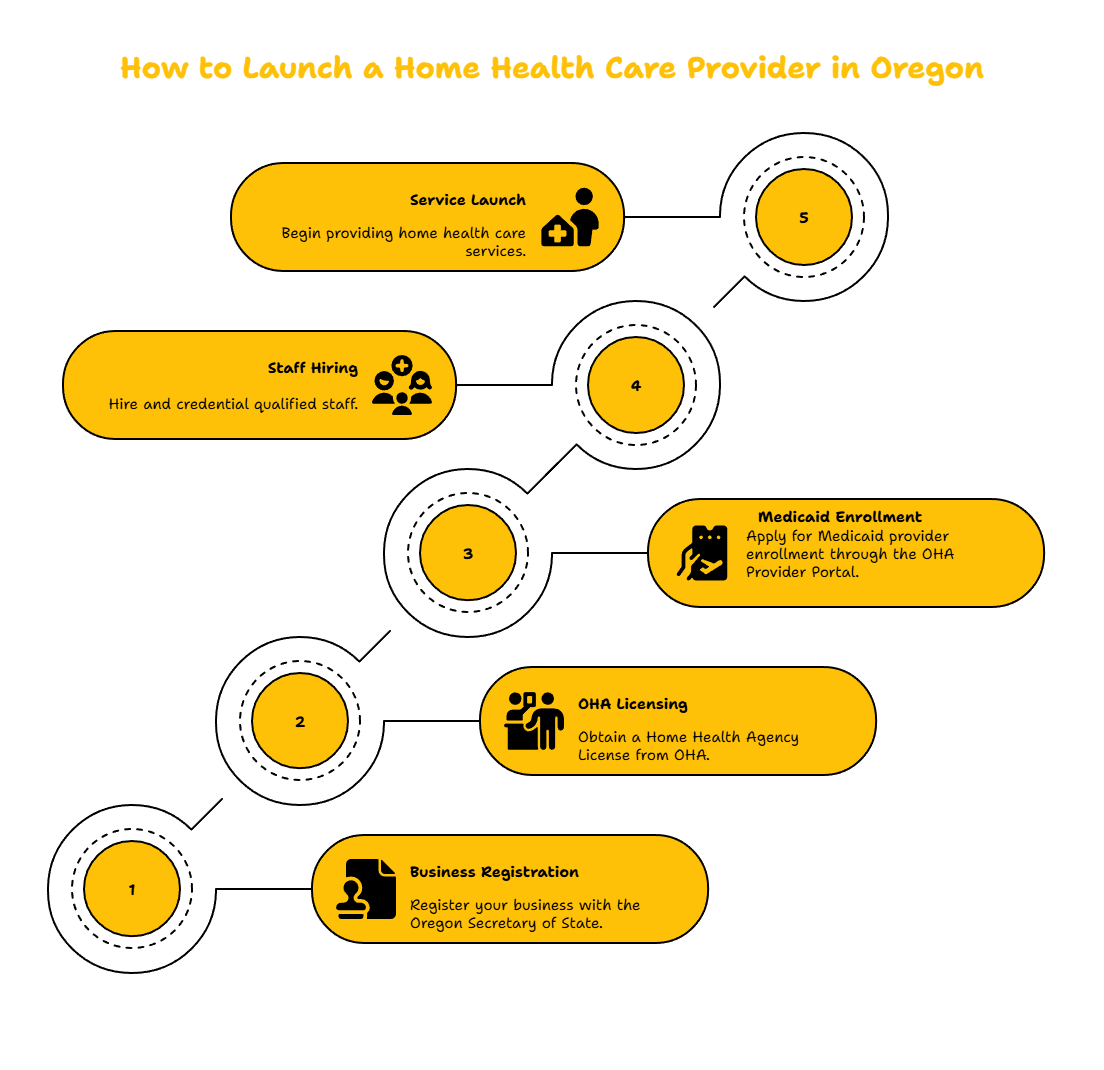
The journey to becoming an approved provider begins with establishing a formal legal entity and obtaining the necessary federal identifiers, specifically an Employer Identification Number (EIN) and a Type 2 National Provider Identifier (NPI). Once the business is registered with the Oregon Secretary of State, the provider must then focus on the licensing process through the OHA’s HCRQI section. This stage involves an intensive review of agency policies, clinical protocols, and operational safety measures.
Following the receipt of an OHA-issued Home Health Agency License, the provider must submit a comprehensive Medicaid provider application via the Oregon Health Plan Provider Portal. This stage triggers the credentialing process, which may include agency inspections and a thorough audit of the agency's internal policies and procedures. Only after the OHA completes its review and grants official enrollment status can the agency begin accepting referrals and billing for services.
Throughout this sequence, it is highly recommended that agencies pursue voluntary accreditation from bodies such as ACHC, CHAP, or the Joint Commission. While not always a regulatory requirement for initial licensure, accreditation serves as an authoritative validation of the agency’s commitment to high-quality care, which can streamline relationships with referral sources and managed care organizations.
What internal documentation and staffing standards are required?
Maintaining regulatory compliance requires a robust Home Health Care Policy & Procedure Manual. This document serves as the backbone of the organization, outlining protocols for everything from nursing care delivery and infection control to emergency preparedness and HIPAA-compliant data management. The manual must provide clear guidelines for physician order tracking and visit documentation, ensuring that every service provided can be verified during a state audit.
Staffing requirements are equally rigid. All clinical personnel must be licensed or certified in the state of Oregon. Registered Nurses (RNs) are required to act as case managers, overseeing patient care plans and supervising Home Health Aides (HHAs). Physical, Occupational, and Speech therapists must be fully licensed in their respective fields to practice under a physician’s plan of care. Furthermore, all staff must undergo rigorous training, covering patient rights, infection control, and standardized documentation practices.
To remain compliant, agencies must implement a system for annual skills verification and continuing education. This ensures that staff remain proficient in current clinical standards and that the agency consistently meets the evolving requirements set forth by both state and federal agencies.
Which Medicaid programs authorize home health services?
Not all home health services are billed identically; they are governed by different funding streams depending on the patient's specific waiver or plan. The State Plan Home Health Benefit is the most common, provided that a physician has ordered the care and prior authorization has been obtained for the Oregon Health Plan (OHP) member.
Beyond the standard state plan, other programs provide specialized coverage:
- K Plan (1915(k)): This section of the Social Security Act allows for enhanced personal care and additional nursing support for qualifying individuals.
- APD HCBS Waivers: These waivers are designed specifically to provide medical and personal care services to individuals who would otherwise require the higher level of care found in nursing facilities.
- Children’s and Medically Fragile Waivers: Targeted programs that provide pediatric-specific home nursing and therapeutic interventions to ensure medically fragile children can remain in their home environments.
Frequently Asked Questions
What is the typical timeline to launch a new home health agency in Oregon?
The timeline is generally structured into four phases. Business registration and initial policy development typically take 1–2 months. The OHA licensing and Medicaid enrollment process is the most time-intensive, often requiring 3–4 months depending on inspection scheduling. Staff hiring and credentialing typically occur over 30–60 days, leading to service launch once all approvals are finalized.
Is accreditation required for Medicaid participation?
While accreditation by bodies like ACHC, CHAP, or the Joint Commission is not always a mandatory prerequisite for state licensure, it is highly recommended. Achieving accreditation demonstrates a higher level of operational maturity and quality assurance, which can prove beneficial during the credentialing process and when building a reputation with healthcare partners.
What roles are essential for agency compliance?
An agency must have an RN to serve as the Case Manager for clinical oversight. Depending on the scope of services, you will also need to engage licensed therapists and potentially a Medical Social Worker. All staff must be trained in HIPAA compliance, infection control, and the specific documentation protocols required for Medicaid billing.
Key Takeaway
Launching a successful Home Health Care agency in Oregon requires a rigorous, methodical approach to clinical compliance and administrative documentation. By mastering the coordination between OHA licensing requirements and the specific billing protocols of the Oregon Health Plan and HCBS waiver programs, providers can build a sustainable, high-quality care organization that serves the most vulnerable members of the community.
Last verified: [Insert Date]. This information is provided for educational purposes and does not constitute legal or professional advice. Always consult with the Oregon Health Authority and relevant legal counsel when establishing a healthcare business to ensure compliance with current state and federal regulations.