HOME HEALTH CARE SERVICES PROVIDER IN MISSISSIPPI
By Fatumata Kaba · 2025-08-06 · 5 min read
DELIVERING QUALITY HEALTH CARE AT HOME TO PROMOTE INDEPENDENCE AND WELL-BEING
Home Health Care Services in Mississippi provide essential medical care, personal support, and therapeutic interventions directly within an individual's residence. These services are vital for Mississippians with disabilities, chronic illnesses, or those transitioning home after a hospitalization, ensuring they can maintain their health and independence through Mississippi’s Home and Community-Based Services (HCBS) Waiver programs.
How Do Governing Agencies Oversee Home Health Care in Mississippi?
The regulatory environment for home health in Mississippi is defined by a tiered structure of state and federal oversight. This framework ensures that service delivery meets rigorous clinical and administrative standards, protecting the health and safety of Medicaid beneficiaries while maintaining the integrity of the state's healthcare system.
At the state level, the Mississippi Department of Health (MDH) holds primary responsibility for the licensure of home health agencies and the enforcement of health regulations. Concurrently, the Mississippi Division of Medicaid (DOM) acts as the state's primary administrator for Medicaid and HCBS programs, managing funding mechanisms and overseeing provider enrollment. These state entities operate under the broader federal guidance provided by the Centers for Medicare & Medicaid Services (CMS), which monitors compliance with federal waiver requirements to ensure consistency and quality across state lines.
- Mississippi Department of Health (MDH): Regulates home health agencies and enforces compliance with state health regulations.
- Mississippi Division of Medicaid (DOM): Administers Medicaid and HCBS Waiver programs, including funding for home health care services.
- Centers for Medicare & Medicaid Services (CMS): Provides federal oversight and ensures waiver compliance.
What Constitutes Home Health Care Service Delivery?
Home Health Care Services are customized to meet the unique needs of each client, as documented in an Individual Service Plan (ISP) or Person-Centered Plan (PCP). By shifting care from institutional settings to the home environment, providers support better clinical outcomes and a higher quality of life for participants.
The scope of these services is broad, encompassing both skilled medical interventions and routine personal support. Services typically include skilled nursing, such as complex wound care or IV therapy, as well as restorative physical, occupational, and speech therapies. Furthermore, providers are tasked with chronic disease monitoring, medication management, and the use of telehealth or remote monitoring technologies to ensure consistent patient oversight between in-person visits.
What Are the Licensing and Provider Enrollment Requirements?
Entering the Mississippi market as a home health provider requires a meticulous approach to business formation and regulatory registration. Before a business can begin offering services or billing the state, it must demonstrate operational readiness and adherence to specific health-related mandates.
The path to becoming a provider begins with standard corporate registration with the Mississippi Secretary of State and obtaining federal identifiers, specifically an Employer Identification Number (EIN) and a Type 2 National Provider Identifier (NPI). Once the business is established, the applicant must secure a Home Health Agency License from the MDH. Following the acquisition of this license, the provider must undergo the official enrollment process with the Mississippi Division of Medicaid to receive an authorization number, while simultaneously maintaining necessary liability insurance and clinical documentation protocols.
How Are Medicaid Waiver Services Structured?
Mississippi utilizes several specific waiver programs to funnel home health services to those who require them most. These programs are designed to keep participants in their homes and communities, avoiding the necessity for nursing facility placement. Approved providers must ensure their service delivery aligns with the specific parameters of the waiver the participant is enrolled in.
Key programs include the 1915(c) HCBS Waiver for the Elderly and Disabled, the Independent Living Waiver, and the Traumatic Brain Injury/Spinal Cord Injury Waiver. Under these umbrellas, providers are authorized to deliver a spectrum of care, ranging from professional skilled nursing and therapeutic services to daily living support and long-term chronic condition management. Each service must be clearly linked to the health goals identified in the participant's person-centered plan.
- 1915(c) HCBS Waiver: Serves the Elderly and Disabled.
- Independent Living Waiver: Designed for those seeking community integration.
- Traumatic Brain Injury/Spinal Cord Injury Waiver: Focused on specific rehabilitation and support needs.
What Are the Essential Staffing and Training Protocols?
The quality of a home health agency is fundamentally tied to the caliber and preparedness of its personnel. Administrators are expected to possess significant experience in healthcare management, ensuring that the agency remains both compliant with regulations and effective in its clinical delivery. All clinical staff, from Registered Nurses (RNs) to Home Health Aides (HHA), must be appropriately credentialed and vetted.
Training requirements are rigorous to ensure patient safety. Staff must be trained in infection control, standardized hygiene practices, emergency response procedures, and precise medication administration protocols. Furthermore, accurate documentation and care coordination are non-negotiable, as these logs serve as the primary audit trail for Medicaid billing and clinical follow-up.
Frequently Asked Questions
What is the typical timeline for launching a home health agency in Mississippi?
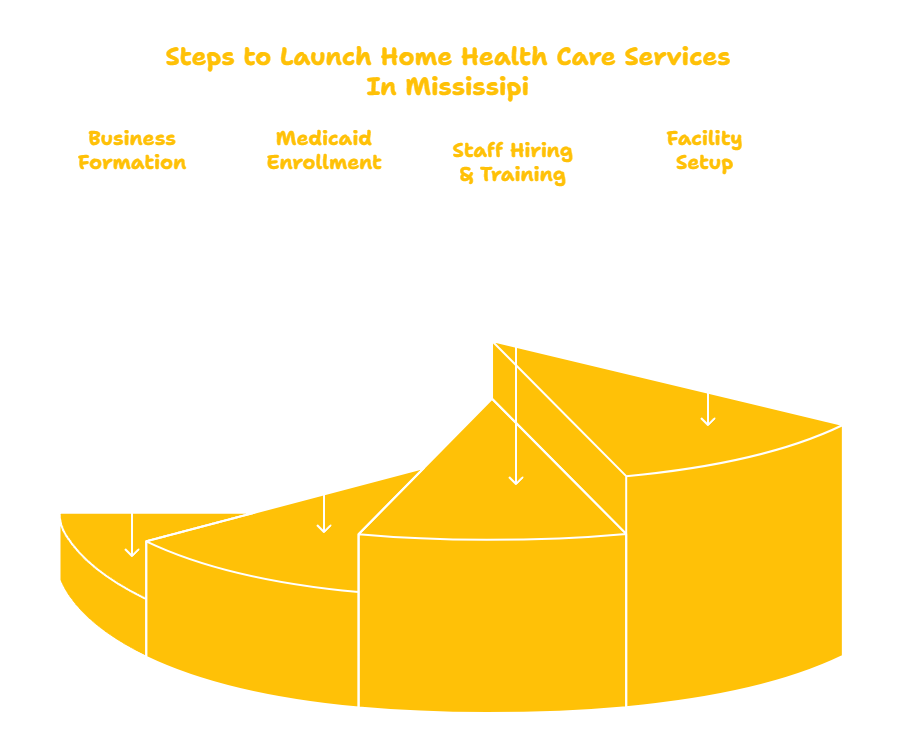
The launch process is sequential. Business formation generally requires 1–2 weeks, followed by a Medicaid provider enrollment period of 60–90 days. Staff hiring and training typically takes 30–45 days, and facility or operational setup requires 2–4 weeks.
What documentation is required for enrollment?
Agencies must provide proof of business registration, an IRS EIN, an NPI confirmation, a valid Home Health Agency License, and proof of liability insurance. Additionally, a comprehensive policy and procedure manual covering client assessments, infection control, and staff training logs is essential.
Who should I contact for official program requirements?
For regulatory guidance, the Mississippi Department of Health (MDH) is the primary contact, while inquiries regarding Medicaid provider enrollment and funding should be directed to the Mississippi Division of Medicaid (DOM).
WAIVER CONSULTING GROUP'S START-UP ASSISTANCE SERVICE — MISSISSIPPI HOME HEALTH CARE SERVICES PROVIDER: WCG supports agencies and entrepreneurs in launching compliant Home Health Care Services across Mississippi under the HCBS Waiver models. Our scope of work includes business registration and licensing assistance, Medicaid provider enrollment, the development of comprehensive policy and procedure manuals, staff credentialing frameworks, and operational templates for client intake and care coordination.
Key takeaway: Success in the Mississippi HCBS landscape depends on strict adherence to the licensing requirements of the Mississippi Department of Health and the provider enrollment mandates of the Mississippi Division of Medicaid, combined with a robust internal framework for clinical documentation and staff competency.
Last verified: October 2023. This information is provided for general informational purposes only and does not constitute legal or professional consulting advice. Requirements for Medicaid provider enrollment and state licensure may change; readers are encouraged to verify current regulations directly with the Mississippi Division of Medicaid and the Mississippi Department of Health.