HOME HEALTH CARE SERVICES PROVIDER IN MINNESOTA
By Fatumata Kaba · 2025-07-27 · 5 min read
Becoming a Home Health Care Services provider in Minnesota is a strategic opportunity to support vulnerable populations while contributing to the state’s robust Home and Community-Based Services (HCBS) ecosystem. This process requires navigating a dual-regulatory environment involving state health licensing and federal Medicaid participation, ensuring all clinical and administrative standards are met to promote patient independence and well-being.
Understanding the Regulatory Landscape and Governing Agencies
The provision of home health care in Minnesota is subject to rigorous oversight to ensure the safety and quality of life for individuals with disabilities, chronic illnesses, or post-hospitalization recovery needs. Providers must maintain compliance with requirements set forth by both state and federal entities, which collaboratively manage the standards for service delivery, staff qualifications, and fiscal integrity.
Governance is divided among three primary agencies:
- Minnesota Department of Health (MDH): Responsible for regulating home health agencies and enforcing state health regulations, including the issuance and oversight of the Comprehensive Home Care Provider License.
- Minnesota Department of Human Services (DHS): Acts as the administrator for the state's Medicaid program and HCBS Waiver systems, managing provider enrollment and the distribution of funding for covered services.
- Centers for Medicare & Medicaid Services (CMS): Provides the necessary federal oversight to ensure that state-level waiver programs remain compliant with national Medicaid requirements and quality standards.
Service Delivery and the Role of HCBS Waivers
Home Health Care Services focus on bringing medical care and personal support directly into the client’s residence. By operating within the home environment, providers help individuals maintain their independence while managing complex medical needs. Services must be tailored to the specific goals outlined in the Individual Service Plan (ISP) or Person-Centered Plan (PCP), ensuring that the care provided is both relevant and medically necessary.
These services are heavily utilized within Minnesota’s 1915(c) HCBS Waiver programs, including the Elderly and Disabled Waiver, the Community Access for Disability Inclusion (CADI) Waiver, and the Brain Injury (BI) Waiver. Approved providers typically deliver a blend of the following:
- Skilled nursing care, such as wound management and IV therapy.
- Physical, occupational, and speech therapy sessions.
- Personal care assistance for activities of daily living like bathing and dressing.
- Medication management, administration, and monitoring.
- Chronic disease management education and remote telehealth monitoring.
Navigating Licensing and Provider Enrollment
The path to becoming an active provider involves a sequential commitment to administrative and clinical prerequisites. Before an agency can bill for Medicaid services, it must establish a formal business structure and obtain the necessary licensure through the Minnesota Department of Health. This is not merely a registration step; it is a foundational requirement that verifies the agency's ability to provide high-quality care.
The Medicaid enrollment process is a multi-stage journey that begins with verifying eligibility requirements through the Minnesota Department of Human Services. Agencies must secure their EIN from the IRS and an NPI (Type 2) for billing purposes. Once the Comprehensive Home Care Provider License is issued by the MDH, the agency can finalize its Medicaid provider enrollment, which concludes with the assignment of a specific Medicaid provider number authorizing the delivery of reimbursable services.
Operational Requirements and Staffing Standards
Success as a home health provider depends on the quality of the clinical team and the robustness of internal policies. All agencies must maintain a comprehensive policy and procedure manual that covers critical areas such as infection control, emergency response protocols, medication administration, and client assessment procedures. These documents form the backbone of an agency’s audit readiness.
Staffing requirements are strictly regulated to protect client safety. Essential roles and expectations include:
- Home Health Care Administrator: Must possess demonstrable experience in healthcare administration and the management of home care operations.
- Registered Nurse (RN): Required to hold a nursing degree, an active Minnesota RN license, current CPR certification, and must have passed appropriate background checks and TB clearance.
- Home Health Aide (HHA): Should possess a CNA certification or equivalent training in personal care, patient safety, and clinical documentation.
Timeline and Strategic Planning for Launch
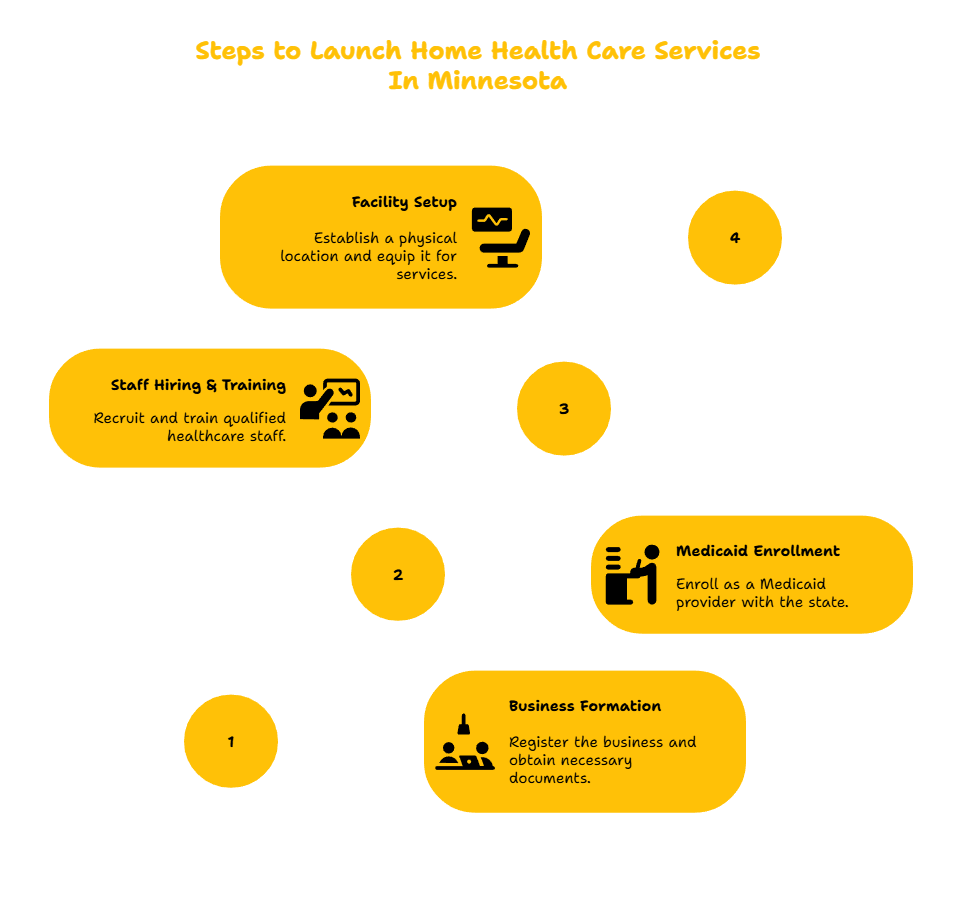
Launching a home health agency requires careful synchronization of business development and regulatory filings. While timelines can vary based on state responsiveness, agencies should expect a multi-month development phase. The initial stage focuses on business formation, such as articles of incorporation, which typically takes 1–2 weeks. Following this, the Medicaid provider enrollment process is the most intensive, often requiring 60–90 days for review and approval.
Concurrently, agencies must focus on staffing and infrastructure. Hiring and training staff, including competency verification, generally requires 30–45 days. Physical setup, which includes securing an office and necessary operational equipment, usually spans 2–4 weeks. By planning for these overlapping timelines, founders can reduce the risk of delays in their operational launch.
Frequently Asked Questions
What is the primary difference between a personal care agency and a home health agency in Minnesota?
While both provide support at home, home health agencies are specifically licensed to provide skilled medical services, such as nursing and therapy, usually requiring higher-level clinical oversight and specific licensure from the Minnesota Department of Health.
How does the DHS verify that an agency is compliant with waiver requirements?
The Minnesota Department of Human Services performs periodic reviews, audits, and site visits to ensure that services delivered match the Individual Service Plan (ISP) and that all documentation, including care logs and training records, meets established program standards.
Can an agency provide services to multiple HCBS waiver populations?
Yes, once an agency is enrolled as a Medicaid provider and possesses the appropriate clinical licensure, they may serve clients across various waiver programs, such as the CADI, BI, and Elderly waivers, provided they have the staff capacity and clinical expertise to meet the unique needs of each program.
Key Takeaway: Establishing a Home Health Care Services agency in Minnesota requires a methodical approach that balances state-mandated clinical licensing with federal Medicaid enrollment standards. Success is predicated on meticulous documentation, experienced staffing, and a deep understanding of the specific requirements of the CADI, BI, and Elderly waivers.
Last verified: October 2023. Disclaimer: This information is for educational purposes only and does not constitute legal or professional consulting advice. Requirements for Medicaid waivers and state licensing are subject to change; always consult with the Minnesota Department of Human Services and the Minnesota Department of Health for the most current regulations.