HOME HEALTH CARE SERVICES PROVIDER IN MICHIGAN
By Fatumata Kaba · 2025-07-27 · 5 min read
Understanding the Regulatory Landscape for Michigan Home Health Providers
Home Health Care Services in Michigan serve as a critical bridge for individuals with disabilities, chronic conditions, or recovery needs, allowing them to receive high-quality medical and non-medical care in the comfort of their own homes. By operating under the oversight of the Michigan Department of Health and Human Services (MDHHS) and adhering to federal standards set by the Centers for Medicare & Medicaid Services (CMS), providers play an essential role in reducing hospital readmissions and supporting long-term independence.
For entrepreneurs and healthcare administrators, navigating this sector requires a dual focus: meeting stringent state licensure requirements through the Department of Licensing and Regulatory Affairs (LARA) and establishing clear, compliant pathways for Medicaid and Home and Community-Based Services (HCBS) waiver reimbursement. Success in this field relies on maintaining strict adherence to clinical standards, person-centered care protocols, and the continuous verification of staff credentials to ensure patient safety and program eligibility.
What Are the Primary Governing Agencies and Regulatory Requirements?
The Michigan home health sector is governed by a multi-layered regulatory framework designed to ensure quality of care and financial accountability. The MDHHS acts as the primary authority for Medicaid-funded HCBS waiver programs, while CMS provides the federal oversight and funding backbone through 1915(c) waivers and State Plan services. Providers must align their operational protocols with these entities to remain in good standing.
In addition to federal and state health departments, operational licensing is managed through LARA, which ensures that home health agencies meet specific safety and administrative standards. Concurrently, the Michigan Board of Nursing regulates the professional staff—including RNs, LPNs, and CNAs—who deliver direct care. At the regional level, Local Area Agencies on Aging (AAA) serve as critical points of contact for coordinating services for seniors enrolled in the MI Choice Waiver program.
- MDHHS: Manages state Medicaid policy and HCBS program integrity.
- CMS: Sets federal benchmarks and funds 1915(c) waiver initiatives.
- LARA: Issues agency licenses and conducts regulatory compliance inspections.
- Board of Nursing: Oversees professional licensure and scope of practice.
- AAA: Facilitates local access and care coordination for waiver participants.
How Do You Categorize Medical and Non-Medical Home Care Services?
Home health care is differentiated by the nature of the support provided. Medical services require a physician’s order and must be documented within a formal Plan of Care (POC). These interventions are designed for patients recovering from surgery, managing chronic illnesses, or requiring skilled clinical oversight, such as wound care, IV therapy, or complex medication management. Physical, occupational, and speech therapists also play a vital role in restorative care.
Non-medical care focuses on improving the quality of life and facilitating daily functioning through assistance with Activities of Daily Living (ADLs) and Instrumental Activities of Daily Living (IADLs). While these services do not typically require a nurse’s intervention, they must still be delivered by trained personnel who follow individualized care plans. This support is essential for sustaining the independence of individuals who might otherwise require institutionalized long-term care.
- Skilled Medical Services: Nursing care, therapy, medical social work, and chronic disease management.
- ADL Support: Bathing, grooming, dressing, mobility assistance, and toileting.
- IADL Support: Meal preparation, light housekeeping, medication reminders, and medical appointment escort services.
What Steps Are Necessary for Provider Enrollment and Licensing?
Launching a home health agency is a sequential process that begins with formal business registration and LARA licensing. Prospective providers must obtain an IRS EIN and Type 2 NPI before applying for their license via the LARA portal. Once the agency is legally established, the focus shifts to the CHAMPS (Community Health Automated Medicaid Processing System) enrollment, which is the gateway for billing Michigan Medicaid and securing reimbursement.
Beyond basic licensing, providers must complete the credentialing process with local AAAs and Medicaid Health Plans (MHPs) to participate in specific HCBS waiver programs. This involves demonstrating that the agency has a comprehensive Policy & Procedure Manual, robust insurance coverage, and a qualified, background-checked staff. Agencies should expect this process to take several months, as documentation must be audit-ready and compliant with state and federal regulations from day one.
What Are the Essential Staffing and Training Mandates?
The quality of a home health agency is defined by its clinical staff. Registered Nurses (RNs) and Licensed Practical Nurses (LPNs) must hold current Michigan licenses, while CNAs and Home Health Aides (HHAs) must have completed state-approved training programs. Every employee, regardless of their role, must undergo a rigorous background check and demonstrate competency in their specific scope of practice prior to visiting patients in their homes.
Continuous training is a mandatory component of agency compliance. Staff must be proficient in infection control, HIPAA protocols, safe patient handling, and the nuances of person-centered care. Furthermore, nurses must be specifically trained in medication safety and the administration protocols unique to their clinical duties. Documenting these trainings is a key requirement for agency audits and ensures that the organization remains aligned with state health mandates.
Frequently Asked Questions
How long does the licensing and enrollment process typically take?
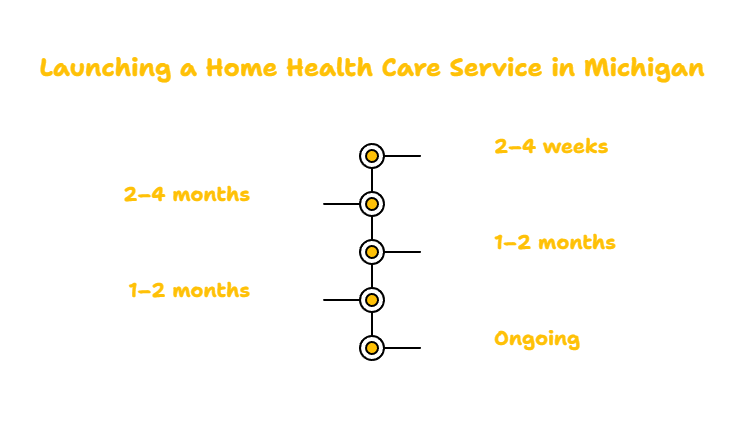
The timeline varies by agency, but business registration and insurance setup usually take 2–4 weeks. Obtaining a LARA home health license typically requires 2–4 months, followed by 1–2 months for Medicaid and waiver program enrollment. Hiring and onboarding qualified staff adds an additional 1–2 months to the process.
What documentation is required to pass a state audit?
Agencies must maintain meticulous records, including client admission forms, individualized care plans, nursing notes, incident reports, staff training logs, and medication administration records. All billing logs must be clear and readily available to prove that services rendered were medically necessary and authorized.
Can agencies provide both medical and non-medical care?
Yes, many agencies provide comprehensive support by offering both skilled medical services and non-medical ADL/IADL assistance. However, agencies must ensure that each service is appropriately categorized, authorized by a physician where required, and billed through the correct Medicaid or waiver codes to maintain compliance.
Key Takeaways for Agency Founders
Entering the Michigan home health market requires a commitment to rigorous regulatory standards and precise operational planning. By focusing on compliant documentation, professional staff training, and the strategic alignment of services with Medicaid and HCBS waiver requirements, agency founders can build a sustainable, high-impact organization. WCG supports healthcare agencies, nurse entrepreneurs, and caregiving businesses in navigating these complexities through expert guidance on LARA licensing, CHAMPS enrollment, and the development of comprehensive Policy & Procedure Manuals tailored to meet CMS Conditions of Participation.
Last verified: 2024. The information provided is for educational purposes only and does not constitute legal or professional advice. Always refer to official MDHHS, LARA, and CMS documentation for the most current regulatory requirements.