HOME HEALTH CARE SERVICES PROVIDER IN MARYLAND
By Fatumata Kaba · 2025-09-02 · 6 min read
Starting a home health care agency in Maryland requires navigating a structured regulatory environment designed to ensure high standards of patient safety and quality of life. By becoming a licensed Residential Service Agency (RSA) and enrolling as a Medicaid provider, entrepreneurs can deliver essential medical, personal, and therapeutic support that allows individuals to remain safely in their own homes.
This guide outlines the critical steps for launching a compliant home health care business in Maryland, from securing OHCQ licensure to mastering the nuances of Medicaid reimbursement through programs like the Community First Choice (CFC) and the Community Options Waiver. Understanding these regulatory requirements is the first step toward building a sustainable agency that meets the needs of Maryland’s vulnerable populations.
Understanding the Regulatory Landscape and Governing Agencies
The provision of home health care in Maryland is heavily regulated to protect client welfare and ensure standardized care delivery. The primary regulatory body is the Maryland Department of Health (MDH), which oversees the state’s Medicaid-funded home health programs. Within this framework, the Office of Health Care Quality (OHCQ) serves as the gatekeeper for operational standards, responsible for licensing and inspecting Residential Service Agencies (RSAs) to ensure they adhere to state regulations, specifically COMAR 10.07.05.
At the federal level, the Centers for Medicare & Medicaid Services (CMS) sets the overarching standards for Home and Community-Based Services (HCBS). These federal mandates require that services be delivered in a person-centered manner, emphasizing individual choice and autonomy. Additionally, individual clinical professionals—including Registered Nurses (RNs), Licensed Practical Nurses (LPNs), and physical or occupational therapists—must maintain active, good-standing licenses with their respective professional boards to provide billable care in the home setting.
Defining Your Scope: What Services Should Your Agency Provide?
A Residential Service Agency in Maryland may choose to provide skilled services, unskilled (personal) services, or a combination of both. Defining this scope early is critical, as it dictates the qualifications of the staff you must recruit and the specific clinical protocols you must document in your Policy and Procedure manual. Skilled services typically require the oversight of a Nursing Administrator and include high-acuity care such as wound management, medication administration, and intravenous therapy.
In contrast, unskilled or personal care services focus on activities of daily living (ADLs), such as grooming, toileting, feeding, and mobility assistance. Many successful agencies operate as hybrid entities, offering both skilled nursing and home health aide services to maximize their utility to Medicaid participants. Regardless of the scope, every service provided must be authorized by a physician’s order and documented within a formal Plan of Care, which serves as the blueprint for all clinical and supportive activities.
Step-by-Step Guide to OHCQ Licensure and Compliance
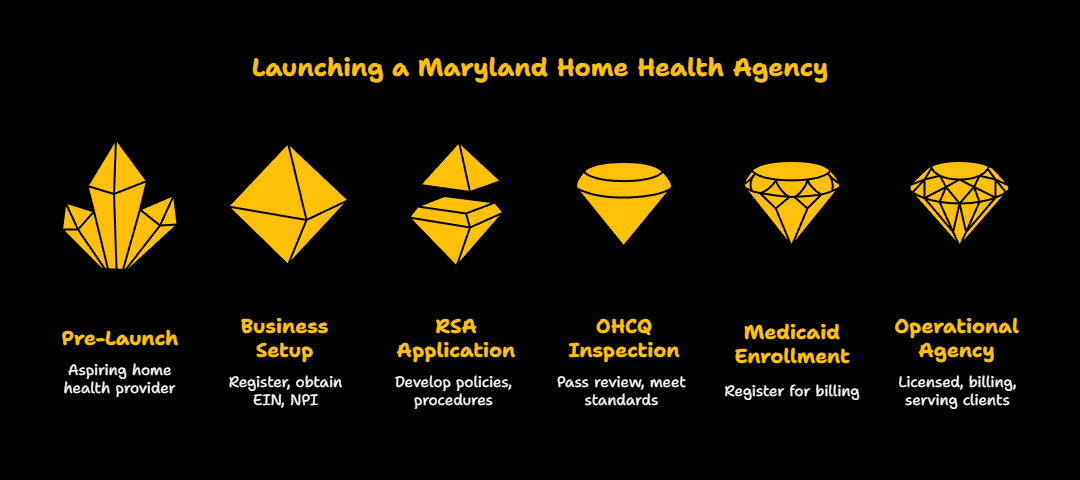
The path to licensure begins with formal business formation, which includes registering your LLC with the Maryland Department of Assessments and Taxation (SDAT) and securing a federal Employer Identification Number (EIN) and a Type 2 NPI. Once the business entity is established, you must develop a comprehensive policy and procedure manual that satisfies OHCQ requirements. This manual must detail your agency’s approach to infection control, emergency preparedness, incident reporting, and HIPAA compliance.
The OHCQ application process involves a thorough review of your organizational structure, clinical policies, and staff credentials. After the application is submitted and approved for review, the OHCQ will conduct an inspection. During this audit, surveyors review your clinical documentation, patient rights policies, and employee files. Successfully passing this inspection is the mandatory precursor to enrolling with Maryland Medicaid through the ePREP portal, which is the final step before you can begin billing for services rendered to waiver participants.
- Phase 1 (1–2 weeks): Business registration, office location securing, and federal credentialing.
- Phase 2 (2–4 weeks): Development of RSA application, policy manual, and clinical protocols.
- Phase 3 (6–8 weeks): Submission to OHCQ and preparation for the on-site compliance inspection.
- Phase 4 (4–6 weeks): Finalizing Medicaid provider enrollment via ePREP and initiating referral networking.
Navigating Medicaid Waiver Programs and Reimbursement
Maryland provides home health services through several specialized Medicaid programs, each targeting specific participant needs. The Community First Choice (CFC) program is a primary pathway for individuals who meet a nursing facility level of care but prefer to receive assistance with ADLs and nursing support at home. Other critical programs include the Community Options Waiver for the elderly and adults with physical disabilities, and the Model Waiver, which is specifically designed for medically fragile children under the age of 22.
For individuals transitioning out of institutional settings, the Increased Community Services (ICS) program provides a pathway to home-based care. As a provider, your agency must be enrolled to bill specifically for these programs. Success in this area requires meticulous adherence to billing requirements, timely submission of documentation, and a clear understanding of the specific service definitions covered under each waiver. Agency administrators should regularly monitor the LTSS Maryland system to ensure seamless authorization and billing cycles.
Staffing Requirements and Clinical Oversight
Personnel management is the foundation of quality care. An RSA must employ a qualified Nursing Administrator, who must be a Registered Nurse (RN) with experience in home health care. This individual is responsible for the overall supervision of the clinical team, including the delegation of tasks to LPNs and Home Health Aides (HHAs) or Certified Nursing Assistants (CNAs). All clinical staff, including therapists, must maintain current licenses and undergo rigorous background and credentialing checks.
Beyond technical certifications, your agency is responsible for ensuring ongoing training and competency testing for all employees. This includes mandatory instruction in HIPAA standards, infection control practices, and emergency response protocols. Maintaining an organized staff credentialing tracker is essential, as OHCQ inspectors will audit these files to ensure that every staff member is qualified, licensed, and trained to perform the duties outlined in the patient’s Plan of Care.
- Nursing Administrator: Must be a licensed RN; manages clinical protocols and oversight.
- Support Staff: CNAs and HHAs providing hands-on care; requires active state certification.
- Clinical Specialists: PT, OT, and ST professionals who provide rehabilitative care.
- Mandatory Training: Annual skills checks, infection control, and documentation standards.
Frequently Asked Questions
What is the difference between an RSA and a Home Health Agency?
In Maryland, a Residential Service Agency (RSA) is the specific license issued by the OHCQ to agencies providing skilled and unskilled care in the home. While these are often referred to as home health agencies, the regulatory term for the license under COMAR 10.07.05 is the RSA license.
Is an office location required to obtain an RSA license?
Yes, Maryland regulations require an RSA to maintain a physical office location that is accessible for OHCQ inspections and serves as the central hub for administrative and clinical records management.
Can I begin billing Medicaid immediately after getting my RSA license?
No, the RSA license is only the first part of the process. You must also successfully enroll as a provider in the Maryland Medicaid program via the ePREP portal and receive authorization to bill for specific waiver services before you can request reimbursement.
Key Takeaway
Launching a home health care provider in Maryland is a complex but rewarding process that demands strict attention to regulatory detail and clinical excellence. By maintaining compliance with OHCQ licensing standards, adhering to Medicaid billing requirements through ePREP, and fostering a team of highly qualified clinicians, agency founders can build a stable organization capable of providing vital care to the Maryland community.
Last verified: October 2023. Disclaimer: This document is for informational purposes only and does not constitute legal or professional medical advice. Always consult with the Maryland Department of Health and legal counsel specializing in healthcare regulations before making business decisions or submitting applications to state agencies.