HOME HEALTH CARE SERVICES PROVIDER IN LOUISIANA
By Fatumata Kaba · 2025-08-12 · 5 min read
Establishing a Home Health Care Services agency in Louisiana is a rigorous, highly regulated process that requires navigating both state licensing and Medicaid provider enrollment mandates. This pathway involves securing approval from the Louisiana Department of Health (LDH), establishing a robust clinical infrastructure, and coordinating with Managed Care Organizations (MCOs) to deliver essential skilled nursing, therapy, and aide services to participants within their own residences.
What Are the Governing Agencies and Regulatory Requirements for Louisiana Home Health Providers?
The regulatory landscape for home health in Louisiana is multi-tiered, involving oversight at both the state and federal levels. The primary regulatory body is the Louisiana Department of Health (LDH) — Health Standards Section, which is responsible for the initial licensing of agencies and conducting ongoing surveys to ensure compliance with state statutes. Their role is to verify that your agency meets all safety, administrative, and clinical standards required to operate legally within the state.
Beyond state licensure, operational oversight is managed through the Medicaid Management Information System (MMIS) and Molina Medicaid Solutions. These entities govern provider enrollment, claims processing, and reimbursement workflows. Additionally, Managed Care Organizations (MCOs) under the Bayou Health program serve as the primary gateways for service authorization, while the Centers for Medicare & Medicaid Services (CMS) maintains federal standards for providers participating in federal healthcare programs.
How Do You Structure Your Home Health Agency for Operational Compliance?
Founding a home health agency requires more than simple business registration; it requires the development of a comprehensive operational framework. Prospective providers must first incorporate their business entity with the Louisiana Secretary of State and obtain a Federal Employer Identification Number (EIN) and a Type 2 National Provider Identifier (NPI). These foundational steps are prerequisites for all subsequent licensing and enrollment applications.
A critical component of your operational setup is the creation of a Home Health Care Policy & Procedure Manual. This document serves as the backbone of your agency, detailing your clinical protocols, patient rights, and administrative workflows. You must also select a HIPAA-compliant electronic health record (EHR) system to ensure that all documentation—ranging from nursing assessments to medication administration records—remains secure and audit-ready.
- Register business with the Louisiana Secretary of State.
- Obtain IRS EIN and Type 2 NPI.
- Implement a formal Home Health Care Policy & Procedure Manual.
- Secure general and professional liability insurance policies.
- Set up HIPAA-compliant EHR and clinical documentation systems.
What is the Step-by-Step Pathway to State Licensure and Medicaid Enrollment?
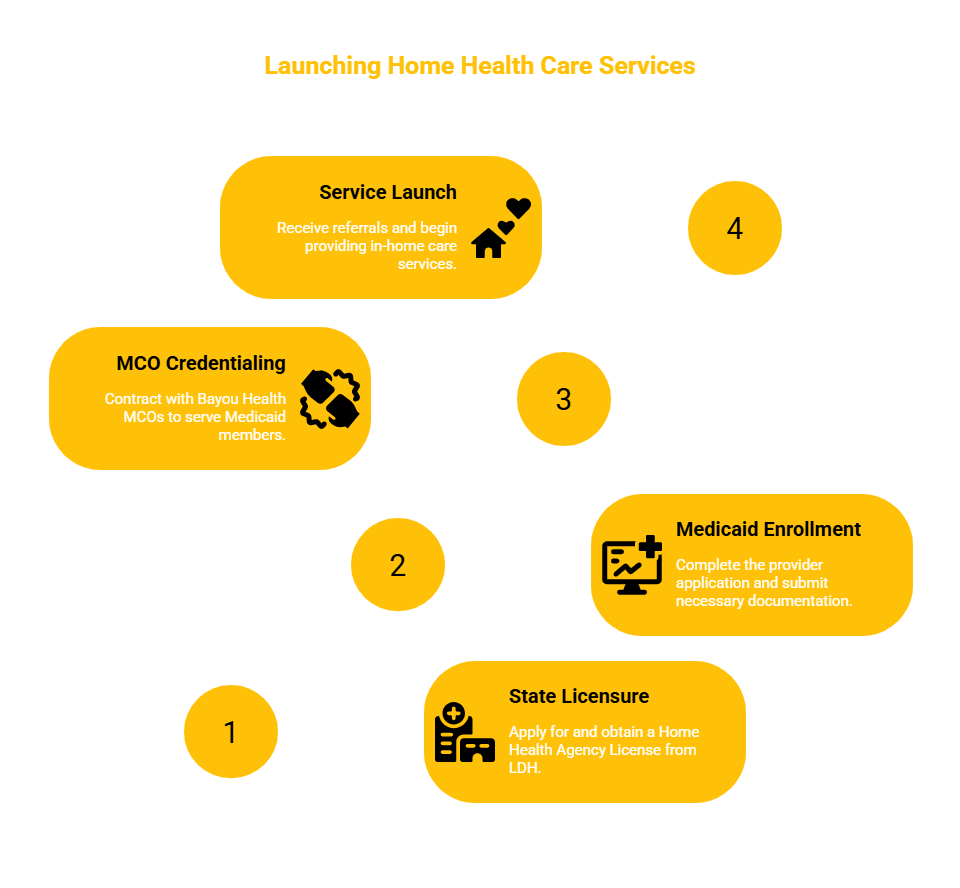
The roadmap to launching an agency follows a logical, sequential progression. The first phase is securing state licensure via the LDH Health Standards Section. This process includes a formal application, an inspection, and a readiness review where your staffing plans, emergency protocols, and infection control measures are vetted by state officials. Do not attempt to enroll in Medicaid until you have secured this initial state license.
Once licensed, you must enroll with Louisiana Medicaid through the official Provider Enrollment Portal. During this phase, you will submit your business documentation, licensure credentials, and staff information. Following Medicaid enrollment, you must move into the MCO credentialing phase. Contracting with Bayou Health MCOs is essential, as these organizations authorize the majority of Medicaid-covered home health services for participants. Only after these approvals are finalized can the agency begin accepting referrals and initiating clinical care.
How Are Clinical Staffing and Care Protocols Managed?
Staffing requirements are strictly defined by the clinical nature of home health services. Your team must include licensed professionals, including Registered Nurses (RNs) or Licensed Practical Nurses (LPNs), as well as state-certified Home Health Aides (HHAs). Each staff member must undergo rigorous background checks and demonstrate competency in infection control, clinical documentation, and patient confidentiality before providing direct care.
Clinical direction is typically spearheaded by an Administrator or Clinical Director who maintains oversight of all patient care plans. Every service provided—whether it is physical, occupational, or speech therapy, or skilled nursing—must be guided by a physician’s order and a documented Plan of Care (POC). This ensures that every intervention is medically necessary, clearly tracked, and aligned with the participant's recovery or maintenance goals.
- Registered Nurses and LPNs with active Louisiana licenses and CPR certification.
- Home Health Aides trained in ADLs and infection control practices.
- Physical, Occupational, and Speech Therapists licensed in their respective disciplines.
- Administrative leadership with home health or healthcare management experience.
Which Medicaid Programs and Waivers Cover Home Health Services?
Louisiana Medicaid provides a variety of pathways for home health reimbursement, catering to diverse populations. The Louisiana Medicaid State Plan covers essential medical home care services for eligible participants. Beyond this, specialized waiver programs provide further opportunities for care delivery, including the Community Choices Waiver (CCW) for the elderly and disabled, and the Residential Options Waiver (ROW) or the NOW Waiver for individuals with intellectual and developmental disabilities.
Additionally, the EPSDT program provides comprehensive home health services for children under the age of 21. For those transitioning from institutional care back to the community, the Money Follows the Person (MFP) program offers a bridge for discharge planning and ongoing support. Each of these programs requires specific adherence to the authorized Plan of Care and consistent documentation of medical necessity to ensure claims are successfully processed.
Frequently Asked Questions
How long does the licensing and enrollment process typically take?
The total timeline varies, but generally, state home health licensure takes 90–120 days, followed by 60–90 days for Medicaid enrollment and MCO credentialing. Factoring in business registration and staff training, the entire process often spans 6 to 9 months.
What documentation is required to pass a state inspection?
You must have a comprehensive Policy & Procedure Manual, documented nursing assessment templates, HHA assignment sheets, therapy visit logs, Medication Administration Records (MARs), and documented emergency and infection control protocols. You must also demonstrate an organized system for clinical supervision and incident reporting.
What is the role of an MCO in home health services?
Managed Care Organizations (MCOs) under Bayou Health act as the primary coordinators for Medicaid members. They manage the authorization process for services, ensuring that the care requested by a physician is medically necessary and falls within the scope of the participant's specific waiver or state plan coverage.
Key Takeaways
Establishing a successful home health agency in Louisiana requires meticulous adherence to state licensing, precise clinical documentation, and strategic integration with MCO networks. Founders must balance regulatory compliance with the operational demands of hiring licensed clinicians and implementing secure EHR systems. By strictly following the protocols set forth by the Louisiana Department of Health and Medicaid, agencies can ensure sustainable participation in the state’s healthcare delivery system.
Last verified: September 2023. Disclaimer: This information is for educational purposes only and does not constitute legal or professional consulting advice. Requirements and state regulations are subject to change; always verify current statutes via official Louisiana Department of Health and Medicaid portals before making business decisions.