HOME HEALTH CARE SERVICES PROVIDER IN ALASKA
By Fatumata Kaba · 2025-07-03 · 6 min read
DELIVERING CLINICAL AND PERSONALIZED MEDICAL CARE TO INDIVIDUALS IN THE COMFORT OF THEIR OWN HOMES
Home Health Care Services in Alaska provide essential, medically necessary in-home care for individuals managing chronic illnesses, disabilities, or post-acute recovery needs under the state’s Medicaid and Home and Community-Based Services (HCBS) Waiver programs. By delivering skilled nursing, therapeutic, and medical support directly to a patient’s residence, these services aim to maintain health stability and promote independence while preventing unnecessary institutionalization.
Establishing a Home Health Agency (HHA) in Alaska requires navigating a complex regulatory landscape involving state licensing, Medicaid enrollment, and rigorous clinical oversight. This guide outlines the foundational requirements and systemic processes for providers seeking to enter the Alaska home health market.
What Are the Primary Regulatory Agencies Overseeing Alaska Home Health?
The operation of a home health agency in Alaska is governed by a collaboration between state and federal entities to ensure patient safety and fiscal accountability. Prospective providers must coordinate with multiple divisions to satisfy distinct administrative and clinical requirements.
The Alaska Department of Health—Division of Senior and Disabilities Services (SDS) serves as the primary authority for approving providers for HCBS waiver participation, monitoring service delivery, and ensuring ongoing compliance with waiver-specific requirements. Simultaneously, the Division of Health Care Services (HCS) is responsible for the state-level licensing of Home Health Agencies, enforcing healthcare regulations and facility standards.
Beyond state-level oversight, Alaska Medicaid (under the Department of Health) manages provider enrollment and the reimbursement infrastructure for services rendered. Furthermore, the federal Centers for Medicare & Medicaid Services (CMS) mandates that all programs remain in alignment with federal home health and HCBS regulations, ensuring that care quality and documentation meet national benchmarks.
What Scope of Services Defines Home Health Care in Alaska?
Home health care services are defined as skilled medical and therapeutic interventions provided in the home setting. These services must be intermittent, part-time, and focused on the patient's recovery, stabilization, or the maintenance of health conditions as ordered by a physician or authorized via a person-centered care plan.
Approved providers are authorized to deliver a spectrum of care, including:
- Skilled nursing, such as complex wound care, medication management, and clinical injections.
- Therapeutic interventions including physical therapy, occupational therapy, and speech therapy.
- Home health aide services, including assistance with bathing, mobility support, and routine vitals monitoring.
- Medical social work services to assist with care coordination and patient needs.
- Comprehensive chronic condition management, patient health education, and training for family caregivers.
What Are the Foundational Licensing and Provider Requirements?
Before an agency can begin operations, it must meet stringent administrative prerequisites. These requirements ensure that the business entity is legally recognized and clinically equipped to handle the complexities of home-based medical care. Initial steps include the formal registration of the business with the Alaska Division of Corporations, Business and Professional Licensing, obtaining a federal Employer Identification Number (EIN), and securing a Type 2 National Provider Identifier (NPI).
Operational compliance is dictated by the Alaska Administrative Code (7 AAC 12). Providers must obtain a state-issued Home Health Agency (HHA) license from the Division of Health Care Services. This process involves proving that the agency employs licensed, credentialed medical professionals and maintains adequate malpractice, general liability, and worker’s compensation insurance. A critical component of this phase is the implementation of a secure Electronic Health Record (EHR) system to ensure HIPAA compliance and accurate clinical documentation.
How Is the Enrollment Process Structured for SDS and Medicaid?
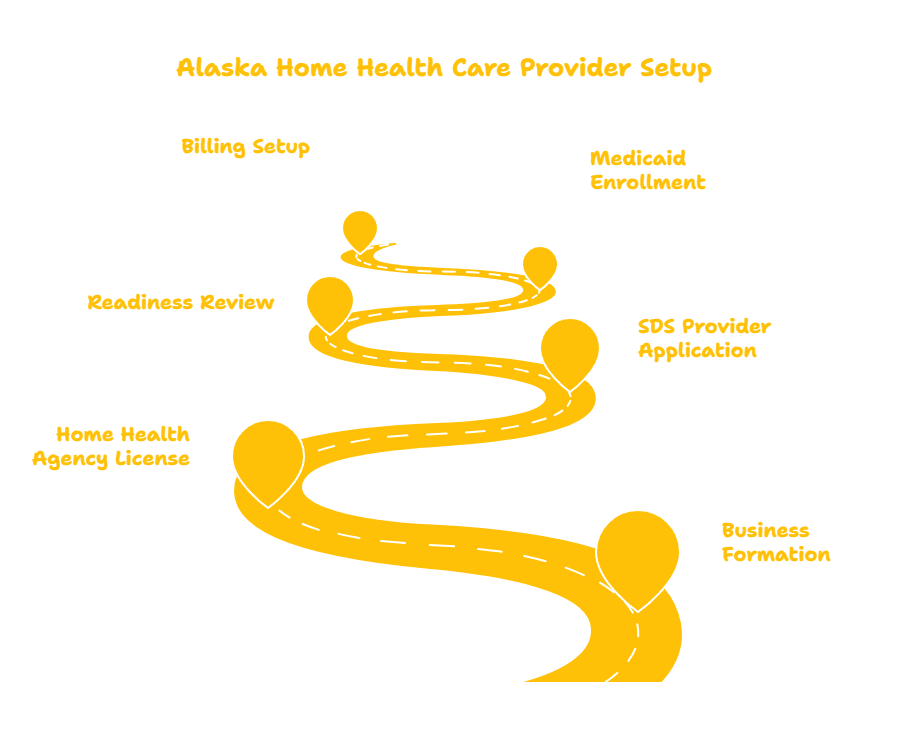
The transition from a licensed agency to an active Medicaid provider follows a structured, multi-phase sequence. Initially, applicants must submit a formal HHA licensing application to the Division of Health Care Services, which will trigger a licensing survey to evaluate staff credentialing, patient rights, and infection control protocols.
Once state licensure is secured, the provider must engage with SDS to initiate the HCBS provider application process. This involves submitting comprehensive organizational documentation, such as plan-of-care templates and internal supervisory protocols. A readiness review is typically conducted by the state, where inspectors assess the agency’s physical infrastructure, clinical staffing models, and overall service delivery readiness, including the ability to maintain confidentiality and accurate medical records.
Final authorization is achieved through enrollment in the Alaska Medicaid Management Information System (MMIS). Once fully enrolled, the provider can activate specific billing codes and finalize the Medicaid provider agreement, enabling the agency to begin billing for waiver-authorized services.
Which Documentation Must Be Maintained for Compliance?
Successful agencies maintain a centralized repository of documentation to satisfy both state audits and Medicaid reimbursement reviews. Essential documents include the business license, proof of office location, and a comprehensive Policy and Procedure Manual. This manual must explicitly cover clinical intake, physician order protocols, infection control, and emergency response procedures.
Furthermore, providers must keep detailed logs regarding staff hiring, training, and license verification, alongside patient-facing documentation such as informed consent forms, grievance procedures, and HIPAA-compliant communication policies. Regular utilization review procedures and incident reporting logs are also mandatory for maintaining "good standing" with state regulators.
What Are the Mandatory Staffing and Training Qualifications?
The quality of home health care is inherently linked to the qualifications of the staff delivering it. A core requirement is the appointment of a Clinical Director or Director of Nursing, who must be a Registered Nurse (RN) with verified home health and supervisory experience. All skilled nursing and therapeutic staff, including LPNs, PTs, OTs, and SLPs, must hold current, valid Alaska professional licenses.
Home health aides are required to hold a current Alaska CNA license and maintain up-to-date CPR certification. Regardless of their role, all personnel must undergo comprehensive training covering SDS orientation, person-centered planning, HIPAA compliance, abuse prevention, and emergency preparedness. These staff credentials and certifications must be tracked and renewed annually to ensure continuous regulatory compliance.
Frequently Asked Questions
How long does the licensing and enrollment process typically take?
The total timeline varies, but the preparation of business and licensing typically takes 2–4 weeks, followed by 90–120 days for the HHA license survey, 45–60 days for the SDS readiness review, and an additional 45–60 days for final Medicaid enrollment and billing setup.
Which Medicaid Waivers include home health services?
Home health care services may be authorized for individuals enrolled in the Alaskans Living Independently (ALI) Waiver, the Adults with Physical and Developmental Disabilities (APDD) Waiver, the Intellectual and Developmental Disabilities (IDD) Waiver, and the Children with Complex Medical Conditions (CCMC) Waiver.
What is the role of the SDS in the provider journey?
The Division of Senior and Disabilities Services (SDS) serves as the primary liaison for HCBS providers. They approve providers for waiver participation, oversee the clinical readiness of the agency, and ensure that the care provided adheres to the specific person-centered goals established in each patient's waiver care plan.
Key Takeaway: Establishing a successful home health agency in Alaska requires a disciplined approach to both clinical licensure and administrative compliance. By meticulously preparing the necessary policy manuals, ensuring staff credentials meet the requirements of 7 AAC 12, and aligning documentation with Medicaid billing standards, providers can effectively bridge the gap between regulatory requirements and high-quality patient care.
Last verified: May 2024. This information is for educational purposes only and does not constitute legal or professional advice. Requirements for Medicaid providers may change; please consult with the Alaska Department of Health and the Division of Senior and Disabilities Services directly for the most current regulations and application procedures.