HOME DELIVERY MEALS SERVICES PROVIDER IN MICHIGAN
By Fatumata Kaba · 2025-07-27 · 5 min read
SUPPORTING INDIVIDUALS WITH NUTRITIONAL NEEDS THROUGH HOME-DELIVERED MEALS
Home Delivery Meals Services in Michigan are essential community-based interventions designed to support older adults, individuals with disabilities, and those managing chronic health conditions by providing nutritionally balanced meals directly to their residences. These services, authorized under various Michigan Home and Community-Based Services (HCBS) Medicaid Waivers, operate under the strict regulatory oversight of the Michigan Department of Health and Human Services (MDHHS) to ensure participant safety and health outcomes.
What Are the Governing Agencies and Regulatory Frameworks?
Operating as a Home Delivery Meals provider in Michigan requires navigating a multi-layered regulatory environment. The Michigan Department of Health and Human Services (MDHHS) serves as the primary authority, overseeing the critical aspects of provider enrollment, service authorization, and ongoing Medicaid compliance. By adhering to the standards set by the MDHHS, providers ensure they remain eligible for reimbursement through state-administered waiver programs.
Beyond state-level management, the Centers for Medicare & Medicaid Services (CMS) provide the overarching federal framework for HCBS waiver programs. CMS ensures that Michigan’s delivery of these services aligns with national guidelines regarding quality of care, participant health, and program integrity. Providers must maintain a robust understanding of both federal expectations and state-specific protocols to successfully navigate the enrollment and operational requirements of the Michigan Medicaid Agency.
How Does the Home Delivery Meals Service Model Function?
The Home Delivery Meals service model is fundamentally designed to fill a gap in care for individuals who lack the physical or cognitive capacity to shop for groceries or prepare balanced meals independently. By integrating nutritional support into the broader care plan, these services prevent malnutrition and help participants maintain independence within their own homes, thereby reducing the necessity for higher-cost institutional care.
Approved providers must go beyond simple delivery; they act as a vital link in the participant’s wellness network. The scope of service generally includes:
- Comprehensive meal planning and dietary consultation to address specific health needs, such as low-sodium or diabetic-friendly options.
- Professional preparation and hygienic packaging of meals in accordance with state nutritional guidelines.
- Consistent, reliable delivery of meals directly to the client’s residence.
- Active monitoring of meal acceptance and dietary satisfaction to ensure the service meets the client's evolving health goals.
- Detailed documentation of every delivery event and ongoing client feedback for clinical records.
What Are the Prerequisites for Provider Enrollment and Licensing?
Before an entity can offer Home Delivery Meals under Michigan’s Medicaid waivers, it must establish a formal business structure and obtain the necessary credentials. The process begins with registering the business entity with the Michigan Department of Licensing and Regulatory Affairs (LARA). This ensures the business is recognized by the state for tax and legal purposes.
Simultaneously, the agency must secure an Employer Identification Number (EIN) from the IRS and a Type 2 National Provider Identifier (NPI). A physical office or an approved food preparation facility within Michigan is mandatory to support operational activities. Furthermore, all providers must demonstrate strict compliance with food safety regulations, including obtaining required certifications such as ServSafe. Staffing requirements also demand that the agency hires personnel trained in professional food preparation, dietary science, and safe delivery protocols to ensure the integrity of the meal chain from kitchen to consumer.
How to Navigate the MDHHS Provider Enrollment Process
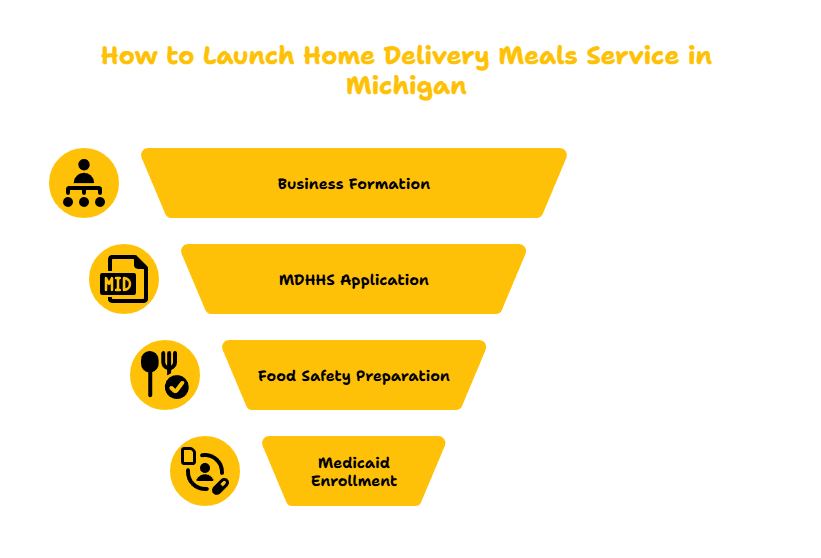
The enrollment journey is a multi-phase endeavor that requires thorough preparation and attention to detail. Initially, an interested provider must request the formal Home Delivery Meals Provider Application Packet from the MDHHS. This submission must include a comprehensive business and service plan that details internal logistics, such as meal preparation workflows, delivery route safety measures, dietary assessment methodologies, and mechanisms for tracking client satisfaction.
Once the application is submitted, the agency will undergo a background and credentialing review. This process verifies that all staff involved in handling food or interacting with clients have cleared mandatory background checks and that the organization possesses valid food-handling certifications. The final stage is a Program Readiness Review, where the provider must demonstrate the operational capacity to manage meal planning, hygiene, and documentation before being granted full Medicaid provider status.
What Are the Essential Documentation and Staffing Requirements?
Maintaining high standards of documentation is non-negotiable for Medicaid compliance. Providers must organize and maintain a comprehensive Policy & Procedure Manual. This manual acts as the backbone of the organization, encompassing food safety and sanitation protocols, procedures for meal customization, systems for tracking deliveries, and financial logs. In addition to internal policies, the provider must keep on file their Articles of Incorporation, NPI confirmation, and proof of facility compliance.
Staffing needs are dictated by both operational and clinical requirements. Key roles include:
- Program Director: Responsible for the overall management of food service operations and oversight of community nutrition standards.
- Meal Delivery Coordinator: Manages the logistical aspects of delivery, ensuring that food safety protocols are maintained throughout the transport process.
- Training Requirements: All staff are required to complete MDHHS orientation, HCBS Waiver training, and annual training cycles covering food safety, sanitation, confidentiality, ethics, and professional boundaries during client interactions.
Frequently Asked Questions
Which Medicaid Waivers cover Home Delivery Meals in Michigan?
Home Delivery Meals Services are authorized under the MI Choice Waiver, the Habilitation Supports Waiver, and the Children’s Waiver Program.
What is the typical timeline for launching a meal delivery service?
The total timeline varies, but generally includes 0–1 week for business formation, 30–60 days for safety and compliance preparation, and 60–90 days for both the MDHHS application review and the final Medicaid enrollment process.
What specific dietary support can a provider offer?
Approved providers can offer customized meal plans, daily or weekly delivery schedules, and ongoing dietary consultation to ensure the nutritional needs of the waiver participant are met according to their specific care plan.
Key Takeaway
Launching a Home Delivery Meals service in Michigan requires a meticulous commitment to MDHHS regulations, consistent food safety practices, and a well-structured administrative foundation. By aligning business operations with the requirements of the MI Choice, Habilitation Supports, or Children’s Waiver programs, providers can deliver critical support that enhances the health and quality of life for vulnerable residents across the state.
Last verified: October 2023. Disclaimer: This article is for informational purposes only and does not constitute legal or professional consulting advice. Regulatory requirements are subject to change; please consult the Michigan Department of Health and Human Services (MDHHS) for the most current program guidelines and application materials.